

1.1 Sum Frequency Generation
3
where P (ω k ) and E(ω k ) denote the amplitudes of frequency ω k . The Fourier form
of Eq. (1.3) is convenient to deal with oscillating electric fields of light in the
following. Note that P (t) and E(t) are real quantities. Accordingly, the summation
with k in Eq. (1.3) must include a pair of the ω k term and its complex conjugate ω −k
(i.e. ω −k = −ω k and P (ω −k ) = P (ω k ) ∗ ) except for the static component ω = 0.
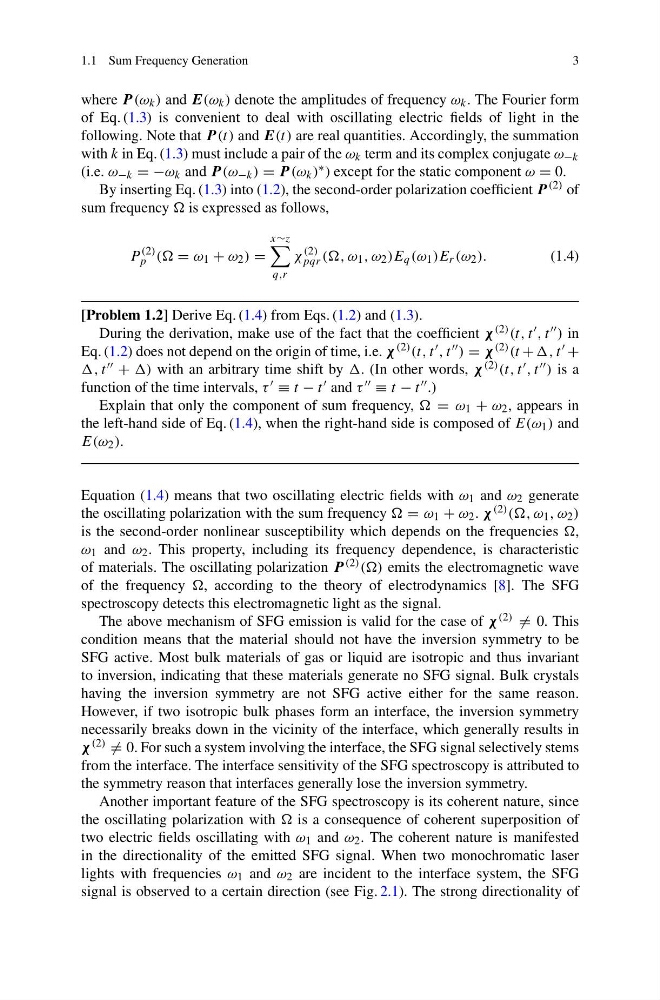
By inserting Eq. (1.3) into (1.2), the second-order polarization coefficient P (2) of
sum frequency is expressed as follows,
P
(2)
p (( = ω 1 + ω 2 ) =
x∼z
q,r
χ
(2)
pqr ((, ω 1 , ω 2 )E q (ω 1 )E r (ω 2 ).
(1.4)
[Problem 1.2] Derive Eq. (1.4) from Eqs. (1.2) and (1.3).
During the derivation, make use of the fact that the coefficient χ (2) (t, t , t ) in
Eq. (1.2) does not depend on the origin of time, i.e. χ (2) (t, t , t ) = χ (2) (t + t +
, t + ) with an arbitrary time shift by . (In other words, χ (2) (t, t , t ) is a
function of the time intervals, τ ≡ t − t and τ ≡ t − t .)
Explain that only the component of sum frequency, = ω 1 + ω 2 , appears in
the left-hand side of Eq. (1.4), when the right-hand side is composed of E(ω 1 ) and
E(ω 2 ).
Equation (1.4) means that two oscillating electric fields with ω 1 and ω 2 generate
the oscillating polarization with the sum frequency = ω 1 + ω 2 . χ (2) ((, ω 1 , ω 2 )
is the second-order nonlinear susceptibility which depends on the frequencies ,
ω 1 and ω 2 . This property, including its frequency dependence, is characteristic
of materials. The oscillating polarization P (2) (() emits the electromagnetic wave
of the frequency , according to the theory of electrodynamics [8]. The SFG
spectroscopy detects this electromagnetic light as the signal.
The above mechanism of SFG emission is valid for the case of χ (2) = 0. This
condition means that the material should not have the inversion symmetry to be
SFG active. Most bulk materials of gas or liquid are isotropic and thus invariant
to inversion, indicating that these materials generate no SFG signal. Bulk crystals
having the inversion symmetry are not SFG active either for the same reason.
However, if two isotropic bulk phases form an interface, the inversion symmetry
necessarily breaks down in the vicinity of the interface, which generally results in
χ (2) = 0. For such a system involving the interface, the SFG signal selectively stems
from the interface. The interface sensitivity of the SFG spectroscopy is attributed to
the symmetry reason that interfaces generally lose the inversion symmetry.
Another important feature of the SFG spectroscopy is its coherent nature, since
the oscillating polarization with is a consequence of coherent superposition of
two electric fields oscillating with ω 1 and ω 2 . The coherent nature is manifested
in the directionality of the emitted SFG signal. When two monochromatic laser
lights with frequencies ω 1 and ω 2 are incident to the interface system, the SFG
signal is observed to a certain direction (see Fig. 2.1). The strong directionality of
3
where P (ω k ) and E(ω k ) denote the amplitudes of frequency ω k . The Fourier form
of Eq. (1.3) is convenient to deal with oscillating electric fields of light in the
following. Note that P (t) and E(t) are real quantities. Accordingly, the summation
with k in Eq. (1.3) must include a pair of the ω k term and its complex conjugate ω −k
(i.e. ω −k = −ω k and P (ω −k ) = P (ω k ) ∗ ) except for the static component ω = 0.
By inserting Eq. (1.3) into (1.2), the second-order polarization coefficient P (2) of
sum frequency is expressed as follows,
P
(2)
p (( = ω 1 + ω 2 ) =
x∼z
q,r
χ
(2)
pqr ((, ω 1 , ω 2 )E q (ω 1 )E r (ω 2 ).
(1.4)
[Problem 1.2] Derive Eq. (1.4) from Eqs. (1.2) and (1.3).
During the derivation, make use of the fact that the coefficient χ (2) (t, t , t ) in
Eq. (1.2) does not depend on the origin of time, i.e. χ (2) (t, t , t ) = χ (2) (t + t +
, t + ) with an arbitrary time shift by . (In other words, χ (2) (t, t , t ) is a
function of the time intervals, τ ≡ t − t and τ ≡ t − t .)
Explain that only the component of sum frequency, = ω 1 + ω 2 , appears in
the left-hand side of Eq. (1.4), when the right-hand side is composed of E(ω 1 ) and
E(ω 2 ).
Equation (1.4) means that two oscillating electric fields with ω 1 and ω 2 generate
the oscillating polarization with the sum frequency = ω 1 + ω 2 . χ (2) ((, ω 1 , ω 2 )
is the second-order nonlinear susceptibility which depends on the frequencies ,
ω 1 and ω 2 . This property, including its frequency dependence, is characteristic
of materials. The oscillating polarization P (2) (() emits the electromagnetic wave
of the frequency , according to the theory of electrodynamics [8]. The SFG
spectroscopy detects this electromagnetic light as the signal.
The above mechanism of SFG emission is valid for the case of χ (2) = 0. This
condition means that the material should not have the inversion symmetry to be
SFG active. Most bulk materials of gas or liquid are isotropic and thus invariant
to inversion, indicating that these materials generate no SFG signal. Bulk crystals
having the inversion symmetry are not SFG active either for the same reason.
However, if two isotropic bulk phases form an interface, the inversion symmetry
necessarily breaks down in the vicinity of the interface, which generally results in
χ (2) = 0. For such a system involving the interface, the SFG signal selectively stems
from the interface. The interface sensitivity of the SFG spectroscopy is attributed to
the symmetry reason that interfaces generally lose the inversion symmetry.
Another important feature of the SFG spectroscopy is its coherent nature, since
the oscillating polarization with is a consequence of coherent superposition of
two electric fields oscillating with ω 1 and ω 2 . The coherent nature is manifested
in the directionality of the emitted SFG signal. When two monochromatic laser
lights with frequencies ω 1 and ω 2 are incident to the interface system, the SFG
signal is observed to a certain direction (see Fig. 2.1). The strong directionality of