

138
6 Charge Response Kernel for Electronic Polarization
where
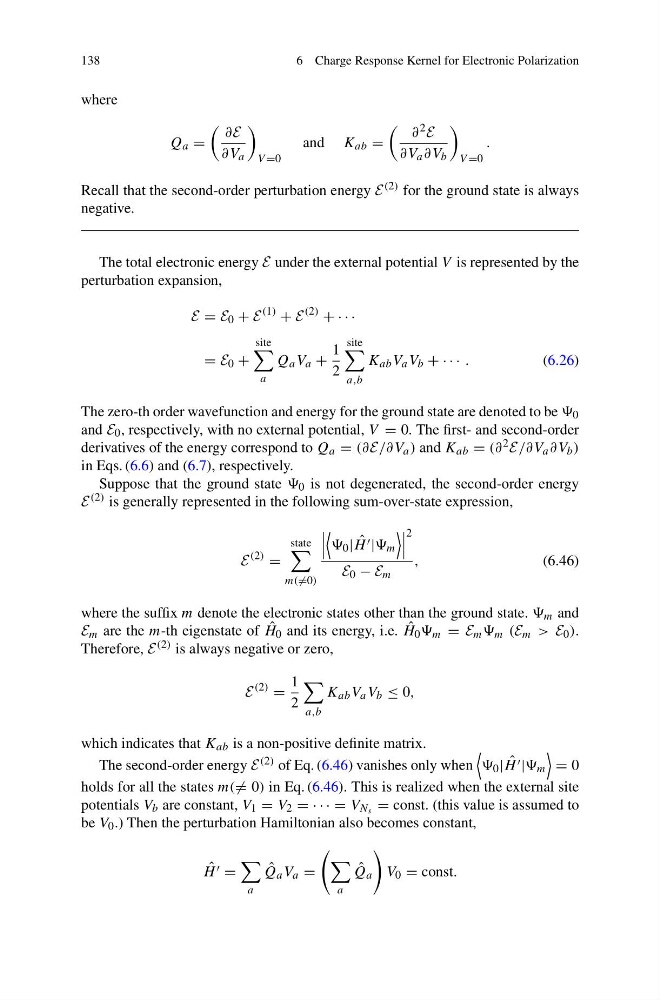
Q a =
∂E
∂V a
V =0
and K ab =
∂ 2 E
∂V a ∂V b
V =0
.
Recall that the second-order perturbation energy E (2) for the ground state is always
negative.
The total electronic energy E under the external potential V is represented by the
perturbation expansion,
E = E 0 + E
(1)
+ E
(2)
+ · · ·
= E 0 +
site
a
Q a V a +
1
2
site
a,b
K ab V a V b + · · · .
(6.26)
The zero-th order wavefunction and energy for the ground state are denoted to be 0
and E 0 , respectively, with no external potential, V = 0. The first- and second-order
derivatives of the energy correspond to Q a = (∂E/∂V a ) and K ab = (∂ 2 E/∂V a ∂V b )
in Eqs. (6.6) and (6.7), respectively.
Suppose that the ground state 0 is not degenerated, the second-order energy
E (2) is generally represented in the following sum-over-state expression,
E
(2)
=
state
m( =0)
0 | ˆ
H | m
2
E 0 − E m
,
(6.46)
where the suffix m denote the electronic states other than the ground state. m and
E m are the m-th eigenstate of ˆ
H 0 and its energy, i.e. ˆ
H 0 m = E m m (E m > E 0 ).
Therefore, E (2) is always negative or zero,
E
(2)
=
1
2
a,b
K ab V a V b ≤ 0,
which indicates that K ab is a non-positive definite matrix.
The second-order energy E (2) of Eq. (6.46) vanishes only when
0 | ˆ
H | m
= 0
holds for all the states m( = 0) in Eq. (6.46). This is realized when the external site
potentials V b are constant, V 1 = V 2 = · · · = V N s = const. (this value is assumed to
be V 0 .) Then the perturbation Hamiltonian also becomes constant,
ˆ
H =
a
ˆ
Q a V a =
a
ˆ
Q a
V 0 = const.
6 Charge Response Kernel for Electronic Polarization
where
Q a =
∂E
∂V a
V =0
and K ab =
∂ 2 E
∂V a ∂V b
V =0
.
Recall that the second-order perturbation energy E (2) for the ground state is always
negative.
The total electronic energy E under the external potential V is represented by the
perturbation expansion,
E = E 0 + E
(1)
+ E
(2)
+ · · ·
= E 0 +
site
a
Q a V a +
1
2
site
a,b
K ab V a V b + · · · .
(6.26)
The zero-th order wavefunction and energy for the ground state are denoted to be 0
and E 0 , respectively, with no external potential, V = 0. The first- and second-order
derivatives of the energy correspond to Q a = (∂E/∂V a ) and K ab = (∂ 2 E/∂V a ∂V b )
in Eqs. (6.6) and (6.7), respectively.
Suppose that the ground state 0 is not degenerated, the second-order energy
E (2) is generally represented in the following sum-over-state expression,
E
(2)
=
state
m( =0)
0 | ˆ
H | m
2
E 0 − E m
,
(6.46)
where the suffix m denote the electronic states other than the ground state. m and
E m are the m-th eigenstate of ˆ
H 0 and its energy, i.e. ˆ
H 0 m = E m m (E m > E 0 ).
Therefore, E (2) is always negative or zero,
E
(2)
=
1
2
a,b
K ab V a V b ≤ 0,
which indicates that K ab is a non-positive definite matrix.
The second-order energy E (2) of Eq. (6.46) vanishes only when
0 | ˆ
H | m
= 0
holds for all the states m( = 0) in Eq. (6.46). This is realized when the external site
potentials V b are constant, V 1 = V 2 = · · · = V N s = const. (this value is assumed to
be V 0 .) Then the perturbation Hamiltonian also becomes constant,
ˆ
H =
a
ˆ
Q a V a =
a
ˆ
Q a
V 0 = const.