

6.5 Solutions to Problems
137
ˆ
B a =
grid
n
1
|r − R G (n)|
·
1
|R(a) − R G (n)|
,
(6.16)
C a =
grid
n
nuc
c
Z c
|R N (c) − R G (n)|
·
1
|R(a) − R G (n)|
.
(6.17)
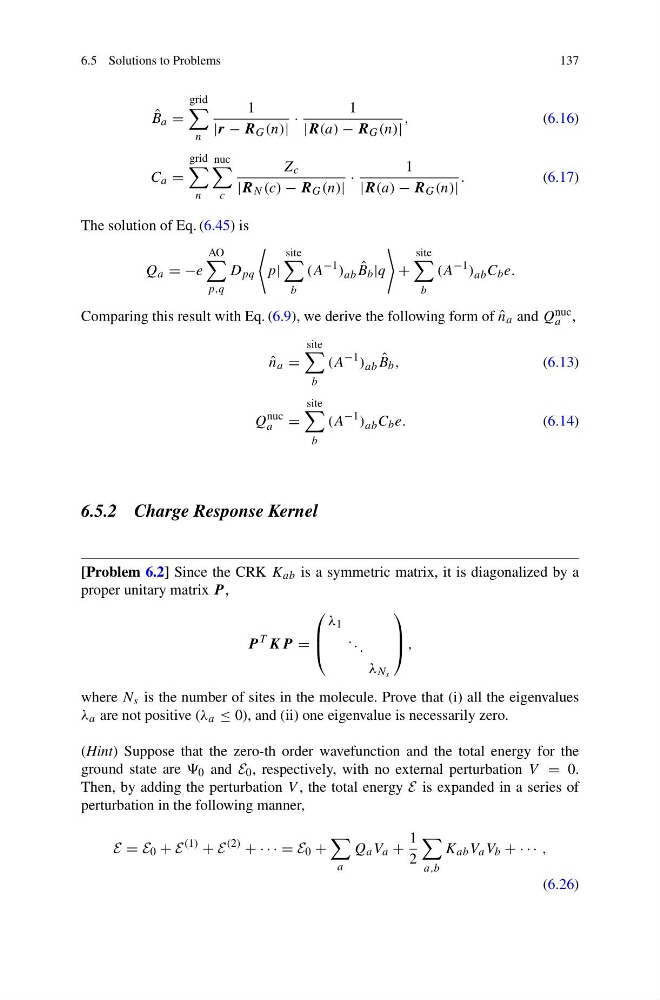
The solution of Eq. (6.45) is
Q a = −e
AO
p,q
D pq
p|
site
b
(A
−1 ) ab ˆ
B b |q
+
site
b
(A
−1 ) ab C b e.
Comparing this result with Eq. (6.9), we derive the following form of ˆ
n a and Q nuc
a ,
ˆ
n a =
site
b
(A
−1 ) ab ˆ
B b ,
(6.13)
Q
nuc
a =
site
b
(A
−1 ) ab C b e.
(6.14)
6.5.2 Charge Response Kernel
[Problem 6.2] Since the CRK K ab is a symmetric matrix, it is diagonalized by a
proper unitary matrix P ,
P
T KP =
⎛
⎜
⎝
λ 1
. . .
λ N s
⎞
⎟
⎠ ,
where N s is the number of sites in the molecule. Prove that (i) all the eigenvalues
λ a are not positive (λ a ≤ 0), and (ii) one eigenvalue is necessarily zero.
(Hint) Suppose that the zero-th order wavefunction and the total energy for the
ground state are 0 and E 0 , respectively, with no external perturbation V = 0.
Then, by adding the perturbation V , the total energy E is expanded in a series of
perturbation in the following manner,
E = E 0 + E
(1)
+ E
(2)
+ · · · = E 0 +
a
Q a V a +
1
2
a,b
K ab V a V b + · · · ,
(6.26)
137
ˆ
B a =
grid
n
1
|r − R G (n)|
·
1
|R(a) − R G (n)|
,
(6.16)
C a =
grid
n
nuc
c
Z c
|R N (c) − R G (n)|
·
1
|R(a) − R G (n)|
.
(6.17)
The solution of Eq. (6.45) is
Q a = −e
AO
p,q
D pq
p|
site
b
(A
−1 ) ab ˆ
B b |q
+
site
b
(A
−1 ) ab C b e.
Comparing this result with Eq. (6.9), we derive the following form of ˆ
n a and Q nuc
a ,
ˆ
n a =
site
b
(A
−1 ) ab ˆ
B b ,
(6.13)
Q
nuc
a =
site
b
(A
−1 ) ab C b e.
(6.14)
6.5.2 Charge Response Kernel
[Problem 6.2] Since the CRK K ab is a symmetric matrix, it is diagonalized by a
proper unitary matrix P ,
P
T KP =
⎛
⎜
⎝
λ 1
. . .
λ N s
⎞
⎟
⎠ ,
where N s is the number of sites in the molecule. Prove that (i) all the eigenvalues
λ a are not positive (λ a ≤ 0), and (ii) one eigenvalue is necessarily zero.
(Hint) Suppose that the zero-th order wavefunction and the total energy for the
ground state are 0 and E 0 , respectively, with no external perturbation V = 0.
Then, by adding the perturbation V , the total energy E is expanded in a series of
perturbation in the following manner,
E = E 0 + E
(1)
+ E
(2)
+ · · · = E 0 +
a
Q a V a +
1
2
a,b
K ab V a V b + · · · ,
(6.26)