

130
6 Charge Response Kernel for Electronic Polarization
where the suffix j denotes the occupied MOs and k denotes the virtual (unoccupied)
MOs. ε i is the canonical orbital energy for the i-th orbital ψ i . H likj is the twoelectron integral in the MO representation,
H likj = 4
ψ l ψ i |ψ k ψ j
−
ψ l ψ k |ψ i ψ j
−
ψ l ψ j |ψ k ψ i
,
(6.23)
where
ψ i ψ j |ψ k ψ l
=
ψ i (r)ψ j (r)
e 2
|r − r |
ψ k (r
)ψ l (r
)drdr
=
AO
p,q,r,s
C pi C qj C rk C sl
χ p χ q |χ r χ s
and
ψ l | ˆ
n b |ψ i
=
AO
p,q
C pl C qi χ p | ˆ
n b |χ q .
(6.24)
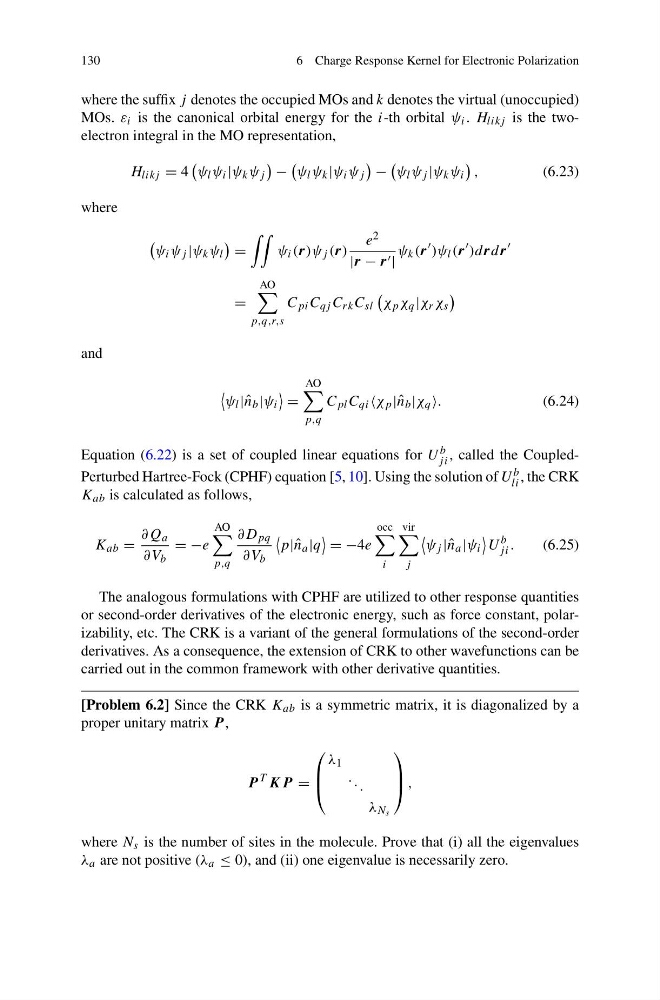
Equation (6.22) is a set of coupled linear equations for U b
ji , called the CoupledPerturbed Hartree-Fock (CPHF) equation [5, 10]. Using the solution of U b
li , the CRK
K ab is calculated as follows,
K ab =
∂Q a
∂V b
= −e
AO
p,q
∂D pq
∂V b
p| ˆ
n a |q
= −4e
occ
i
vir
j
ψ j | ˆ
n a |ψ i
U
b
ji .
(6.25)
The analogous formulations with CPHF are utilized to other response quantities
or second-order derivatives of the electronic energy, such as force constant, polarizability, etc. The CRK is a variant of the general formulations of the second-order
derivatives. As a consequence, the extension of CRK to other wavefunctions can be
carried out in the common framework with other derivative quantities.
[Problem 6.2] Since the CRK K ab is a symmetric matrix, it is diagonalized by a
proper unitary matrix P ,
P
T KP =
⎛
⎜
⎝
λ 1
. . .
λ N s
⎞
⎟
⎠ ,
where N s is the number of sites in the molecule. Prove that (i) all the eigenvalues
λ a are not positive (λ a ≤ 0), and (ii) one eigenvalue is necessarily zero.
6 Charge Response Kernel for Electronic Polarization
where the suffix j denotes the occupied MOs and k denotes the virtual (unoccupied)
MOs. ε i is the canonical orbital energy for the i-th orbital ψ i . H likj is the twoelectron integral in the MO representation,
H likj = 4
ψ l ψ i |ψ k ψ j
−
ψ l ψ k |ψ i ψ j
−
ψ l ψ j |ψ k ψ i
,
(6.23)
where
ψ i ψ j |ψ k ψ l
=
ψ i (r)ψ j (r)
e 2
|r − r |
ψ k (r
)ψ l (r
)drdr
=
AO
p,q,r,s
C pi C qj C rk C sl
χ p χ q |χ r χ s
and
ψ l | ˆ
n b |ψ i
=
AO
p,q
C pl C qi χ p | ˆ
n b |χ q .
(6.24)
Equation (6.22) is a set of coupled linear equations for U b
ji , called the CoupledPerturbed Hartree-Fock (CPHF) equation [5, 10]. Using the solution of U b
li , the CRK
K ab is calculated as follows,
K ab =
∂Q a
∂V b
= −e
AO
p,q
∂D pq
∂V b
p| ˆ
n a |q
= −4e
occ
i
vir
j
ψ j | ˆ
n a |ψ i
U
b
ji .
(6.25)
The analogous formulations with CPHF are utilized to other response quantities
or second-order derivatives of the electronic energy, such as force constant, polarizability, etc. The CRK is a variant of the general formulations of the second-order
derivatives. As a consequence, the extension of CRK to other wavefunctions can be
carried out in the common framework with other derivative quantities.
[Problem 6.2] Since the CRK K ab is a symmetric matrix, it is diagonalized by a
proper unitary matrix P ,
P
T KP =
⎛
⎜
⎝
λ 1
. . .
λ N s
⎞
⎟
⎠ ,
where N s is the number of sites in the molecule. Prove that (i) all the eigenvalues
λ a are not positive (λ a ≤ 0), and (ii) one eigenvalue is necessarily zero.