

6.2 Electronic Structure Theory of CRK
129
Note 3. The ESP charges tend to be problematic to determine for buried sites of
molecules [1]. This problem is resolved with introducing a damping parameter
in the least square fitting procedure, as described in Ref. [9]. This modification
effectively removes the instability of the definition, while the following procedure of CRK calculations unchanged.
Charge Response Kernel Once the perturbation Hamiltonian ˆ
H is defined above,
the derivative of the total energy E or the wavefunction by the external parameter
V is uniquely determined. Consequently, the CRK K ab is determined using the
derivatives,
K ab =
∂ 2 E
∂V a ∂V b
=
∂Q a
∂V b
=
∂∂
∂V b
| ˆ
Q a |
+
| ˆ
Q a |
∂∂
∂V b
.
(6.18)
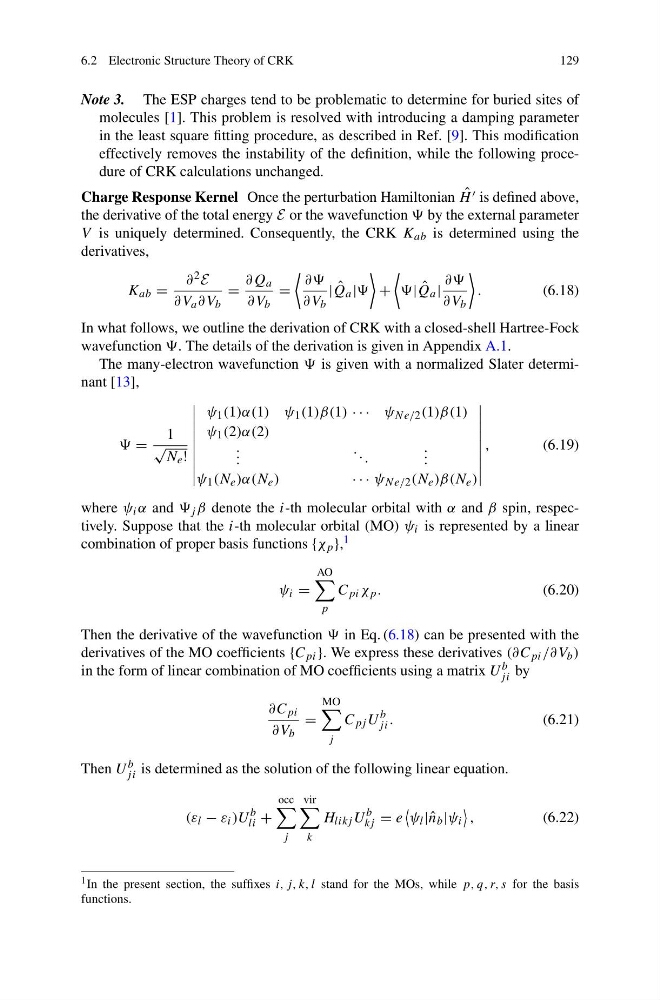
In what follows, we outline the derivation of CRK with a closed-shell Hartree-Fock
wavefunction . The details of the derivation is given in Appendix A.1.
The many-electron wavefunction is given with a normalized Slater determinant [13],
=
1
√
N e !
ψ 1 (1)α(1) ψ 1 (1)β(1) · · · ψ Ne/2 (1)β(1)
ψ 1 (2)α(2)
. . .
. . .
. . .
ψ 1 (N e )α(N e )
· · · ψ Ne/2 (N e )β(N e )
,
(6.19)
where ψ i α and j β denote the i-th molecular orbital with α and β spin, respectively. Suppose that the i-th molecular orbital (MO) ψ i is represented by a linear
combination of proper basis functions {χ p }, 1
ψ i =
AO
p
C pi χ p .
(6.20)
Then the derivative of the wavefunction in Eq. (6.18) can be presented with the
derivatives of the MO coefficients {C pi }. We express these derivatives (∂C pi /∂V b )
in the form of linear combination of MO coefficients using a matrix U b
ji by
∂C pi
∂V b
=
MO
j
C pj U
b
ji .
(6.21)
Then U b
ji is determined as the solution of the following linear equation.
(ε l − ε i )U
b
li +
occ
j
vir
k
H likj U
b
kj = e
ψ l | ˆ
n b |ψ i
,
(6.22)
1 In the present section, the suffixes i, j, k, l stand for the MOs, while p, q, r, s for the basis
functions.
129
Note 3. The ESP charges tend to be problematic to determine for buried sites of
molecules [1]. This problem is resolved with introducing a damping parameter
in the least square fitting procedure, as described in Ref. [9]. This modification
effectively removes the instability of the definition, while the following procedure of CRK calculations unchanged.
Charge Response Kernel Once the perturbation Hamiltonian ˆ
H is defined above,
the derivative of the total energy E or the wavefunction by the external parameter
V is uniquely determined. Consequently, the CRK K ab is determined using the
derivatives,
K ab =
∂ 2 E
∂V a ∂V b
=
∂Q a
∂V b
=
∂∂
∂V b
| ˆ
Q a |
+
| ˆ
Q a |
∂∂
∂V b
.
(6.18)
In what follows, we outline the derivation of CRK with a closed-shell Hartree-Fock
wavefunction . The details of the derivation is given in Appendix A.1.
The many-electron wavefunction is given with a normalized Slater determinant [13],
=
1
√
N e !
ψ 1 (1)α(1) ψ 1 (1)β(1) · · · ψ Ne/2 (1)β(1)
ψ 1 (2)α(2)
. . .
. . .
. . .
ψ 1 (N e )α(N e )
· · · ψ Ne/2 (N e )β(N e )
,
(6.19)
where ψ i α and j β denote the i-th molecular orbital with α and β spin, respectively. Suppose that the i-th molecular orbital (MO) ψ i is represented by a linear
combination of proper basis functions {χ p }, 1
ψ i =
AO
p
C pi χ p .
(6.20)
Then the derivative of the wavefunction in Eq. (6.18) can be presented with the
derivatives of the MO coefficients {C pi }. We express these derivatives (∂C pi /∂V b )
in the form of linear combination of MO coefficients using a matrix U b
ji by
∂C pi
∂V b
=
MO
j
C pj U
b
ji .
(6.21)
Then U b
ji is determined as the solution of the following linear equation.
(ε l − ε i )U
b
li +
occ
j
vir
k
H likj U
b
kj = e
ψ l | ˆ
n b |ψ i
,
(6.22)
1 In the present section, the suffixes i, j, k, l stand for the MOs, while p, q, r, s for the basis
functions.