

6.2 Electronic Structure Theory of CRK
125
6.2 Electronic Structure Theory of CRK
The CRK model is defined as a second-order derivative quantity in an arbitrary
electronic structure theory of ab initio MO or DFT. In the present section, it
is formulated with the closed-shell Hartree-Fock wavefunction for an example.
Application to other levels of theory, including DFT [3], is straightforward once
the perturbation Hamiltonian is given in the following.
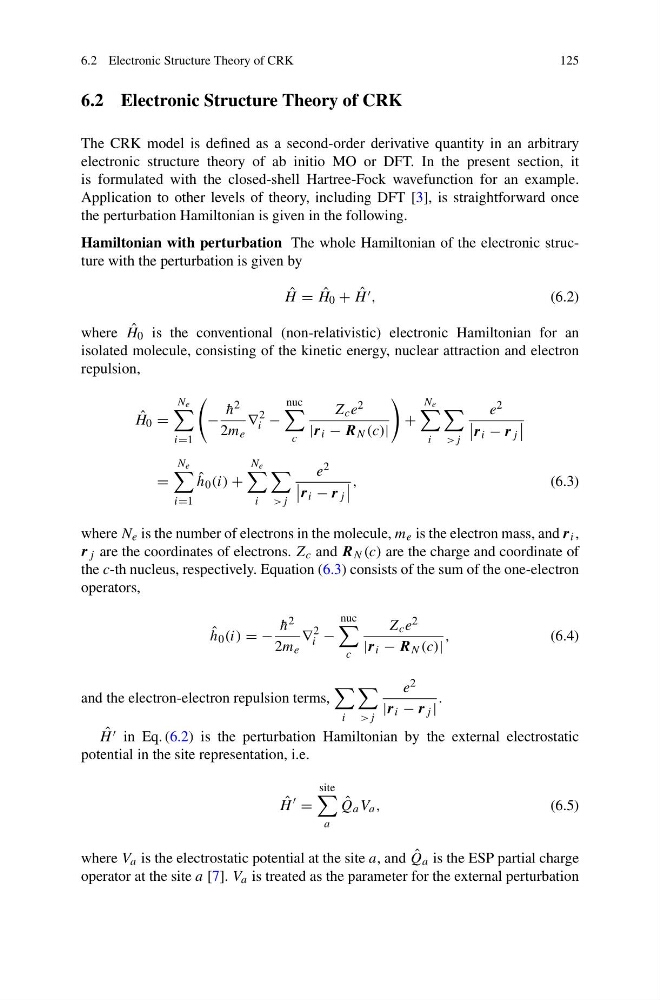
Hamiltonian with perturbation The whole Hamiltonian of the electronic structure with the perturbation is given by
ˆ
H = ˆ
H 0 + ˆ
H ,
(6.2)
where ˆ
H 0 is the conventional (non-relativistic) electronic Hamiltonian for an
isolated molecule, consisting of the kinetic energy, nuclear attraction and electron
repulsion,
ˆ
H 0 =
N e
i=1
−
¯
h 2
2m e
∇
2
i −
nuc
c
Z c e 2
|r i − R N (c)|
+
N e
i
>j
e 2
r i − r j
=
N e
i=1
ˆ
h 0 (i) +
N e
i
>j
e 2
r i − r j
,
(6.3)
where N e is the number of electrons in the molecule, m e is the electron mass, and r i ,
r j are the coordinates of electrons. Z c and R N (c) are the charge and coordinate of
the c-th nucleus, respectively. Equation (6.3) consists of the sum of the one-electron
operators,
ˆ
h 0 (i) = −
¯
h 2
2m e
∇
2
i −
nuc
c
Z c e 2
|r i − R N (c)|
,
(6.4)
and the electron-electron repulsion terms,
i
>j
e 2
|r i − r j |
.
ˆ
H in Eq. (6.2) is the perturbation Hamiltonian by the external electrostatic
potential in the site representation, i.e.
ˆ
H
=
site
a
ˆ
Q a V a ,
(6.5)
where V a is the electrostatic potential at the site a, and ˆ
Q a is the ESP partial charge
operator at the site a [7]. V a is treated as the parameter for the external perturbation
125
6.2 Electronic Structure Theory of CRK
The CRK model is defined as a second-order derivative quantity in an arbitrary
electronic structure theory of ab initio MO or DFT. In the present section, it
is formulated with the closed-shell Hartree-Fock wavefunction for an example.
Application to other levels of theory, including DFT [3], is straightforward once
the perturbation Hamiltonian is given in the following.
Hamiltonian with perturbation The whole Hamiltonian of the electronic structure with the perturbation is given by
ˆ
H = ˆ
H 0 + ˆ
H ,
(6.2)
where ˆ
H 0 is the conventional (non-relativistic) electronic Hamiltonian for an
isolated molecule, consisting of the kinetic energy, nuclear attraction and electron
repulsion,
ˆ
H 0 =
N e
i=1
−
¯
h 2
2m e
∇
2
i −
nuc
c
Z c e 2
|r i − R N (c)|
+
N e
i
>j
e 2
r i − r j
=
N e
i=1
ˆ
h 0 (i) +
N e
i
>j
e 2
r i − r j
,
(6.3)
where N e is the number of electrons in the molecule, m e is the electron mass, and r i ,
r j are the coordinates of electrons. Z c and R N (c) are the charge and coordinate of
the c-th nucleus, respectively. Equation (6.3) consists of the sum of the one-electron
operators,
ˆ
h 0 (i) = −
¯
h 2
2m e
∇
2
i −
nuc
c
Z c e 2
|r i − R N (c)|
,
(6.4)
and the electron-electron repulsion terms,
i
>j
e 2
|r i − r j |
.
ˆ
H in Eq. (6.2) is the perturbation Hamiltonian by the external electrostatic
potential in the site representation, i.e.
ˆ
H
=
site
a
ˆ
Q a V a ,
(6.5)
where V a is the electrostatic potential at the site a, and ˆ
Q a is the ESP partial charge
operator at the site a [7]. V a is treated as the parameter for the external perturbation