

124
6 Charge Response Kernel for Electronic Polarization
calculations of ab initio molecular orbital (MO) or density functional theory (DFT).
This is particularly useful to SFG calculations, as it reconciles the ab initio accuracy
in the above modeling and the computational efficiency of classical MD simulation.
6.1 Charge Response Kernel (CRK)
The charge response kernel (CRK) is introduced to represent electronic polarization
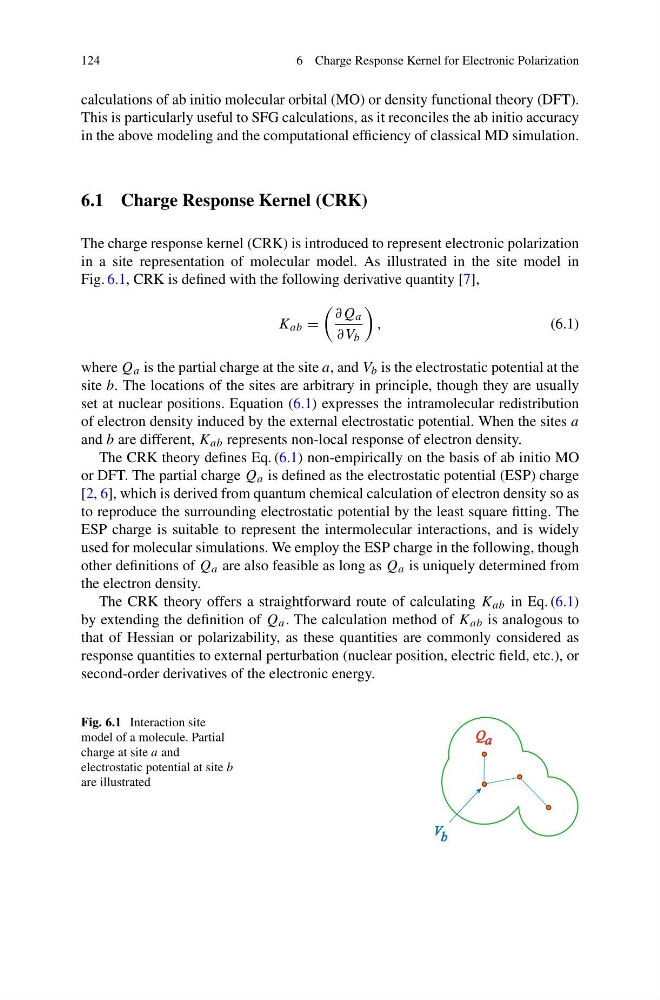
in a site representation of molecular model. As illustrated in the site model in
Fig. 6.1, CRK is defined with the following derivative quantity [7],
K ab =
∂Q a
∂V b
,
(6.1)
where Q a is the partial charge at the site a, and V b is the electrostatic potential at the
site b. The locations of the sites are arbitrary in principle, though they are usually
set at nuclear positions. Equation (6.1) expresses the intramolecular redistribution
of electron density induced by the external electrostatic potential. When the sites a
and b are different, K ab represents non-local response of electron density.
The CRK theory defines Eq. (6.1) non-empirically on the basis of ab initio MO
or DFT. The partial charge Q a is defined as the electrostatic potential (ESP) charge
[2, 6], which is derived from quantum chemical calculation of electron density so as
to reproduce the surrounding electrostatic potential by the least square fitting. The
ESP charge is suitable to represent the intermolecular interactions, and is widely
used for molecular simulations. We employ the ESP charge in the following, though
other definitions of Q a are also feasible as long as Q a is uniquely determined from
the electron density.
The CRK theory offers a straightforward route of calculating K ab in Eq. (6.1)
by extending the definition of Q a . The calculation method of K ab is analogous to
that of Hessian or polarizability, as these quantities are commonly considered as
response quantities to external perturbation (nuclear position, electric field, etc.), or
second-order derivatives of the electronic energy.
Fig. 6.1 Interaction site
model of a molecule. Partial
charge at site a and
electrostatic potential at site b
are illustrated
Q
V
a
b
6 Charge Response Kernel for Electronic Polarization
calculations of ab initio molecular orbital (MO) or density functional theory (DFT).
This is particularly useful to SFG calculations, as it reconciles the ab initio accuracy
in the above modeling and the computational efficiency of classical MD simulation.
6.1 Charge Response Kernel (CRK)
The charge response kernel (CRK) is introduced to represent electronic polarization
in a site representation of molecular model. As illustrated in the site model in
Fig. 6.1, CRK is defined with the following derivative quantity [7],
K ab =
∂Q a
∂V b
,
(6.1)
where Q a is the partial charge at the site a, and V b is the electrostatic potential at the
site b. The locations of the sites are arbitrary in principle, though they are usually
set at nuclear positions. Equation (6.1) expresses the intramolecular redistribution
of electron density induced by the external electrostatic potential. When the sites a
and b are different, K ab represents non-local response of electron density.
The CRK theory defines Eq. (6.1) non-empirically on the basis of ab initio MO
or DFT. The partial charge Q a is defined as the electrostatic potential (ESP) charge
[2, 6], which is derived from quantum chemical calculation of electron density so as
to reproduce the surrounding electrostatic potential by the least square fitting. The
ESP charge is suitable to represent the intermolecular interactions, and is widely
used for molecular simulations. We employ the ESP charge in the following, though
other definitions of Q a are also feasible as long as Q a is uniquely determined from
the electron density.
The CRK theory offers a straightforward route of calculating K ab in Eq. (6.1)
by extending the definition of Q a . The calculation method of K ab is analogous to
that of Hessian or polarizability, as these quantities are commonly considered as
response quantities to external perturbation (nuclear position, electric field, etc.), or
second-order derivatives of the electronic energy.
Fig. 6.1 Interaction site
model of a molecule. Partial
charge at site a and
electrostatic potential at site b
are illustrated
Q
V
a
b