

4.4 Motional Effect on χ (2)
99
≈ −
a
1
2m a ω a
∂α
∂Q a
∂μ
∂Q a
1
ω − ω a + ii a
,
(4.37)
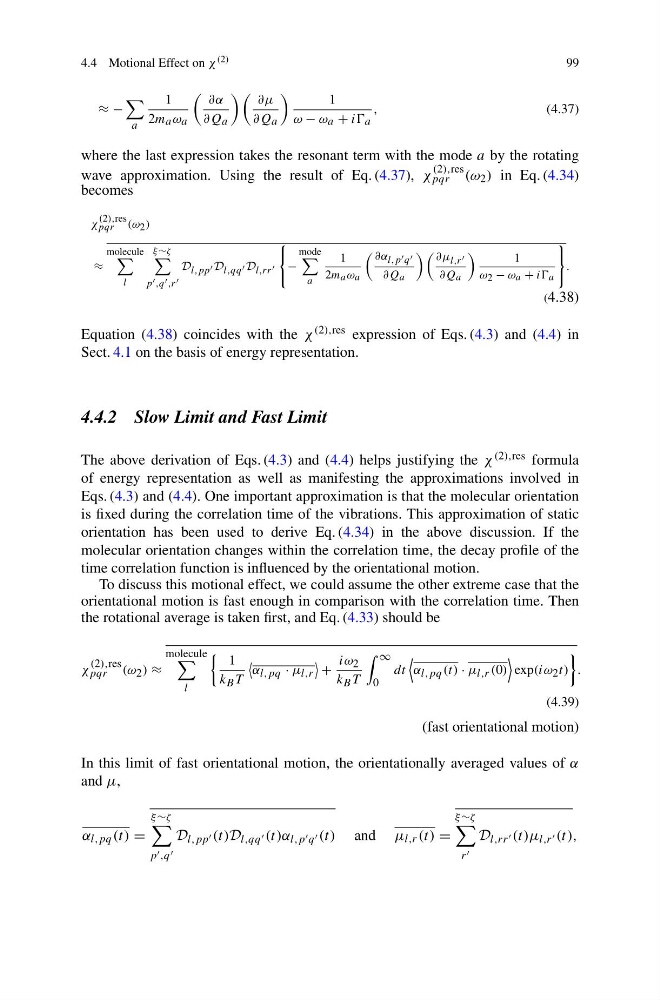
where the last expression takes the resonant term with the mode a by the rotating
wave approximation. Using the result of Eq. (4.37), χ
(2),res
pqr (ω 2 ) in Eq. (4.34)
becomes
χ
(2),res
pqr (ω 2 )
≈
molecule
l
ξ ∼ζ
p ,q ,r
D l,pp D l,qq D l,rr
⎧
⎨
⎩
−
mode
a
1
2m a ω a
∂α l,p q
∂Q a
∂μ l,r
∂Q a
1
ω 2 − ω a + ii a
⎫
⎬
⎭
.
(4.38)
Equation (4.38) coincides with the χ (2),res expression of Eqs. (4.3) and (4.4) in
Sect. 4.1 on the basis of energy representation.
4.4.2 Slow Limit and Fast Limit
The above derivation of Eqs. (4.3) and (4.4) helps justifying the χ (2),res formula
of energy representation as well as manifesting the approximations involved in
Eqs. (4.3) and (4.4). One important approximation is that the molecular orientation
is fixed during the correlation time of the vibrations. This approximation of static
orientation has been used to derive Eq. (4.34) in the above discussion. If the
molecular orientation changes within the correlation time, the decay profile of the
time correlation function is influenced by the orientational motion.
To discuss this motional effect, we could assume the other extreme case that the
orientational motion is fast enough in comparison with the correlation time. Then
the rotational average is taken first, and Eq. (4.33) should be
χ
(2),res
pqr (ω 2 ) ≈
molecule
l
1
k B T
α l,pq · μ l,r
+
iω 2
k B T
∞
0
dt
α l,pq (t) · μ l,r (0)
exp(iω 2 t)
.
(4.39)
(fast orientational motion)
In this limit of fast orientational motion, the orientationally averaged values of α
and μ,
α l,pq (t) =
ξ ∼ζ
p ,q
D l,pp (t)D l,qq (t)α l,p q (t) and μ l,r (t) =
ξ ∼ζ
r
D l,rr (t)μ l,r (t),
99
≈ −
a
1
2m a ω a
∂α
∂Q a
∂μ
∂Q a
1
ω − ω a + ii a
,
(4.37)
where the last expression takes the resonant term with the mode a by the rotating
wave approximation. Using the result of Eq. (4.37), χ
(2),res
pqr (ω 2 ) in Eq. (4.34)
becomes
χ
(2),res
pqr (ω 2 )
≈
molecule
l
ξ ∼ζ
p ,q ,r
D l,pp D l,qq D l,rr
⎧
⎨
⎩
−
mode
a
1
2m a ω a
∂α l,p q
∂Q a
∂μ l,r
∂Q a
1
ω 2 − ω a + ii a
⎫
⎬
⎭
.
(4.38)
Equation (4.38) coincides with the χ (2),res expression of Eqs. (4.3) and (4.4) in
Sect. 4.1 on the basis of energy representation.
4.4.2 Slow Limit and Fast Limit
The above derivation of Eqs. (4.3) and (4.4) helps justifying the χ (2),res formula
of energy representation as well as manifesting the approximations involved in
Eqs. (4.3) and (4.4). One important approximation is that the molecular orientation
is fixed during the correlation time of the vibrations. This approximation of static
orientation has been used to derive Eq. (4.34) in the above discussion. If the
molecular orientation changes within the correlation time, the decay profile of the
time correlation function is influenced by the orientational motion.
To discuss this motional effect, we could assume the other extreme case that the
orientational motion is fast enough in comparison with the correlation time. Then
the rotational average is taken first, and Eq. (4.33) should be
χ
(2),res
pqr (ω 2 ) ≈
molecule
l
1
k B T
α l,pq · μ l,r
+
iω 2
k B T
∞
0
dt
α l,pq (t) · μ l,r (0)
exp(iω 2 t)
.
(4.39)
(fast orientational motion)
In this limit of fast orientational motion, the orientationally averaged values of α
and μ,
α l,pq (t) =
ξ ∼ζ
p ,q
D l,pp (t)D l,qq (t)α l,p q (t) and μ l,r (t) =
ξ ∼ζ
r
D l,rr (t)μ l,r (t),