

K. Chruszcz-Lipska and E. W. Blanch
72
It is worth taking notice that the proper choice of the level of dFt theory is essential for the RoA calculation. Recent studies presented in the literature show that
the basis set requirements for the calculation of the Raman/RoA tensor invariants
and force field are different. diffuse functions are important to compute properly
the Raman/RoA tensors [69, 71–73] while for geometry optimization and force
field calculations they usually are not required [69]. Prior analysis of the basis set
dependence of vibrational Raman and RoA intensities has pointed out that calculations at the aug-cc-pvdZ or aug(sp)-cc-pvdZ levels of theory are the best option
to obtain reasonable results for the ‘one step’ procedure in which the force field
and Raman/RoA tensor invariant are computed at the same time using the same
level of theory. For the more efficient, especially for large molecules, ‘two step’
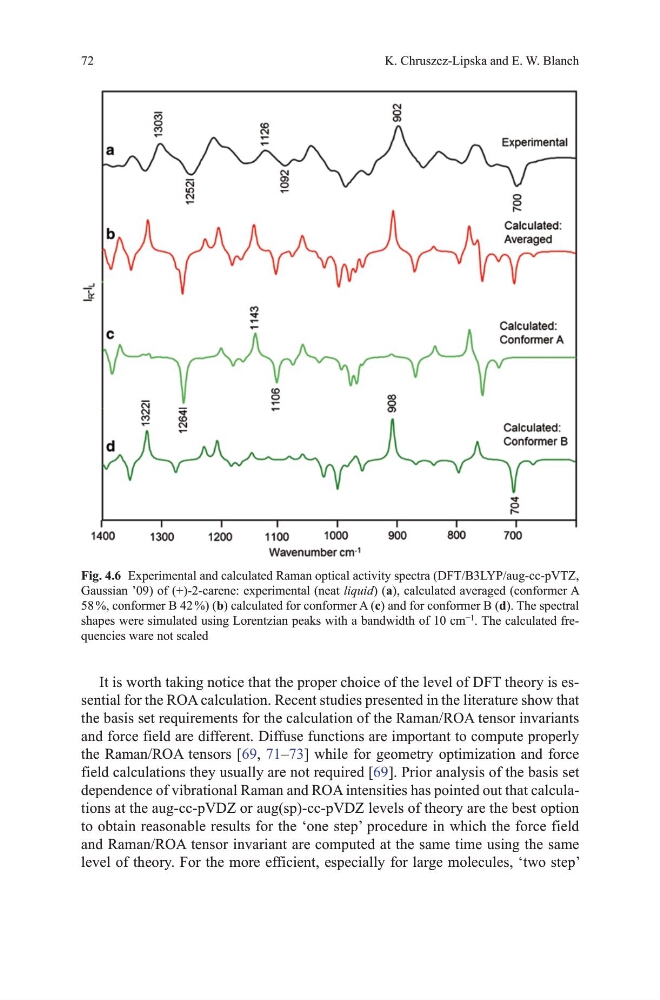
Fig. 4.6 Experimental and calculated Raman optical activity spectra (dFt/B3LYP/aug-cc-pvtZ,
gaussian ’09) of (+)-2-carene: experimental (neat liquid) (a), calculated averaged (conformer A
58 %, conformer B 42 %) (b) calculated for conformer A (c) and for conformer B (d). the spectral
shapes were simulated using Lorentzian peaks with a bandwidth of 10 cm
−1
. the calculated frequencies ware not scaled
72
It is worth taking notice that the proper choice of the level of dFt theory is essential for the RoA calculation. Recent studies presented in the literature show that
the basis set requirements for the calculation of the Raman/RoA tensor invariants
and force field are different. diffuse functions are important to compute properly
the Raman/RoA tensors [69, 71–73] while for geometry optimization and force
field calculations they usually are not required [69]. Prior analysis of the basis set
dependence of vibrational Raman and RoA intensities has pointed out that calculations at the aug-cc-pvdZ or aug(sp)-cc-pvdZ levels of theory are the best option
to obtain reasonable results for the ‘one step’ procedure in which the force field
and Raman/RoA tensor invariant are computed at the same time using the same
level of theory. For the more efficient, especially for large molecules, ‘two step’
Fig. 4.6 Experimental and calculated Raman optical activity spectra (dFt/B3LYP/aug-cc-pvtZ,
gaussian ’09) of (+)-2-carene: experimental (neat liquid) (a), calculated averaged (conformer A
58 %, conformer B 42 %) (b) calculated for conformer A (c) and for conformer B (d). the spectral
shapes were simulated using Lorentzian peaks with a bandwidth of 10 cm
−1
. the calculated frequencies ware not scaled