

K. Chruszcz-Lipska and E. W. Blanch
70
the comparison of experimental spectra of (+)-3-carene and calculated spectra
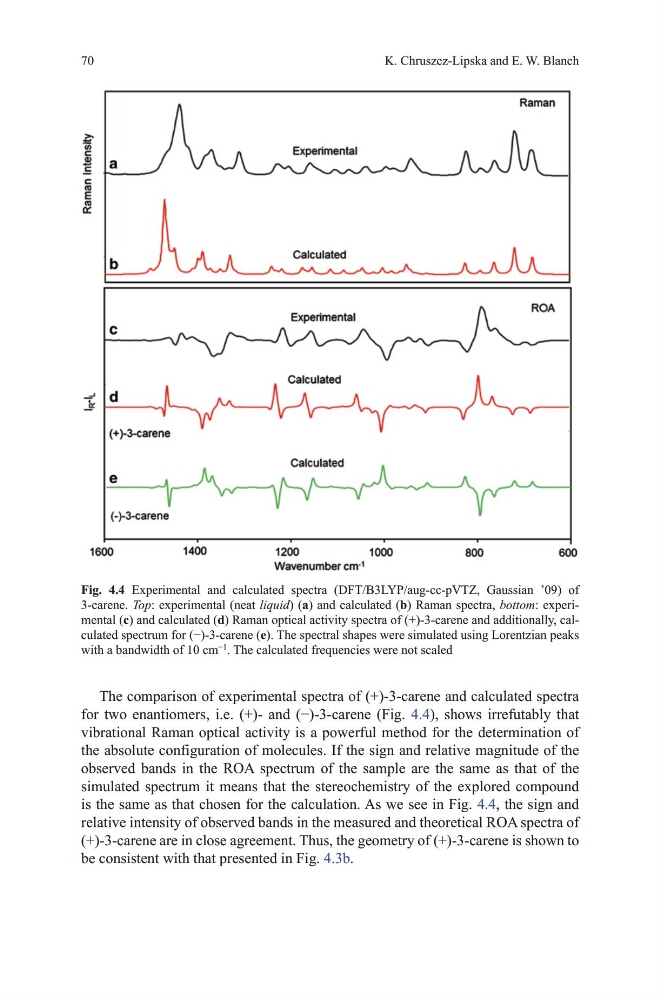
for two enantiomers, i.e. (+)- and (−)-3-carene (Fig. 4.4), shows irrefutably that
vibrational Raman optical activity is a powerful method for the determination of
the absolute configuration of molecules. If the sign and relative magnitude of the
observed bands in the RoA spectrum of the sample are the same as that of the
simulated spectrum it means that the stereochemistry of the explored compound
is the same as that chosen for the calculation. As we see in Fig. 4.4, the sign and
relative intensity of observed bands in the measured and theoretical RoA spectra of
(+)-3-carene are in close agreement. thus, the geometry of (+)-3-carene is shown to
be consistent with that presented in Fig. 4.3b.
Fig. 4.4 Experimental and calculated spectra (dFt/B3LYP/aug-cc-pvtZ, gaussian ’09) of
3-carene. Top: experimental (neat liquid) (a) and calculated (b) Raman spectra, bottom: experimental (c) and calculated (d) Raman optical activity spectra of (+)-3-carene and additionally, calculated spectrum for (−)-3-carene (e). the spectral shapes were simulated using Lorentzian peaks
with a bandwidth of 10 cm
−1
. the calculated frequencies were not scaled
70
the comparison of experimental spectra of (+)-3-carene and calculated spectra
for two enantiomers, i.e. (+)- and (−)-3-carene (Fig. 4.4), shows irrefutably that
vibrational Raman optical activity is a powerful method for the determination of
the absolute configuration of molecules. If the sign and relative magnitude of the
observed bands in the RoA spectrum of the sample are the same as that of the
simulated spectrum it means that the stereochemistry of the explored compound
is the same as that chosen for the calculation. As we see in Fig. 4.4, the sign and
relative intensity of observed bands in the measured and theoretical RoA spectra of
(+)-3-carene are in close agreement. thus, the geometry of (+)-3-carene is shown to
be consistent with that presented in Fig. 4.3b.
Fig. 4.4 Experimental and calculated spectra (dFt/B3LYP/aug-cc-pvtZ, gaussian ’09) of
3-carene. Top: experimental (neat liquid) (a) and calculated (b) Raman spectra, bottom: experimental (c) and calculated (d) Raman optical activity spectra of (+)-3-carene and additionally, calculated spectrum for (−)-3-carene (e). the spectral shapes were simulated using Lorentzian peaks
with a bandwidth of 10 cm
−1
. the calculated frequencies were not scaled