

K. Chruszcz-Lipska and E. W. Blanch
62
where I
R
and I
L
are the scattered Raman intensities in right- and left-circularly
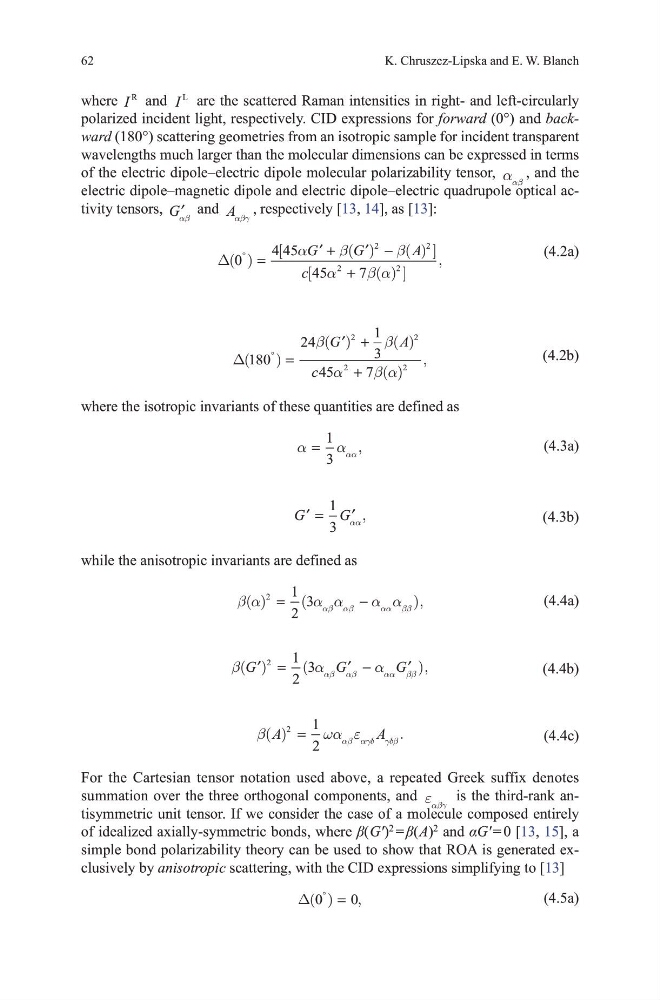
polarized incident light, respectively. CId expressions for forward (0°) and backward (180°) scattering geometries from an isotropic sample for incident transparent
wavelengths much larger than the molecular dimensions can be expressed in terms
of the electric dipole–electric dipole molecular polarizability tensor, α αβ
, and the
electric dipole–magnetic dipole and electric dipole–electric quadrupole optical activity tensors, ′
G αβ
and A αβγ
, respectively [13, 14], as [13]:
(4.2a)
∆(
)
( )
( )
( )
,
180
24
1
3
45
7
2
2
2
2
°
=
′ +
+
β
β
α
β α
G
A
c
(4.2b)
where the isotropic invariants of these quantities are defined as
α
α αα
=
1
3
,
(4.3a)
′ =
′
G
G
1
3
αα
,
(4.3b)
while the anisotropic invariants are defined as
β α
α α
α α
αβ αβ
αα ββ
( )
(
) ,
2
1
2
3
=
−
(4.4a)
β
α
α
αβ αβ
αα ββ
( )
(
) ,
′ =
′ −
′
G
G
G
2
1
2
3
(4.4b)
β
ω α ε
αβ αγδ γδβ
( )
.
A
A
2
1
2
=
(4.4c)
For the Cartesian tensor notation used above, a repeated greek suffix denotes
summation over the three orthogonal components, and ε αβγ
is the third-rank antisymmetric unit tensor. If we consider the case of a molecule composed entirely
of idealized axially-symmetric bonds, where β( G′)
2
= β( A)
2
and αG′ = 0 [13, 15], a
simple bond polarizability theory can be used to show that RoA is generated exclusively by anisotropic scattering, with the CId expressions simplifying to [13]
∆( )
,
0
0
°
=
(4.5a)
∆( )
[
( )
( )
[
( )
,
]
]
0
4 45
45
7
2
2
2
2
°
=
′ +
′ −
+
α
β
β
α
β α
G
G
A
c
62
where I
R
and I
L
are the scattered Raman intensities in right- and left-circularly
polarized incident light, respectively. CId expressions for forward (0°) and backward (180°) scattering geometries from an isotropic sample for incident transparent
wavelengths much larger than the molecular dimensions can be expressed in terms
of the electric dipole–electric dipole molecular polarizability tensor, α αβ
, and the
electric dipole–magnetic dipole and electric dipole–electric quadrupole optical activity tensors, ′
G αβ
and A αβγ
, respectively [13, 14], as [13]:
(4.2a)
∆(
)
( )
( )
( )
,
180
24
1
3
45
7
2
2
2
2
°
=
′ +
+
β
β
α
β α
G
A
c
(4.2b)
where the isotropic invariants of these quantities are defined as
α
α αα
=
1
3
,
(4.3a)
′ =
′
G
G
1
3
αα
,
(4.3b)
while the anisotropic invariants are defined as
β α
α α
α α
αβ αβ
αα ββ
( )
(
) ,
2
1
2
3
=
−
(4.4a)
β
α
α
αβ αβ
αα ββ
( )
(
) ,
′ =
′ −
′
G
G
G
2
1
2
3
(4.4b)
β
ω α ε
αβ αγδ γδβ
( )
.
A
A
2
1
2
=
(4.4c)
For the Cartesian tensor notation used above, a repeated greek suffix denotes
summation over the three orthogonal components, and ε αβγ
is the third-rank antisymmetric unit tensor. If we consider the case of a molecule composed entirely
of idealized axially-symmetric bonds, where β( G′)
2
= β( A)
2
and αG′ = 0 [13, 15], a
simple bond polarizability theory can be used to show that RoA is generated exclusively by anisotropic scattering, with the CId expressions simplifying to [13]
∆( )
,
0
0
°
=
(4.5a)
∆( )
[
( )
( )
[
( )
,
]
]
0
4 45
45
7
2
2
2
2
°
=
′ +
′ −
+
α
β
β
α
β α
G
G
A
c