

445
15 FtIR Imaging of tissues: techniques and methods of Analysis
output classifiers. during each cycle of the learning phase, the training input activations are first passed forward to compute output activations (i.e. the classifications).
Next, the output classifications are compared with the training set target classifications, and based on the errors a backpropagation process is deployed through the
network to adjust each of the neuron’s input weights. At some predefined point of
minimal errors, the learning cycle completes (it is common practice to use a crossvalidation approach against a test set of spectra when determining the remaining
error to guard against the possibility of obtaining an overtrained network). It is necessary to test the final trained neural network against a fully independent validation
set of spectra, again with known target output classes, to validate the generalization
performance of the trained network. It was shown by vapnik and Chervonenkis [87]
that given a finite sized set of training data there is an upper limit to the number
of neuron interconnections that can be included if the network is to achieve good
generalization [88]. In practice, for FtIR analysis, this limits the number of spectroscopically derived values that can be included as inputs for the ANN. one approach
to reducing the dimension of the input data is to first perform a feature selection
on the spectra. For example, only absorbance band features of chemical interest
or regions of the spectra containing the most variance within the data set might be
presented as inputs to the network.
one advantage of artificial neural networks for automatic classification (i.e. diagnosis) of spectra of tissues and cells is their potential to discover non-linear separation of classes. to enable this feature a non-linear sigmoid activation function is
employed to determine if the stimulation received at a neuron’s inputs is sufficient
to generate output activation for feed forward to other neurons. A disadvantage of
ANN analysis is that it is difficult to interpret the model to determine which of
the inputs (i.e. which spectral information) are most important for successful class
prediction.
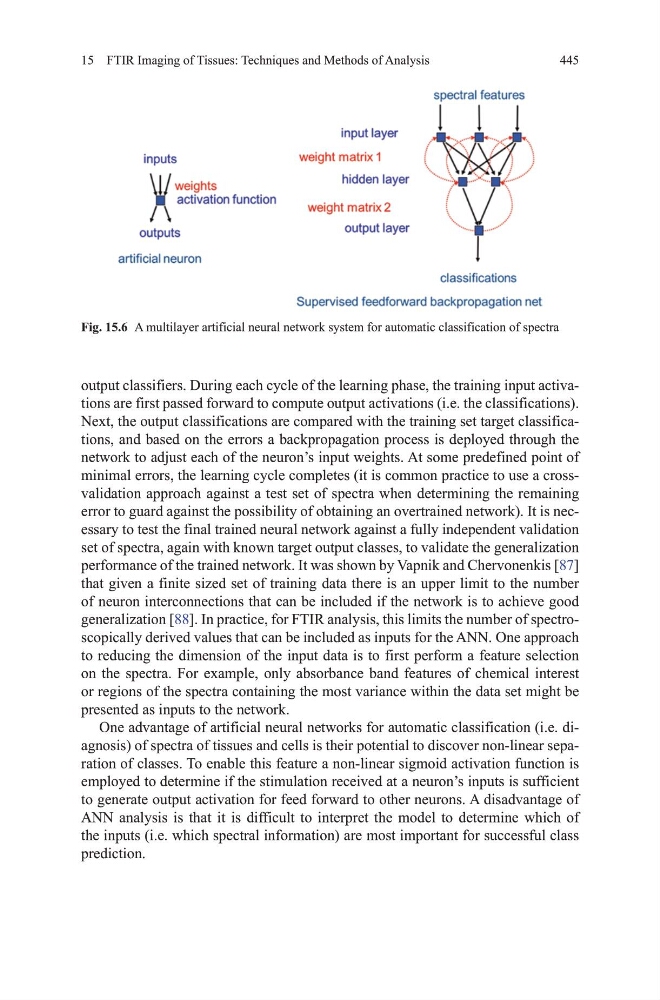
Fig. 15.6 A multilayer artificial neural network system for automatic classification of spectra
15 FtIR Imaging of tissues: techniques and methods of Analysis
output classifiers. during each cycle of the learning phase, the training input activations are first passed forward to compute output activations (i.e. the classifications).
Next, the output classifications are compared with the training set target classifications, and based on the errors a backpropagation process is deployed through the
network to adjust each of the neuron’s input weights. At some predefined point of
minimal errors, the learning cycle completes (it is common practice to use a crossvalidation approach against a test set of spectra when determining the remaining
error to guard against the possibility of obtaining an overtrained network). It is necessary to test the final trained neural network against a fully independent validation
set of spectra, again with known target output classes, to validate the generalization
performance of the trained network. It was shown by vapnik and Chervonenkis [87]
that given a finite sized set of training data there is an upper limit to the number
of neuron interconnections that can be included if the network is to achieve good
generalization [88]. In practice, for FtIR analysis, this limits the number of spectroscopically derived values that can be included as inputs for the ANN. one approach
to reducing the dimension of the input data is to first perform a feature selection
on the spectra. For example, only absorbance band features of chemical interest
or regions of the spectra containing the most variance within the data set might be
presented as inputs to the network.
one advantage of artificial neural networks for automatic classification (i.e. diagnosis) of spectra of tissues and cells is their potential to discover non-linear separation of classes. to enable this feature a non-linear sigmoid activation function is
employed to determine if the stimulation received at a neuron’s inputs is sufficient
to generate output activation for feed forward to other neurons. A disadvantage of
ANN analysis is that it is difficult to interpret the model to determine which of
the inputs (i.e. which spectral information) are most important for successful class
prediction.
Fig. 15.6 A multilayer artificial neural network system for automatic classification of spectra