

3 Surface-enhanced Raman Scattering ...
33
cant rise in the background is usually observed in the SERS spectra. Among less
apparent differences one may recognize: increase of the depolarization ratio of the
bands (intensity ratio of the perpendicular to the parallel component of the Raman
scattered light) and potential dependence of positions and intensity of the bands for
molecules adsorbed on electrodes.
3.3 SERS Supports
For generating SERS spectrum, molecule must be in close contact with SERS-active
support. Although many materials have been reported as providing enhancement of
the Raman scattering with visible and near-infrared excitation, there are three metals that exhibit the highest enhancement—silver, gold, and copper. Because of high
reactivity of Cu, silver and gold are most commonly used as the SERS supports. A
key problem in a variety of applications of SERS is obtaining substrates that provide stable, robust, reproducible and effectively enhancing surface. development of
strongly enhancing and highly reproducible substrates is critical in the applications
of SERS as an important and efficient spectroscopic technique for studying biomolecules. Some examples of SERS supports are shown in Fig. 3.2.
the main source of the surface enhancement is a very strong electromagnetic field
generated by excitation of the localized surface plasmons in the metallic nanoparticles (NP) (see Sect. 2). It is well known that the highest enhancement of the Raman
spectrum is obtained when the energy of the laser beam used to excite the spectrum
is close to the energy of the surface plasmons. to fulfill the condition of the plasmon resonance for a given excitation laser line, nanoparticles should have proper
size, shape and composition. historically, first substrates used for SERS were electrochemically roughened Ag electrode surfaces [1, 2]. they are still used in some
SERS experiments, especially when the applied potential has to be controlled. the
advantage of the electrodes is an ease of electrochemical preparation of the rough
surface, high enhancement factors and possibility to simply regenerate the surface
by subsequent electrochemical dissolution—deposition of the electrode material.
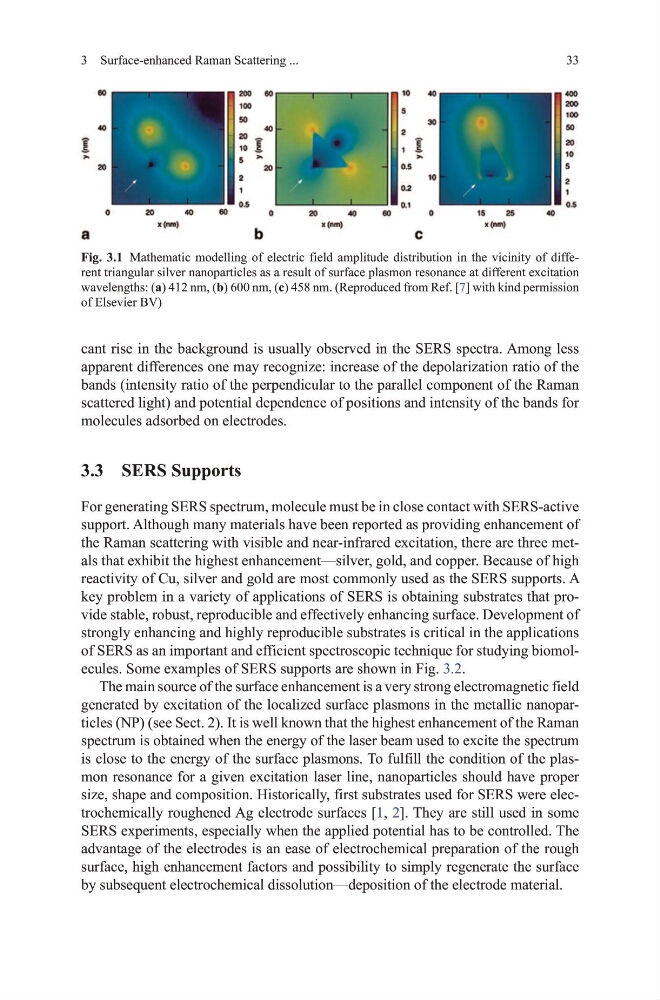
Fig. 3.1 mathematic modelling of electric field amplitude distribution in the vicinity of different triangular silver nanoparticles as a result of surface plasmon resonance at different excitation
wavelengths: (a) 412 nm, (b) 600 nm, (c) 458 nm. (Reproduced from Ref. [7] with kind permission
of Elsevier Bv)
33
cant rise in the background is usually observed in the SERS spectra. Among less
apparent differences one may recognize: increase of the depolarization ratio of the
bands (intensity ratio of the perpendicular to the parallel component of the Raman
scattered light) and potential dependence of positions and intensity of the bands for
molecules adsorbed on electrodes.
3.3 SERS Supports
For generating SERS spectrum, molecule must be in close contact with SERS-active
support. Although many materials have been reported as providing enhancement of
the Raman scattering with visible and near-infrared excitation, there are three metals that exhibit the highest enhancement—silver, gold, and copper. Because of high
reactivity of Cu, silver and gold are most commonly used as the SERS supports. A
key problem in a variety of applications of SERS is obtaining substrates that provide stable, robust, reproducible and effectively enhancing surface. development of
strongly enhancing and highly reproducible substrates is critical in the applications
of SERS as an important and efficient spectroscopic technique for studying biomolecules. Some examples of SERS supports are shown in Fig. 3.2.
the main source of the surface enhancement is a very strong electromagnetic field
generated by excitation of the localized surface plasmons in the metallic nanoparticles (NP) (see Sect. 2). It is well known that the highest enhancement of the Raman
spectrum is obtained when the energy of the laser beam used to excite the spectrum
is close to the energy of the surface plasmons. to fulfill the condition of the plasmon resonance for a given excitation laser line, nanoparticles should have proper
size, shape and composition. historically, first substrates used for SERS were electrochemically roughened Ag electrode surfaces [1, 2]. they are still used in some
SERS experiments, especially when the applied potential has to be controlled. the
advantage of the electrodes is an ease of electrochemical preparation of the rough
surface, high enhancement factors and possibility to simply regenerate the surface
by subsequent electrochemical dissolution—deposition of the electrode material.
Fig. 3.1 mathematic modelling of electric field amplitude distribution in the vicinity of different triangular silver nanoparticles as a result of surface plasmon resonance at different excitation
wavelengths: (a) 412 nm, (b) 600 nm, (c) 458 nm. (Reproduced from Ref. [7] with kind permission
of Elsevier Bv)