

405
14 Quantitative Analysis of disease Biomarkers using …
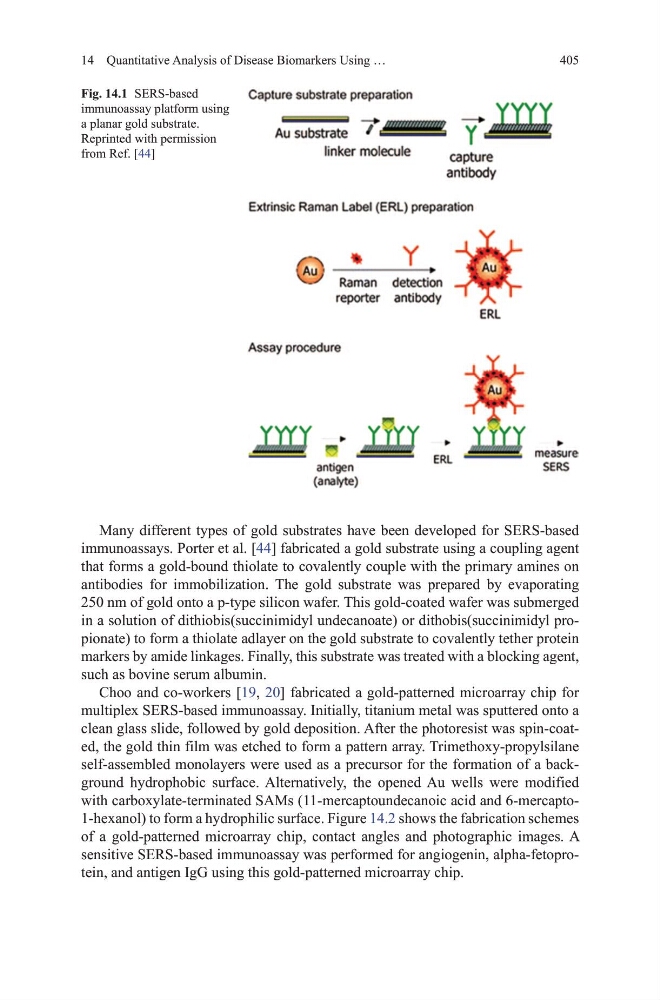
many different types of gold substrates have been developed for SERS-based
immunoassays. Porter et al. [44] fabricated a gold substrate using a coupling agent
that forms a gold-bound thiolate to covalently couple with the primary amines on
antibodies for immobilization. the gold substrate was prepared by evaporating
250 nm of gold onto a p-type silicon wafer. this gold-coated wafer was submerged
in a solution of dithiobis(succinimidyl undecanoate) or dithobis(succinimidyl propionate) to form a thiolate adlayer on the gold substrate to covalently tether protein
markers by amide linkages. Finally, this substrate was treated with a blocking agent,
such as bovine serum albumin.
Choo and co-workers [19, 20] fabricated a gold-patterned microarray chip for
multiplex SERS-based immunoassay. Initially, titanium metal was sputtered onto a
clean glass slide, followed by gold deposition. After the photoresist was spin-coated, the gold thin film was etched to form a pattern array. trimethoxy-propylsilane
self-assembled monolayers were used as a precursor for the formation of a background hydrophobic surface. Alternatively, the opened Au wells were modified
with carboxylate-terminated SAms (11-mercaptoundecanoic acid and 6-mercapto1-hexanol) to form a hydrophilic surface. Figure 14.2 shows the fabrication schemes
of a gold-patterned microarray chip, contact angles and photographic images. A
sensitive SERS-based immunoassay was performed for angiogenin, alpha-fetoprotein, and antigen Igg using this gold-patterned microarray chip.
Fig. 14.1 SERS-based
immunoassay platform using
a planar gold substrate.
Reprinted with permission
from Ref. [44]
14 Quantitative Analysis of disease Biomarkers using …
many different types of gold substrates have been developed for SERS-based
immunoassays. Porter et al. [44] fabricated a gold substrate using a coupling agent
that forms a gold-bound thiolate to covalently couple with the primary amines on
antibodies for immobilization. the gold substrate was prepared by evaporating
250 nm of gold onto a p-type silicon wafer. this gold-coated wafer was submerged
in a solution of dithiobis(succinimidyl undecanoate) or dithobis(succinimidyl propionate) to form a thiolate adlayer on the gold substrate to covalently tether protein
markers by amide linkages. Finally, this substrate was treated with a blocking agent,
such as bovine serum albumin.
Choo and co-workers [19, 20] fabricated a gold-patterned microarray chip for
multiplex SERS-based immunoassay. Initially, titanium metal was sputtered onto a
clean glass slide, followed by gold deposition. After the photoresist was spin-coated, the gold thin film was etched to form a pattern array. trimethoxy-propylsilane
self-assembled monolayers were used as a precursor for the formation of a background hydrophobic surface. Alternatively, the opened Au wells were modified
with carboxylate-terminated SAms (11-mercaptoundecanoic acid and 6-mercapto1-hexanol) to form a hydrophilic surface. Figure 14.2 shows the fabrication schemes
of a gold-patterned microarray chip, contact angles and photographic images. A
sensitive SERS-based immunoassay was performed for angiogenin, alpha-fetoprotein, and antigen Igg using this gold-patterned microarray chip.
Fig. 14.1 SERS-based
immunoassay platform using
a planar gold substrate.
Reprinted with permission
from Ref. [44]