

363
13 Vibrational Spectroscopy: Disease Diagnostics and Beyond
vivo screening of histological or cytological samples is less challenging, but as the
technologies are optically based, the emergence of in-vivo probes is inevitable [57].
the development of such an automated technique measuring biochemical changes
with improved diagnostic capability could allow faster, more effective patient management and inevitably would increase survival rates. Raman spectroscopy therefore
offers enormous potential as a ‘next generation’ technology to assist pathologists
and cytologists with cervical cancer, and other pathological screening and diagnosis.
In the development of the technologies towards clinical and other applications, it
is important to ensure that the preprocessing of the spectral data is appropriate and
in this context it is important to understand the physical and instrumental origin of
any measurement artefacts. Significant progress has been made in FtIR spectroscopy to identify and correct for so-called dispersion artefacts [58–60]. In Raman
microspectroscopy, it has been demonstrated that measurement in immersion significantly reduces the spectral background [61] and photodamage [62], minimizing
the need for spectral preprocessing.
Notably, the analytical capabilities of the spectral techniques rely heavily on
multivariate analytical techniques to classify the complex spectral signatures, and
changes to them, associated with disease. A broad range of data analytical techniques are available including genetic Algorithms, Support vector machines, Neural Networks etc. to date, no direct comparison of the efficacy or suitability of such
techniques has been made and such a comparison on experimental data may not be
conclusive, as the true result is not known. ultimately, the field would benefit from
an exhaustive comparison of the range of data preprocessing and analysis techniques on appropriate simulated datasets [59].
13.3 Exploring the Aetiology of Disease—HPV Infection
[63, 64]
the probability of developing cervical dysplasia is much higher for women infected
with the human papillomavirus (hPv) than those free of infection [65]. Infection
with oncogenic or high-risk hPv (hPv-16, hPv-18) is the main risk factor for
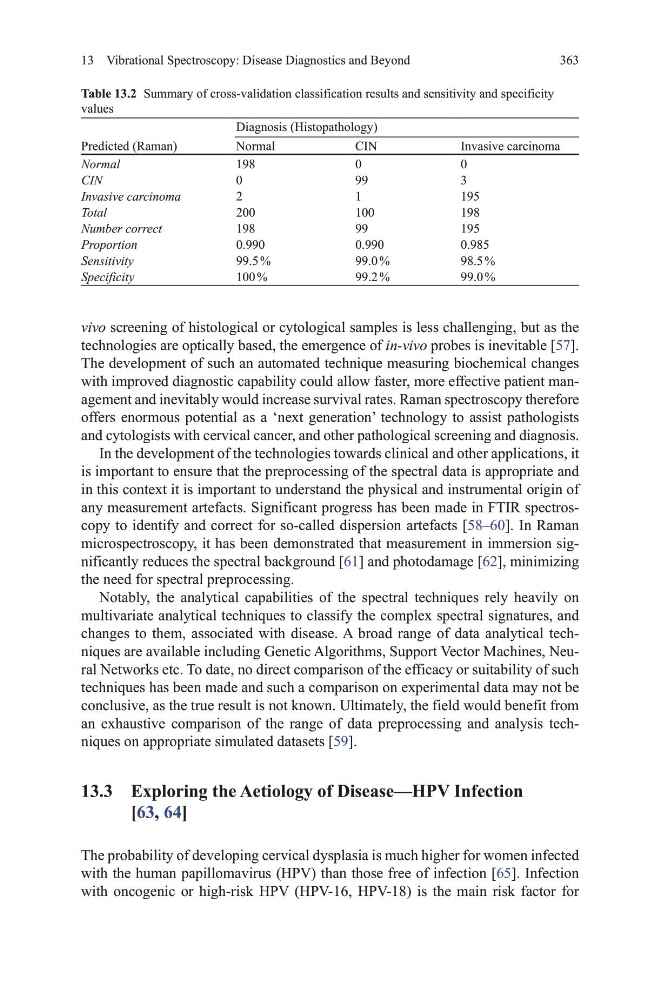
Table 13.2 Summary of cross-validation classification results and sensitivity and specificity
values
diagnosis (histopathology)
Predicted (Raman)
Normal
CIN
Invasive carcinoma
Normal
198
0
0
CIN
0
99
3
Invasive carcinoma
2
1
195
Total
200
100
198
Number correct
198
99
195
Proportion
0.990
0.990
0.985
Sensitivity
99.5 %
99.0 %
98.5 %
Specificity
100 %
99.2 %
99.0 %
13 Vibrational Spectroscopy: Disease Diagnostics and Beyond
vivo screening of histological or cytological samples is less challenging, but as the
technologies are optically based, the emergence of in-vivo probes is inevitable [57].
the development of such an automated technique measuring biochemical changes
with improved diagnostic capability could allow faster, more effective patient management and inevitably would increase survival rates. Raman spectroscopy therefore
offers enormous potential as a ‘next generation’ technology to assist pathologists
and cytologists with cervical cancer, and other pathological screening and diagnosis.
In the development of the technologies towards clinical and other applications, it
is important to ensure that the preprocessing of the spectral data is appropriate and
in this context it is important to understand the physical and instrumental origin of
any measurement artefacts. Significant progress has been made in FtIR spectroscopy to identify and correct for so-called dispersion artefacts [58–60]. In Raman
microspectroscopy, it has been demonstrated that measurement in immersion significantly reduces the spectral background [61] and photodamage [62], minimizing
the need for spectral preprocessing.
Notably, the analytical capabilities of the spectral techniques rely heavily on
multivariate analytical techniques to classify the complex spectral signatures, and
changes to them, associated with disease. A broad range of data analytical techniques are available including genetic Algorithms, Support vector machines, Neural Networks etc. to date, no direct comparison of the efficacy or suitability of such
techniques has been made and such a comparison on experimental data may not be
conclusive, as the true result is not known. ultimately, the field would benefit from
an exhaustive comparison of the range of data preprocessing and analysis techniques on appropriate simulated datasets [59].
13.3 Exploring the Aetiology of Disease—HPV Infection
[63, 64]
the probability of developing cervical dysplasia is much higher for women infected
with the human papillomavirus (hPv) than those free of infection [65]. Infection
with oncogenic or high-risk hPv (hPv-16, hPv-18) is the main risk factor for
Table 13.2 Summary of cross-validation classification results and sensitivity and specificity
values
diagnosis (histopathology)
Predicted (Raman)
Normal
CIN
Invasive carcinoma
Normal
198
0
0
CIN
0
99
3
Invasive carcinoma
2
1
195
Total
200
100
198
Number correct
198
99
195
Proportion
0.990
0.990
0.985
Sensitivity
99.5 %
99.0 %
98.5 %
Specificity
100 %
99.2 %
99.0 %