

320
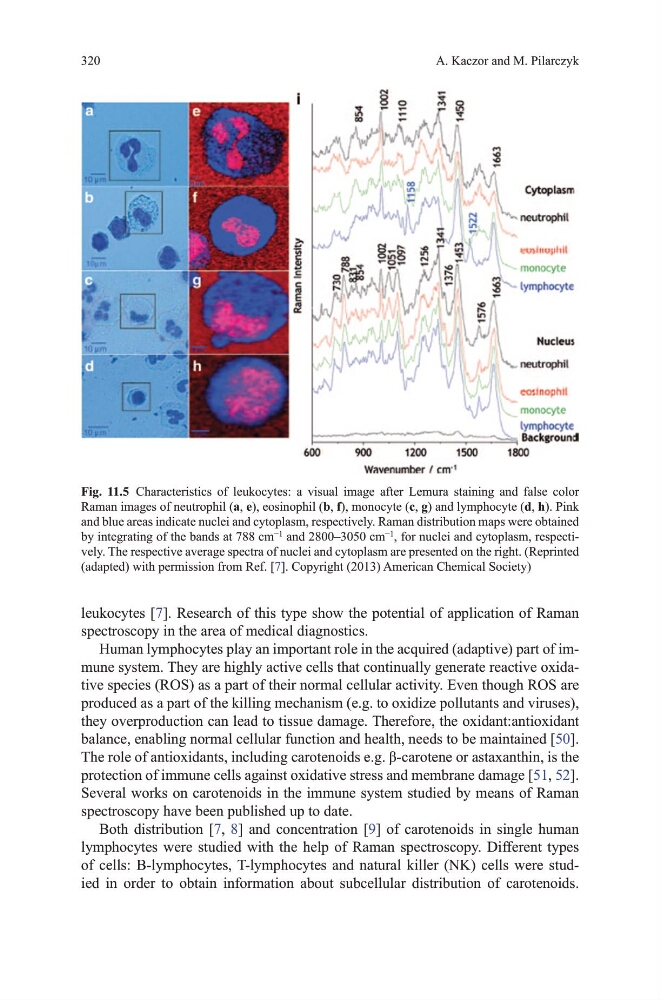
leukocytes [7]. Research of this type show the potential of application of Raman
spectroscopy in the area of medical diagnostics.
human lymphocytes play an important role in the acquired (adaptive) part of immune system. they are highly active cells that continually generate reactive oxidative species (RoS) as a part of their normal cellular activity. Even though RoS are
produced as a part of the killing mechanism (e.g. to oxidize pollutants and viruses),
they overproduction can lead to tissue damage. therefore, the oxidant:antioxidant
balance, enabling normal cellular function and health, needs to be maintained [50].
The role of antioxidants, including carotenoids e.g. β-carotene or astaxanthin, is the
protection of immune cells against oxidative stress and membrane damage [51, 52].
Several works on carotenoids in the immune system studied by means of Raman
spectroscopy have been published up to date.
Both distribution [7, 8] and concentration [9] of carotenoids in single human
lymphocytes were studied with the help of Raman spectroscopy. different types
of cells: B-lymphocytes, t-lymphocytes and natural killer (NK) cells were studied in order to obtain information about subcellular distribution of carotenoids.
Fig. 11.5 Characteristics of leukocytes: a visual image after Lemura staining and false color
Raman images of neutrophil (a, e), eosinophil (b, f), monocyte (c, g) and lymphocyte (d, h). Pink
and blue areas indicate nuclei and cytoplasm, respectively. Raman distribution maps were obtained
by integrating of the bands at 788 cm
−1
and 2800–3050 cm
−1
, for nuclei and cytoplasm, respectively. the respective average spectra of nuclei and cytoplasm are presented on the right. (Reprinted
(adapted) with permission from Ref. [7]. Copyright (2013) American Chemical Society)
A. Kaczor and m. Pilarczyk
leukocytes [7]. Research of this type show the potential of application of Raman
spectroscopy in the area of medical diagnostics.
human lymphocytes play an important role in the acquired (adaptive) part of immune system. they are highly active cells that continually generate reactive oxidative species (RoS) as a part of their normal cellular activity. Even though RoS are
produced as a part of the killing mechanism (e.g. to oxidize pollutants and viruses),
they overproduction can lead to tissue damage. therefore, the oxidant:antioxidant
balance, enabling normal cellular function and health, needs to be maintained [50].
The role of antioxidants, including carotenoids e.g. β-carotene or astaxanthin, is the
protection of immune cells against oxidative stress and membrane damage [51, 52].
Several works on carotenoids in the immune system studied by means of Raman
spectroscopy have been published up to date.
Both distribution [7, 8] and concentration [9] of carotenoids in single human
lymphocytes were studied with the help of Raman spectroscopy. different types
of cells: B-lymphocytes, t-lymphocytes and natural killer (NK) cells were studied in order to obtain information about subcellular distribution of carotenoids.
Fig. 11.5 Characteristics of leukocytes: a visual image after Lemura staining and false color
Raman images of neutrophil (a, e), eosinophil (b, f), monocyte (c, g) and lymphocyte (d, h). Pink
and blue areas indicate nuclei and cytoplasm, respectively. Raman distribution maps were obtained
by integrating of the bands at 788 cm
−1
and 2800–3050 cm
−1
, for nuclei and cytoplasm, respectively. the respective average spectra of nuclei and cytoplasm are presented on the right. (Reprinted
(adapted) with permission from Ref. [7]. Copyright (2013) American Chemical Society)
A. Kaczor and m. Pilarczyk