

2 Integrating Optical Spectroscopy and Chemometric Methods
21
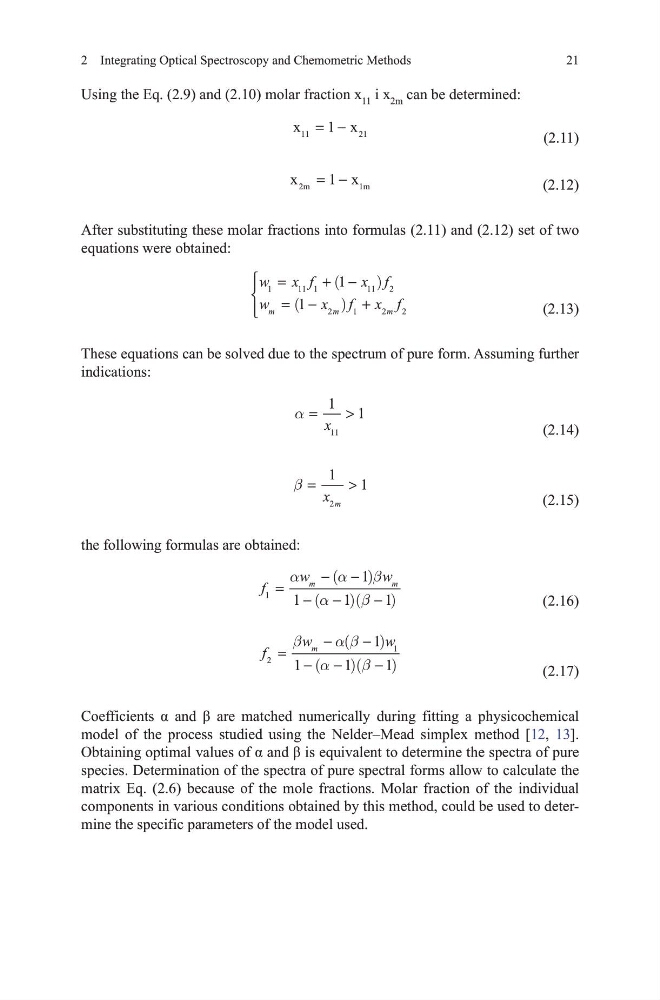
using the Eq. (2.9) and (2.10) molar fraction x 11 i x 2m can be determined:
x
x
11
21
1
= −
(2.11)
x
x
2m
1m
= −
1
(2.12)
After substituting these molar fractions into formulas (2.11) and (2.12) set of two
equations were obtained:
w
x f
x f
w
x f x f
m
m
m
1
1 1 1
11
2
2
1
2
2
1
1
=
+ −
= −
+
(
)
(
)
(2.13)
these equations can be solved due to the spectrum of pure form. Assuming further
indications:
α =
>
1 1
11
x
(2.14)
β =
>
1
1
2
x m
(2.15)
the following formulas are obtained:
f
w
w
m
m
1
1
1
1
1
=
− −
− −
−
α
α
β
α
β
(
)
(
)(
)
(2.16)
f
w
w
m
2
1
1
1
1
1
=
−
−
− −
−
β
α β
α
β
(
)
(
)(
)
(2.17)
Coefficients α and β are matched numerically during fitting a physicochemical
model of the process studied using the Nelder–mead simplex method [12, 13].
Obtaining optimal values of α and β is equivalent to determine the spectra of pure
species. determination of the spectra of pure spectral forms allow to calculate the
matrix Eq. (2.6) because of the mole fractions. molar fraction of the individual
components in various conditions obtained by this method, could be used to determine the specific parameters of the model used.
21
using the Eq. (2.9) and (2.10) molar fraction x 11 i x 2m can be determined:
x
x
11
21
1
= −
(2.11)
x
x
2m
1m
= −
1
(2.12)
After substituting these molar fractions into formulas (2.11) and (2.12) set of two
equations were obtained:
w
x f
x f
w
x f x f
m
m
m
1
1 1 1
11
2
2
1
2
2
1
1
=
+ −
= −
+
(
)
(
)
(2.13)
these equations can be solved due to the spectrum of pure form. Assuming further
indications:
α =
>
1 1
11
x
(2.14)
β =
>
1
1
2
x m
(2.15)
the following formulas are obtained:
f
w
w
m
m
1
1
1
1
1
=
− −
− −
−
α
α
β
α
β
(
)
(
)(
)
(2.16)
f
w
w
m
2
1
1
1
1
1
=
−
−
− −
−
β
α β
α
β
(
)
(
)(
)
(2.17)
Coefficients α and β are matched numerically during fitting a physicochemical
model of the process studied using the Nelder–mead simplex method [12, 13].
Obtaining optimal values of α and β is equivalent to determine the spectra of pure
species. determination of the spectra of pure spectral forms allow to calculate the
matrix Eq. (2.6) because of the mole fractions. molar fraction of the individual
components in various conditions obtained by this method, could be used to determine the specific parameters of the model used.