

314
therefore, it was proposed that the carotenoid, initially in the form of h-aggregates with the trans conformation of the both end-rings, is released from aggregates
and rotamerizes to the more stable gauche forms upon the thermal treatment. Quantum-chemical calculations were very useful in predicting of the structural changes
associated with heating [30].
Apart from implementation of quantum-chemical calculations as a complementary method to analyze experimental Raman data, other strategies are possible. A
good approach toward distinguishing between different pigment molecules inside
the cell and determining of the structure and distribution changes of carotenoids
upon environmental stimuli is the application of statistical methods, such as multivariate analysis, to discern complicated experimental data.
heraud et al. [13] applied chemometric methods to determine differences between individual living Dunaliella tertiolecta cells grown under nitrogen-replete
and nitrogen-starved conditions. two classification methods, namely soft independent modeling of class analogy (SImCA) and discriminant partial least squares
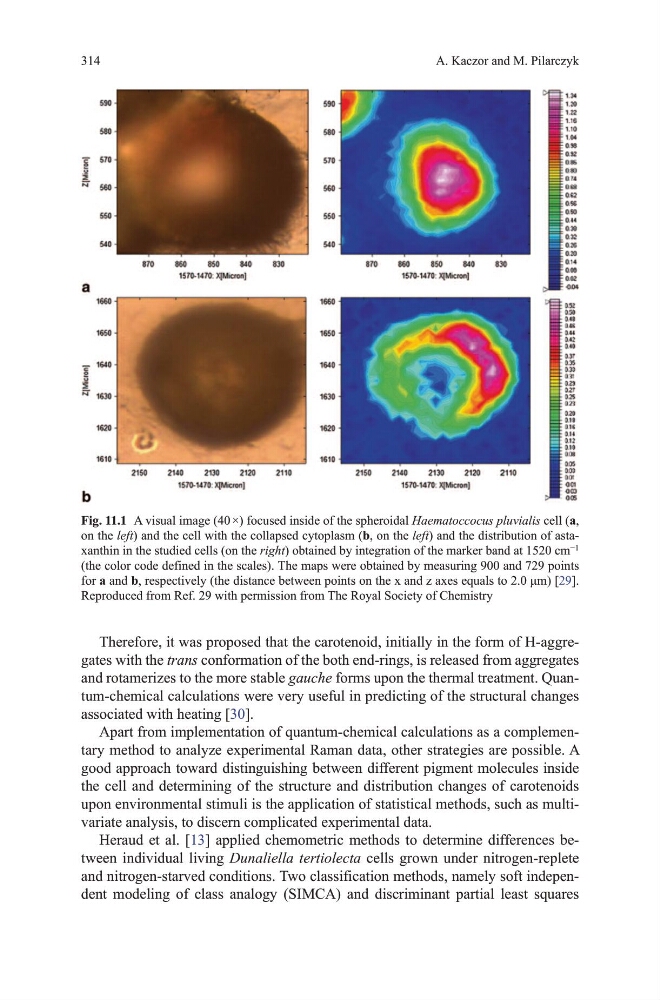
Fig. 11.1 A visual image (40 ×) focused inside of the spheroidal Haematoccocus pluvialis cell (a,
on the left) and the cell with the collapsed cytoplasm (b, on the left) and the distribution of astaxanthin in the studied cells (on the right) obtained by integration of the marker band at 1520 cm
−1
(the color code defined in the scales). the maps were obtained by measuring 900 and 729 points
for a and b, respectively (the distance between points on the x and z axes equals to 2.0 μm) [29].
Reproduced from Ref. 29 with permission from the Royal Society of Chemistry
A. Kaczor and m. Pilarczyk
therefore, it was proposed that the carotenoid, initially in the form of h-aggregates with the trans conformation of the both end-rings, is released from aggregates
and rotamerizes to the more stable gauche forms upon the thermal treatment. Quantum-chemical calculations were very useful in predicting of the structural changes
associated with heating [30].
Apart from implementation of quantum-chemical calculations as a complementary method to analyze experimental Raman data, other strategies are possible. A
good approach toward distinguishing between different pigment molecules inside
the cell and determining of the structure and distribution changes of carotenoids
upon environmental stimuli is the application of statistical methods, such as multivariate analysis, to discern complicated experimental data.
heraud et al. [13] applied chemometric methods to determine differences between individual living Dunaliella tertiolecta cells grown under nitrogen-replete
and nitrogen-starved conditions. two classification methods, namely soft independent modeling of class analogy (SImCA) and discriminant partial least squares
Fig. 11.1 A visual image (40 ×) focused inside of the spheroidal Haematoccocus pluvialis cell (a,
on the left) and the cell with the collapsed cytoplasm (b, on the left) and the distribution of astaxanthin in the studied cells (on the right) obtained by integration of the marker band at 1520 cm
−1
(the color code defined in the scales). the maps were obtained by measuring 900 and 729 points
for a and b, respectively (the distance between points on the x and z axes equals to 2.0 μm) [29].
Reproduced from Ref. 29 with permission from the Royal Society of Chemistry
A. Kaczor and m. Pilarczyk