

234
B. Czarnik-Matusewicz and Y.M. Jung
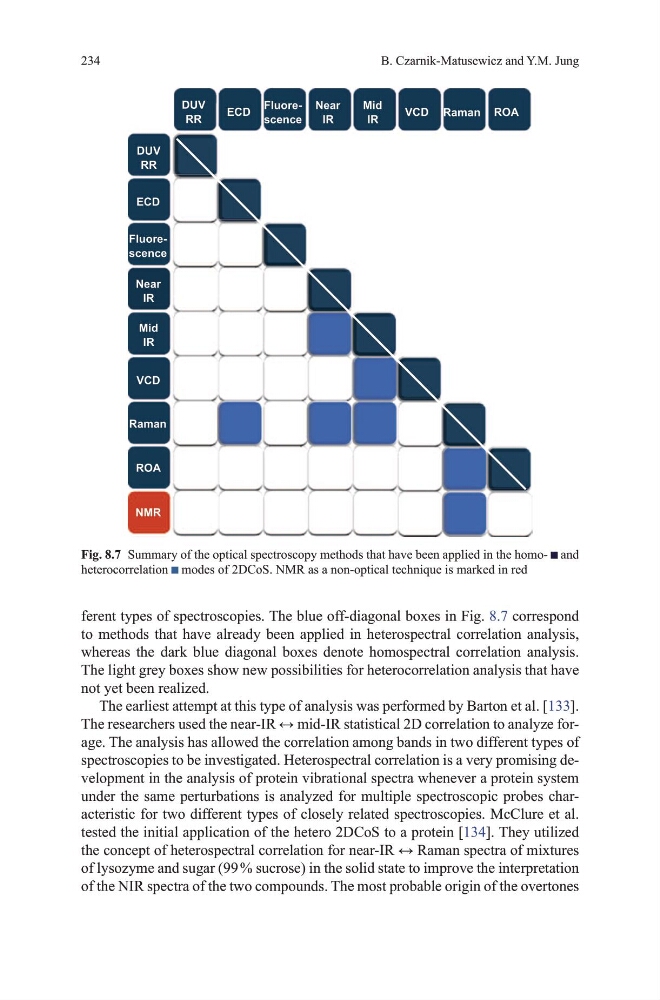
ferent types of spectroscopies. the blue off-diagonal boxes in Fig. 8.7 correspond
to methods that have already been applied in heterospectral correlation analysis,
whereas the dark blue diagonal boxes denote homospectral correlation analysis.
the light grey boxes show new possibilities for heterocorrelation analysis that have
not yet been realized.
the earliest attempt at this type of analysis was performed by Barton et al. [133].
The researchers used the near-IR ↔ mid-IR statistical 2D correlation to analyze forage. the analysis has allowed the correlation among bands in two different types of
spectroscopies to be investigated. heterospectral correlation is a very promising development in the analysis of protein vibrational spectra whenever a protein system
under the same perturbations is analyzed for multiple spectroscopic probes characteristic for two different types of closely related spectroscopies. mcClure et al.
tested the initial application of the hetero 2dCoS to a protein [134]. they utilized
the concept of heterospectral correlation for near-IR ↔ Raman spectra of mixtures
of lysozyme and sugar (99 % sucrose) in the solid state to improve the interpretation
of the NIR spectra of the two compounds. the most probable origin of the overtones
DUV
RR
ECD
Fluorescence
Near
IR
Mid
IR
VCD Raman ROA
DUV
RR
ECD
Fluorescence
Near
IR
Mid
IR
VCD
Raman
ROA
NMR
Fig. 8.7 Summary of the optical spectroscopy methods that have been applied in the homo- and
heterocorrelation modes of 2dCoS. NmR as a non-optical technique is marked in red
B. Czarnik-Matusewicz and Y.M. Jung
ferent types of spectroscopies. the blue off-diagonal boxes in Fig. 8.7 correspond
to methods that have already been applied in heterospectral correlation analysis,
whereas the dark blue diagonal boxes denote homospectral correlation analysis.
the light grey boxes show new possibilities for heterocorrelation analysis that have
not yet been realized.
the earliest attempt at this type of analysis was performed by Barton et al. [133].
The researchers used the near-IR ↔ mid-IR statistical 2D correlation to analyze forage. the analysis has allowed the correlation among bands in two different types of
spectroscopies to be investigated. heterospectral correlation is a very promising development in the analysis of protein vibrational spectra whenever a protein system
under the same perturbations is analyzed for multiple spectroscopic probes characteristic for two different types of closely related spectroscopies. mcClure et al.
tested the initial application of the hetero 2dCoS to a protein [134]. they utilized
the concept of heterospectral correlation for near-IR ↔ Raman spectra of mixtures
of lysozyme and sugar (99 % sucrose) in the solid state to improve the interpretation
of the NIR spectra of the two compounds. the most probable origin of the overtones
DUV
RR
ECD
Fluorescence
Near
IR
Mid
IR
VCD Raman ROA
DUV
RR
ECD
Fluorescence
Near
IR
Mid
IR
VCD
Raman
ROA
NMR
Fig. 8.7 Summary of the optical spectroscopy methods that have been applied in the homo- and
heterocorrelation modes of 2dCoS. NmR as a non-optical technique is marked in red