

218
B. Czarnik-Matusewicz and Y.M. Jung
spectrometer in transmission or in attenuated total reflection (AtR) mode; AtR
has become one of the most popular methods in the spectroscopy of biological
materials [123]. the easily perturbed infrared spectra contain huge amounts of
information, which can be converted into a picture of the sequential response
of the protein to the applied external perturbation. however, this picture can be
blurred by various imperfections, distortions, and noise, which are present in the
routine measurements. the picture can even be artificially enhanced by excess
preprocessing. the quality of information retrieved from 2dCoS spectra largely
depends on both the quality of the raw spectra and the modification of the spectra
at different correction and processing steps. this dependence is a general problem
that also concerns other multivariate methods of analysis; therefore, knowledge of
good practices in infrared data pretreatment is necessary. Some useful guidelines
can be found in [124].
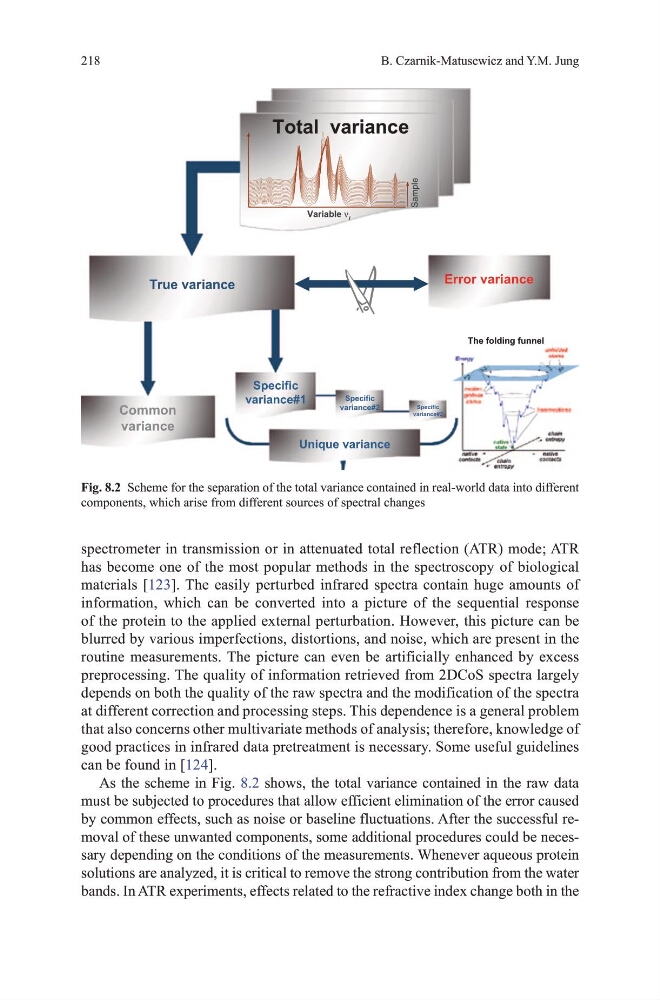
As the scheme in Fig. 8.2 shows, the total variance contained in the raw data
must be subjected to procedures that allow efficient elimination of the error caused
by common effects, such as noise or baseline fluctuations. After the successful removal of these unwanted components, some additional procedures could be necessary depending on the conditions of the measurements. Whenever aqueous protein
solutions are analyzed, it is critical to remove the strong contribution from the water
bands. In AtR experiments, effects related to the refractive index change both in the
Error variance
Specific
variance#1
Common
variance
True variance
Unique variance
Total variance
Specific
variance#2
Specific
variance#3
The folding funnel
Variable ν i
Sample
Fig. 8.2 Scheme for the separation of the total variance contained in real-world data into different
components, which arise from different sources of spectral changes
B. Czarnik-Matusewicz and Y.M. Jung
spectrometer in transmission or in attenuated total reflection (AtR) mode; AtR
has become one of the most popular methods in the spectroscopy of biological
materials [123]. the easily perturbed infrared spectra contain huge amounts of
information, which can be converted into a picture of the sequential response
of the protein to the applied external perturbation. however, this picture can be
blurred by various imperfections, distortions, and noise, which are present in the
routine measurements. the picture can even be artificially enhanced by excess
preprocessing. the quality of information retrieved from 2dCoS spectra largely
depends on both the quality of the raw spectra and the modification of the spectra
at different correction and processing steps. this dependence is a general problem
that also concerns other multivariate methods of analysis; therefore, knowledge of
good practices in infrared data pretreatment is necessary. Some useful guidelines
can be found in [124].
As the scheme in Fig. 8.2 shows, the total variance contained in the raw data
must be subjected to procedures that allow efficient elimination of the error caused
by common effects, such as noise or baseline fluctuations. After the successful removal of these unwanted components, some additional procedures could be necessary depending on the conditions of the measurements. Whenever aqueous protein
solutions are analyzed, it is critical to remove the strong contribution from the water
bands. In AtR experiments, effects related to the refractive index change both in the
Error variance
Specific
variance#1
Common
variance
True variance
Unique variance
Total variance
Specific
variance#2
Specific
variance#3
The folding funnel
Variable ν i
Sample
Fig. 8.2 Scheme for the separation of the total variance contained in real-world data into different
components, which arise from different sources of spectral changes