

7 Biologically Relevant Molecules Studied in Low Temperature Inert Matrices
193
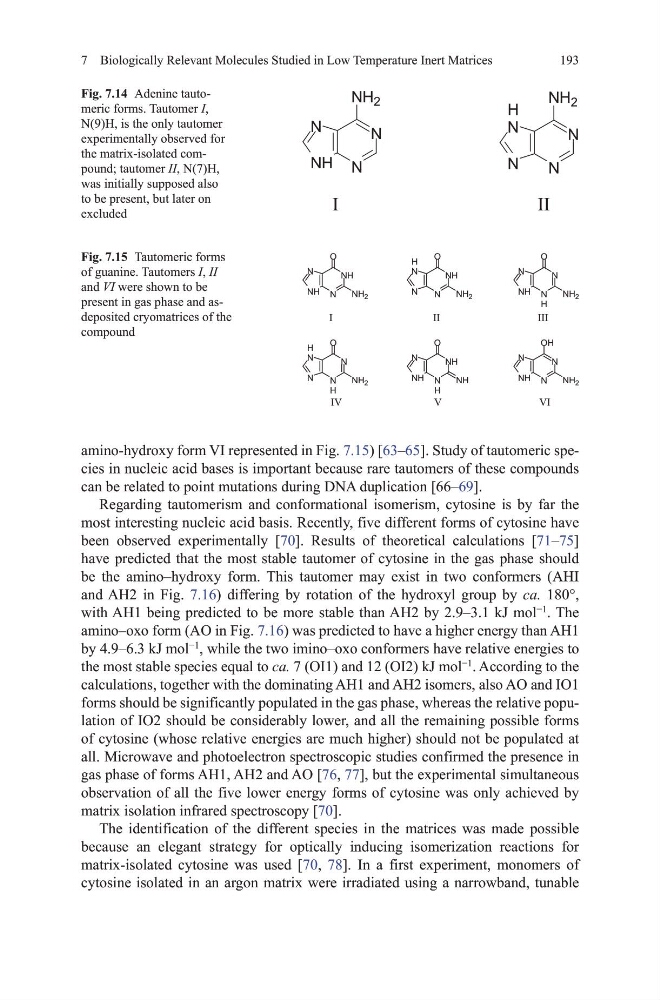
amino-hydroxy form vI represented in Fig. 7.15) [63–65]. Study of tautomeric species in nucleic acid bases is important because rare tautomers of these compounds
can be related to point mutations during dNA duplication [66–69].
Regarding tautomerism and conformational isomerism, cytosine is by far the
most interesting nucleic acid basis. Recently, five different forms of cytosine have
been observed experimentally [70]. Results of theoretical calculations [71–75]
have predicted that the most stable tautomer of cytosine in the gas phase should
be the amino–hydroxy form. this tautomer may exist in two conformers (AhI
and Ah2 in Fig. 7.16) differing by rotation of the hydroxyl group by ca. 180°,
with Ah1 being predicted to be more stable than Ah2 by 2.9–3.1 kJ mol
−1
. the
amino–oxo form (Ao in Fig. 7.16) was predicted to have a higher energy than Ah1
by 4.9–6.3 kJ mol
−1
, while the two imino–oxo conformers have relative energies to
the most stable species equal to ca. 7 (oI1) and 12 (oI2) kJ mol
−1
. According to the
calculations, together with the dominating Ah1 and Ah2 isomers, also Ao and Io1
forms should be significantly populated in the gas phase, whereas the relative population of Io2 should be considerably lower, and all the remaining possible forms
of cytosine (whose relative energies are much higher) should not be populated at
all. microwave and photoelectron spectroscopic studies confirmed the presence in
gas phase of forms Ah1, Ah2 and Ao [76, 77], but the experimental simultaneous
observation of all the five lower energy forms of cytosine was only achieved by
matrix isolation infrared spectroscopy [70].
the identification of the different species in the matrices was made possible
because an elegant strategy for optically inducing isomerization reactions for
matrix-isolated cytosine was used [70, 78]. In a first experiment, monomers of
cytosine isolated in an argon matrix were irradiated using a narrowband, tunable
N
NH
NH
N
NH 2
O
N
NH
N
N
H
NH 2
O
N
H
N
NH
N
NH 2
O
N
H
N
N
N
H
NH 2
O
N
H
NH
NH
N
NH
O
N
N
NH
N
NH 2
OH
I
I I
I II
IV
V
V I
Fig. 7.15 tautomeric forms
of guanine. tautomers I, II
and VI were shown to be
present in gas phase and asdeposited cryomatrices of the
compound
N
N
NH
N
NH 2
N
N
N
N
H
NH 2
I
I I
Fig. 7.14 Adenine tautomeric forms. tautomer I,
N(9)h, is the only tautomer
experimentally observed for
the matrix-isolated compound; tautomer II, N(7)h,
was initially supposed also
to be present, but later on
excluded
193
amino-hydroxy form vI represented in Fig. 7.15) [63–65]. Study of tautomeric species in nucleic acid bases is important because rare tautomers of these compounds
can be related to point mutations during dNA duplication [66–69].
Regarding tautomerism and conformational isomerism, cytosine is by far the
most interesting nucleic acid basis. Recently, five different forms of cytosine have
been observed experimentally [70]. Results of theoretical calculations [71–75]
have predicted that the most stable tautomer of cytosine in the gas phase should
be the amino–hydroxy form. this tautomer may exist in two conformers (AhI
and Ah2 in Fig. 7.16) differing by rotation of the hydroxyl group by ca. 180°,
with Ah1 being predicted to be more stable than Ah2 by 2.9–3.1 kJ mol
−1
. the
amino–oxo form (Ao in Fig. 7.16) was predicted to have a higher energy than Ah1
by 4.9–6.3 kJ mol
−1
, while the two imino–oxo conformers have relative energies to
the most stable species equal to ca. 7 (oI1) and 12 (oI2) kJ mol
−1
. According to the
calculations, together with the dominating Ah1 and Ah2 isomers, also Ao and Io1
forms should be significantly populated in the gas phase, whereas the relative population of Io2 should be considerably lower, and all the remaining possible forms
of cytosine (whose relative energies are much higher) should not be populated at
all. microwave and photoelectron spectroscopic studies confirmed the presence in
gas phase of forms Ah1, Ah2 and Ao [76, 77], but the experimental simultaneous
observation of all the five lower energy forms of cytosine was only achieved by
matrix isolation infrared spectroscopy [70].
the identification of the different species in the matrices was made possible
because an elegant strategy for optically inducing isomerization reactions for
matrix-isolated cytosine was used [70, 78]. In a first experiment, monomers of
cytosine isolated in an argon matrix were irradiated using a narrowband, tunable
N
NH
NH
N
NH 2
O
N
NH
N
N
H
NH 2
O
N
H
N
NH
N
NH 2
O
N
H
N
N
N
H
NH 2
O
N
H
NH
NH
N
NH
O
N
N
NH
N
NH 2
OH
I
I I
I II
IV
V
V I
Fig. 7.15 tautomeric forms
of guanine. tautomers I, II
and VI were shown to be
present in gas phase and asdeposited cryomatrices of the
compound
N
N
NH
N
NH 2
N
N
N
N
H
NH 2
I
I I
Fig. 7.14 Adenine tautomeric forms. tautomer I,
N(9)h, is the only tautomer
experimentally observed for
the matrix-isolated compound; tautomer II, N(7)h,
was initially supposed also
to be present, but later on
excluded