

192
R. Fausto and N. Kuş
as both in the gas phase and in cryogenic matrices prepared from the vapor of the
compound, uracil exists in a single tautomeric form (amide) [41–48].
the detailed assignment of the infrared spectra of uracil in argon and nitrogen
matrices was first reported ca. 30 years ago [41, 42]. An interesting feature of the
spectra of matrix-isolated uracil is the extensive presence of band-splitting due to
Fermi resonances.
uv-photolysis of uracil in an argon matrix, yielded isocyanic acid, most probably formed together with acetylene, though no bands due to this latter species
were experimentally observed [49]. the study of the photochemistry of the nucleic
acid bases is of interest because genetic mutations may be caused by uv radiation
exposition. It is well-known that nucleic acid bases absorb uv radiation efficiently,
though when associated in dNA forming hydrogen-bonded pairs, fast non-radiative
dissipation of the energy gained by these molecules upon uv absorption makes
dNA highly photostable [50, 51]. uracil and adenine were, however, shown to be
considerably photolabile [49] and cannot survive in environments where a significant uv flux is present. Nevertheless, it has still been proposed that nucleic acid
bases molecules might first have been produced in the space, since traces of nucleobases have been found in carbonaceous meteorites [49, 52–55].
thymine (5-methyluracil) also exists in a single tautomeric form (amide) in gas
phase and matrices [45, 46, 56, 57], whereas in solution, like uracil, thymine can
be found in both amide and imide forms. on the other hand, several tautomeric
forms of cytosine have already been experimentally observed, as described below
in detail. Among the nucleic acid bases derived from pyrimidine, cytosine has been
shown to be the most challenging molecule for structural investigation, and matrix
isolation has been the key-technique in the structural studies of this compound.
In case of the purines, adenine revealed itself as a simple case, while guanine was
found to be a more complex system from the structural point of view. In solution,
both compounds may exist as a complex mixture of several tautomers. however,
in case of adenine, though it has been initially believed that the compound existed
in two amino tautomeric forms nearly equally populated in the gas phase [58–60]
(forms I and II in Fig. 7.14), it was latter on unequivocally demonstrated that only
one tautomer (I) is significantly populated in that phase [61, 62]. Isotopic labeling
(
15
N) experiments undertaken on matrix-isolated adenine, together with results from
quantum chemical calculations, were essential to definitely solve that question [62].
on the other hand, at least three tautomeric forms of guanine were spectroscopically identified in cryogenic matrices (the amino-oxo forms I and II, and the
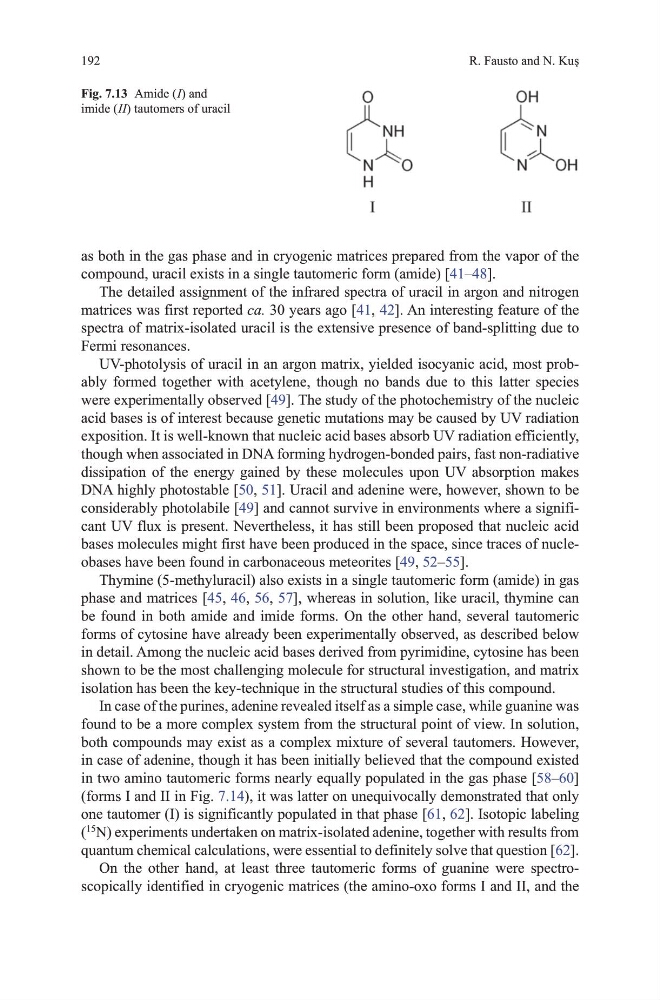
Fig. 7.13 Amide ( I) and
imide ( II) tautomers of uracil
R. Fausto and N. Kuş
as both in the gas phase and in cryogenic matrices prepared from the vapor of the
compound, uracil exists in a single tautomeric form (amide) [41–48].
the detailed assignment of the infrared spectra of uracil in argon and nitrogen
matrices was first reported ca. 30 years ago [41, 42]. An interesting feature of the
spectra of matrix-isolated uracil is the extensive presence of band-splitting due to
Fermi resonances.
uv-photolysis of uracil in an argon matrix, yielded isocyanic acid, most probably formed together with acetylene, though no bands due to this latter species
were experimentally observed [49]. the study of the photochemistry of the nucleic
acid bases is of interest because genetic mutations may be caused by uv radiation
exposition. It is well-known that nucleic acid bases absorb uv radiation efficiently,
though when associated in dNA forming hydrogen-bonded pairs, fast non-radiative
dissipation of the energy gained by these molecules upon uv absorption makes
dNA highly photostable [50, 51]. uracil and adenine were, however, shown to be
considerably photolabile [49] and cannot survive in environments where a significant uv flux is present. Nevertheless, it has still been proposed that nucleic acid
bases molecules might first have been produced in the space, since traces of nucleobases have been found in carbonaceous meteorites [49, 52–55].
thymine (5-methyluracil) also exists in a single tautomeric form (amide) in gas
phase and matrices [45, 46, 56, 57], whereas in solution, like uracil, thymine can
be found in both amide and imide forms. on the other hand, several tautomeric
forms of cytosine have already been experimentally observed, as described below
in detail. Among the nucleic acid bases derived from pyrimidine, cytosine has been
shown to be the most challenging molecule for structural investigation, and matrix
isolation has been the key-technique in the structural studies of this compound.
In case of the purines, adenine revealed itself as a simple case, while guanine was
found to be a more complex system from the structural point of view. In solution,
both compounds may exist as a complex mixture of several tautomers. however,
in case of adenine, though it has been initially believed that the compound existed
in two amino tautomeric forms nearly equally populated in the gas phase [58–60]
(forms I and II in Fig. 7.14), it was latter on unequivocally demonstrated that only
one tautomer (I) is significantly populated in that phase [61, 62]. Isotopic labeling
(
15
N) experiments undertaken on matrix-isolated adenine, together with results from
quantum chemical calculations, were essential to definitely solve that question [62].
on the other hand, at least three tautomeric forms of guanine were spectroscopically identified in cryogenic matrices (the amino-oxo forms I and II, and the
Fig. 7.13 Amide ( I) and
imide ( II) tautomers of uracil