

7 Biologically Relevant Molecules Studied in Low Temperature Inert Matrices
183
preparation of the sample, without decomposing. this requirement precludes matrix
isolation studies of strongly non-volatile species or thermolabile molecules, and
constitutes the most important restriction to its use in the study of complex biomolecules. Secondly, the quantitative determination of matrix concentrations is not an
easy task, even if precision low temperature quartz microbalance is used. hence,
matrix isolation spectroscopy has not been used frequently in quantitative analysis.
In third place, it is well known that even under well-controlled deposition conditions the produced matrices allow for different local environments around the solute
molecules. the co-existence of these different matrix sites leads to slightly different
spectral signatures of molecules of the solute, which results in the usual observation of bands with multiple structure in the spectra of matrix-isolated species. Such
problem can, however, be in general minimized by use of different matrix gases and
judicious choice of the temperature of the cold substrate during deposition. Finally,
since one of the main advantages of the matrix isolation method is the high spectral
resolution it allows to achieve, when the method is used to study very large, complex molecules exhibiting extensive intrinsic band overlapping, it loses relevance.
this is also an important shortcoming for the general application of the method in
biochemistry. Nevertheless, many bioactive or biologically essential compounds of
moderate size have been studied by matrix isolation infrared spectroscopy, and the
method has been progressively catching the interest of biochemists as well. this is
the case of the amino acids, dNA bases, phenolic compounds and coumarins, which
will be shortly reviewed in the next sections of this Chapter mostly based on our
own studies on these types of compounds, but also of many other molecules with
pharmaceutical or medical use [18–20].
Refrigerant
Sample input
High vacuum
(10
-6 mbar)
Cold finger
(4-20 K)
Valve
Valve
Valve
Valve
Valve
Mixing chamber
High vacuum
pumping system
Input channel
Matrix gas
input
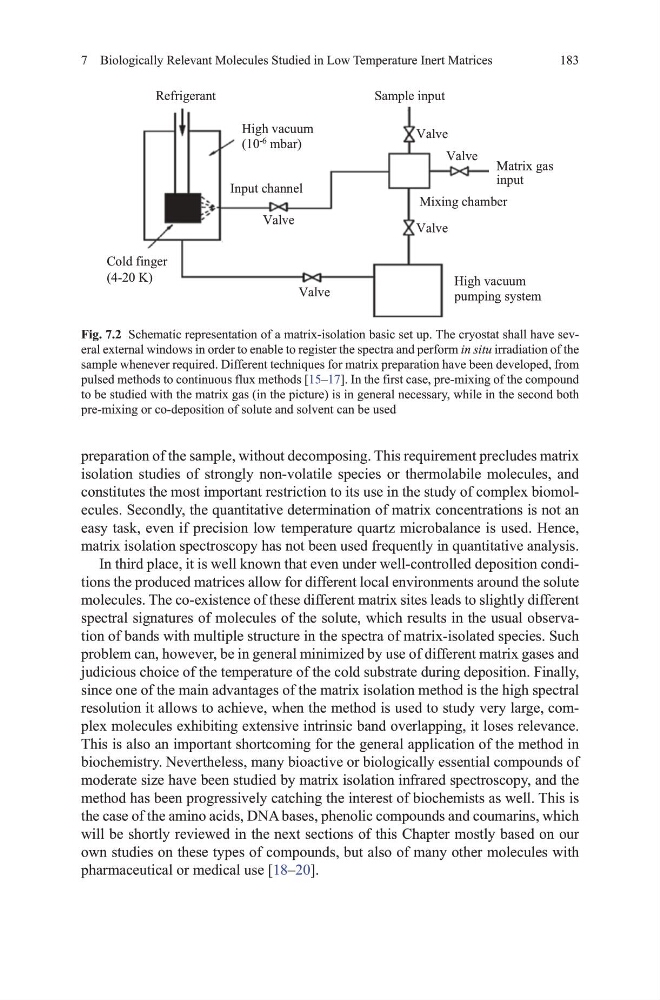
Fig. 7.2 Schematic representation of a matrix-isolation basic set up. the cryostat shall have several external windows in order to enable to register the spectra and perform in situ irradiation of the
sample whenever required. different techniques for matrix preparation have been developed, from
pulsed methods to continuous flux methods [15–17]. In the first case, pre-mixing of the compound
to be studied with the matrix gas (in the picture) is in general necessary, while in the second both
pre-mixing or co-deposition of solute and solvent can be used
183
preparation of the sample, without decomposing. this requirement precludes matrix
isolation studies of strongly non-volatile species or thermolabile molecules, and
constitutes the most important restriction to its use in the study of complex biomolecules. Secondly, the quantitative determination of matrix concentrations is not an
easy task, even if precision low temperature quartz microbalance is used. hence,
matrix isolation spectroscopy has not been used frequently in quantitative analysis.
In third place, it is well known that even under well-controlled deposition conditions the produced matrices allow for different local environments around the solute
molecules. the co-existence of these different matrix sites leads to slightly different
spectral signatures of molecules of the solute, which results in the usual observation of bands with multiple structure in the spectra of matrix-isolated species. Such
problem can, however, be in general minimized by use of different matrix gases and
judicious choice of the temperature of the cold substrate during deposition. Finally,
since one of the main advantages of the matrix isolation method is the high spectral
resolution it allows to achieve, when the method is used to study very large, complex molecules exhibiting extensive intrinsic band overlapping, it loses relevance.
this is also an important shortcoming for the general application of the method in
biochemistry. Nevertheless, many bioactive or biologically essential compounds of
moderate size have been studied by matrix isolation infrared spectroscopy, and the
method has been progressively catching the interest of biochemists as well. this is
the case of the amino acids, dNA bases, phenolic compounds and coumarins, which
will be shortly reviewed in the next sections of this Chapter mostly based on our
own studies on these types of compounds, but also of many other molecules with
pharmaceutical or medical use [18–20].
Refrigerant
Sample input
High vacuum
(10
-6 mbar)
Cold finger
(4-20 K)
Valve
Valve
Valve
Valve
Valve
Mixing chamber
High vacuum
pumping system
Input channel
Matrix gas
input
Fig. 7.2 Schematic representation of a matrix-isolation basic set up. the cryostat shall have several external windows in order to enable to register the spectra and perform in situ irradiation of the
sample whenever required. different techniques for matrix preparation have been developed, from
pulsed methods to continuous flux methods [15–17]. In the first case, pre-mixing of the compound
to be studied with the matrix gas (in the picture) is in general necessary, while in the second both
pre-mixing or co-deposition of solute and solvent can be used