

182
R. Fausto and N. Kuş
reaction intermediates or novel reactive species that can be produced in situ (for
instance, by photolysis of a suitable precursor) or in the vapor phase during deposition, (ii) to study molecular species that easily aggregate, isomerize or decompose
under other experimental conditions and (iii) to freeze out and study particular molecular conformations or isomeric structures.
Among the main advantages of the method, we can highlight the following,
which are consequences of the low working temperature, usually chosen low concentration, rigidity of the matrix and chemical inertness of environment: (a) solute-solute interactions are practically absent in diluted matrices, and can be easily
controlled by varying the matrix concentration or annealing the matrix to a higher
temperature; (b) solute-solvent interactions can be most of times neglected for
many practical applications, since inert gases are generally used as matrix hosts.
In fact, one can control the importance of the solute-solvent interactions by proper
selection of the matrix host gas, or even use a reactive matrix gas ( e.g., oxygen), if
interested to take advantage of this; (c) molecular diffusion and rotation are inhibited (except in the case of very small molecules). Because of this, the vibrational
spectra are essentially pure vibrational spectra, enabling a direct and easy comparison with theoretically predicted spectroscopic data. In addition, if fragmentation
of a matrix-isolated species takes place, most of times the obtained fragments stay
in the matrix site where they were formed. then, no subsequent cross-reactions
involving species resulting from fragmentation of different reactant molecules can
occur, strongly reducing the number of possible products in comparison with gas
phase or solution studies; (d) hot vibrational transitions as well as subtractive combination tones are suppressed, since excited vibrational states are depopulated at the
low work temperatures typical of the matrix isolation experiments, introducing an
additional simplification in the spectra and contributing to their increased resolution.
In addition to the above-mentioned main advantages, standard matrix isolation
studies do not require expensive equipment (Fig. 7.2) and practically all specific
instrumentation for matrix preparation can be easily manufactured or transformed
locally, once a moderately well equipped machine shop exists in the research institution.
In spite of its great capabilities, matrix isolation IR spectroscopy does also
have some drawbacks. Firstly, the studied compound must be evaporated during
O
O
O
O
O
O
CO 2
+
hν
hν
hν
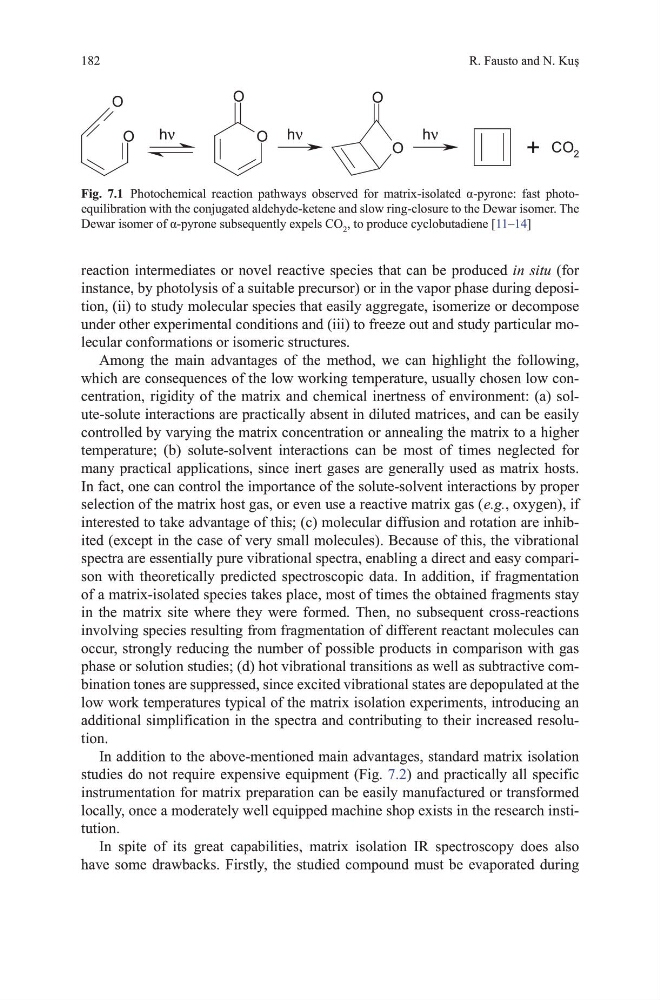
Fig. 7.1 Photochemical reaction pathways observed for matrix-isolated α-pyrone: fast photoequilibration with the conjugated aldehyde-ketene and slow ring-closure to the dewar isomer. the
Dewar isomer of α-pyrone subsequently expels CO 2 , to produce cyclobutadiene [11–14]
R. Fausto and N. Kuş
reaction intermediates or novel reactive species that can be produced in situ (for
instance, by photolysis of a suitable precursor) or in the vapor phase during deposition, (ii) to study molecular species that easily aggregate, isomerize or decompose
under other experimental conditions and (iii) to freeze out and study particular molecular conformations or isomeric structures.
Among the main advantages of the method, we can highlight the following,
which are consequences of the low working temperature, usually chosen low concentration, rigidity of the matrix and chemical inertness of environment: (a) solute-solute interactions are practically absent in diluted matrices, and can be easily
controlled by varying the matrix concentration or annealing the matrix to a higher
temperature; (b) solute-solvent interactions can be most of times neglected for
many practical applications, since inert gases are generally used as matrix hosts.
In fact, one can control the importance of the solute-solvent interactions by proper
selection of the matrix host gas, or even use a reactive matrix gas ( e.g., oxygen), if
interested to take advantage of this; (c) molecular diffusion and rotation are inhibited (except in the case of very small molecules). Because of this, the vibrational
spectra are essentially pure vibrational spectra, enabling a direct and easy comparison with theoretically predicted spectroscopic data. In addition, if fragmentation
of a matrix-isolated species takes place, most of times the obtained fragments stay
in the matrix site where they were formed. then, no subsequent cross-reactions
involving species resulting from fragmentation of different reactant molecules can
occur, strongly reducing the number of possible products in comparison with gas
phase or solution studies; (d) hot vibrational transitions as well as subtractive combination tones are suppressed, since excited vibrational states are depopulated at the
low work temperatures typical of the matrix isolation experiments, introducing an
additional simplification in the spectra and contributing to their increased resolution.
In addition to the above-mentioned main advantages, standard matrix isolation
studies do not require expensive equipment (Fig. 7.2) and practically all specific
instrumentation for matrix preparation can be easily manufactured or transformed
locally, once a moderately well equipped machine shop exists in the research institution.
In spite of its great capabilities, matrix isolation IR spectroscopy does also
have some drawbacks. Firstly, the studied compound must be evaporated during
O
O
O
O
O
O
CO 2
+
hν
hν
hν
Fig. 7.1 Photochemical reaction pathways observed for matrix-isolated α-pyrone: fast photoequilibration with the conjugated aldehyde-ketene and slow ring-closure to the dewar isomer. the
Dewar isomer of α-pyrone subsequently expels CO 2 , to produce cyclobutadiene [11–14]