

J. C. Dobrowolsk et al.
142
histamine (gastric acid secretion and smoothing muscle relaxation and inhibiting of neurotransmitter release) [A28]
Isoleucine
glucogenic and
ketogenic
In yeasts: amyl alcohol [A36]
Lleucine
Ketogenic
β-hydroxy-β-methylbutyrate (involved in cholesterol biosynthesis) [A37, A38]
In yeasts: isoamyl alcohol [A36]
Lysine
Ketogenic
Cadaverine (responsible for distinctive odors of urine and semen as well as of
corpse; in plants it is essential for the normal root development) [A40]
Saccharopine [A38]
Carnitine (transport of fatty acids from the cytosol into the mitochondria) [A41]
methionine
glucogenic
Cysteine, homocysteine [A4,
A5–A7]
S-Adenosylmethionine (methyl donor for tens of transmethylation reactions of
nucleic acids, proteins, lipids, and secondary metabolites) [A42]
Carnitine (transport of fatty acids
from the cytosol into the mitochondria) [A41]
Ethylene (the plant hormone) [A42]
Phenylalanine
glucogenic and
ketogenic
tyrosine [A14, A20]
Monolignols → lignin (confers structural support, vascular integrity, and pathogen resistance to plants) [A92, A93]
A variety of phenylpropanoid compounds generated at the phenylpropanoid
pathway were shown to play miscellaneous roles including increase of the
plant disease resistance [A43, A44, A45]
Phenylacetic acid (a plant hormone), [A46, A47]
Phenylethylamine (a neurotransmitter) [A46, A47]
2-phenylacetamide [A46, A47]
Phenylpyruvate [A46, A47]
various aromatic volatiles such as benzaldehyde, benzyl alcohol, phenylacetaldehyde, phenethyl alcohol, and ethyl phenylacetate acetate contributing to
plant aroma. [A46, A47]
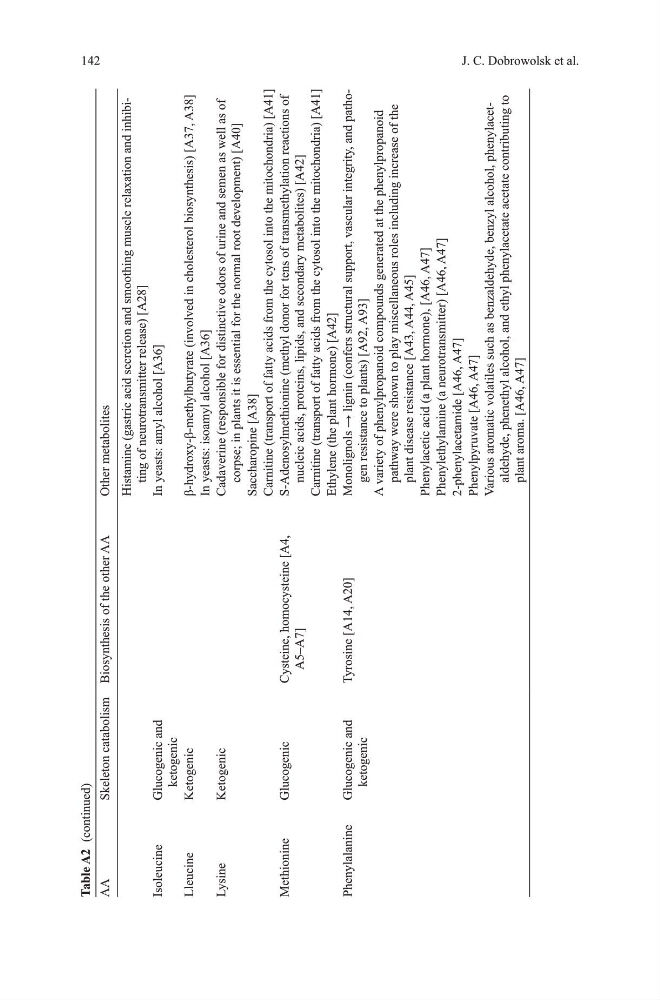
Table A2
(continued)
AA
Skeleton catabolism Biosynthesis of the other AA
other metabolites
142
histamine (gastric acid secretion and smoothing muscle relaxation and inhibiting of neurotransmitter release) [A28]
Isoleucine
glucogenic and
ketogenic
In yeasts: amyl alcohol [A36]
Lleucine
Ketogenic
β-hydroxy-β-methylbutyrate (involved in cholesterol biosynthesis) [A37, A38]
In yeasts: isoamyl alcohol [A36]
Lysine
Ketogenic
Cadaverine (responsible for distinctive odors of urine and semen as well as of
corpse; in plants it is essential for the normal root development) [A40]
Saccharopine [A38]
Carnitine (transport of fatty acids from the cytosol into the mitochondria) [A41]
methionine
glucogenic
Cysteine, homocysteine [A4,
A5–A7]
S-Adenosylmethionine (methyl donor for tens of transmethylation reactions of
nucleic acids, proteins, lipids, and secondary metabolites) [A42]
Carnitine (transport of fatty acids
from the cytosol into the mitochondria) [A41]
Ethylene (the plant hormone) [A42]
Phenylalanine
glucogenic and
ketogenic
tyrosine [A14, A20]
Monolignols → lignin (confers structural support, vascular integrity, and pathogen resistance to plants) [A92, A93]
A variety of phenylpropanoid compounds generated at the phenylpropanoid
pathway were shown to play miscellaneous roles including increase of the
plant disease resistance [A43, A44, A45]
Phenylacetic acid (a plant hormone), [A46, A47]
Phenylethylamine (a neurotransmitter) [A46, A47]
2-phenylacetamide [A46, A47]
Phenylpyruvate [A46, A47]
various aromatic volatiles such as benzaldehyde, benzyl alcohol, phenylacetaldehyde, phenethyl alcohol, and ethyl phenylacetate acetate contributing to
plant aroma. [A46, A47]
Table A2
(continued)
AA
Skeleton catabolism Biosynthesis of the other AA
other metabolites