

J. C. Dobrowolsk et al.
122
B3LYP/PCm/aug-cc-pvdZ method without explicit water molecules was applied.
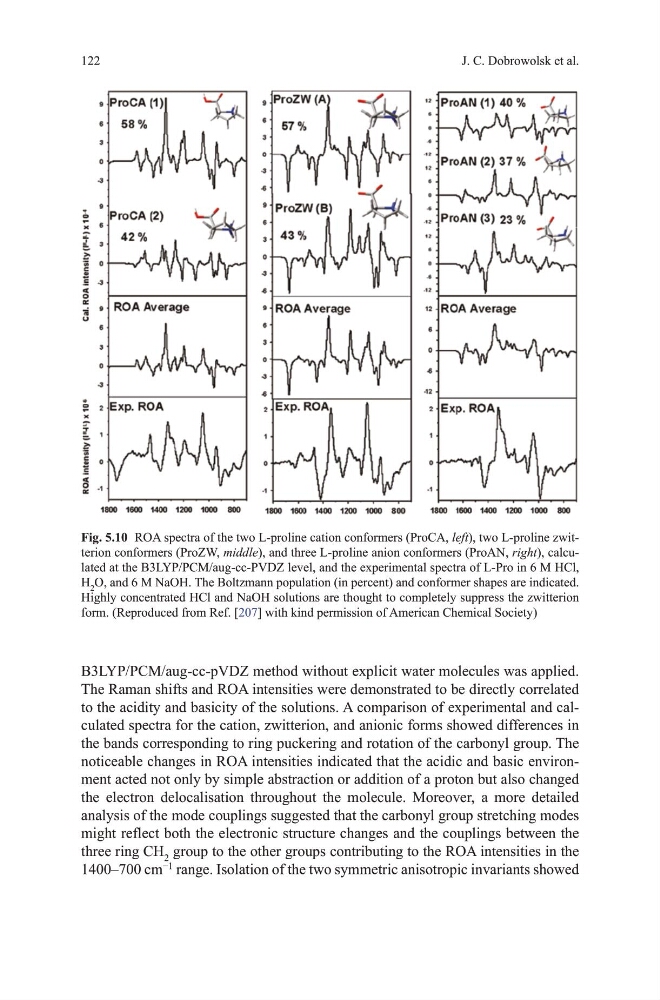
the Raman shifts and RoA intensities were demonstrated to be directly correlated
to the acidity and basicity of the solutions. A comparison of experimental and calculated spectra for the cation, zwitterion, and anionic forms showed differences in
the bands corresponding to ring puckering and rotation of the carbonyl group. the
noticeable changes in RoA intensities indicated that the acidic and basic environment acted not only by simple abstraction or addition of a proton but also changed
the electron delocalisation throughout the molecule. moreover, a more detailed
analysis of the mode couplings suggested that the carbonyl group stretching modes
might reflect both the electronic structure changes and the couplings between the
three ring Ch 2 group to the other groups contributing to the RoA intensities in the
1400–700 cm
−1
range. Isolation of the two symmetric anisotropic invariants showed
Fig. 5.10 RoA spectra of the two L-proline cation conformers (ProCA, left), two L-proline zwitterion conformers (ProZW, middle), and three L-proline anion conformers (ProAN, right), calculated at the B3LYP/PCm/aug-cc-PvdZ level, and the experimental spectra of L-Pro in 6 m hCl,
h 2 o, and 6 m Naoh. the Boltzmann population (in percent) and conformer shapes are indicated.
highly concentrated hCl and Naoh solutions are thought to completely suppress the zwitterion
form. (Reproduced from Ref. [207] with kind permission of American Chemical Society)
122
B3LYP/PCm/aug-cc-pvdZ method without explicit water molecules was applied.
the Raman shifts and RoA intensities were demonstrated to be directly correlated
to the acidity and basicity of the solutions. A comparison of experimental and calculated spectra for the cation, zwitterion, and anionic forms showed differences in
the bands corresponding to ring puckering and rotation of the carbonyl group. the
noticeable changes in RoA intensities indicated that the acidic and basic environment acted not only by simple abstraction or addition of a proton but also changed
the electron delocalisation throughout the molecule. moreover, a more detailed
analysis of the mode couplings suggested that the carbonyl group stretching modes
might reflect both the electronic structure changes and the couplings between the
three ring Ch 2 group to the other groups contributing to the RoA intensities in the
1400–700 cm
−1
range. Isolation of the two symmetric anisotropic invariants showed
Fig. 5.10 RoA spectra of the two L-proline cation conformers (ProCA, left), two L-proline zwitterion conformers (ProZW, middle), and three L-proline anion conformers (ProAN, right), calculated at the B3LYP/PCm/aug-cc-PvdZ level, and the experimental spectra of L-Pro in 6 m hCl,
h 2 o, and 6 m Naoh. the Boltzmann population (in percent) and conformer shapes are indicated.
highly concentrated hCl and Naoh solutions are thought to completely suppress the zwitterion
form. (Reproduced from Ref. [207] with kind permission of American Chemical Society)