

J. C. Dobrowolsk et al.
118
vibrational states and coupling to the motion of the polar groups strongly interacting
with the environment [199].
In the most recent paper by Kaminský et al. [138], the methodology of inclusion
of multiconformational equilibria in the RoA calculations of the alanine zwitterion
was improved (Fig. 5.6b). An additional spectral overlap gradient term was added
to the molecular energy during the molecular dynamics run. An alternative algorithm based on the comparison of the averaged spectra with the reference, enabling
iterative updates of the conformer probabilities, provided realistic RoA spectra and
conformer alanine distributions in a shorter period of time.
very recently, Fang et al. demonstrated an algorithm deriving the bond polarisabilities from Raman intensities and differential bond polarisabilities from RoA
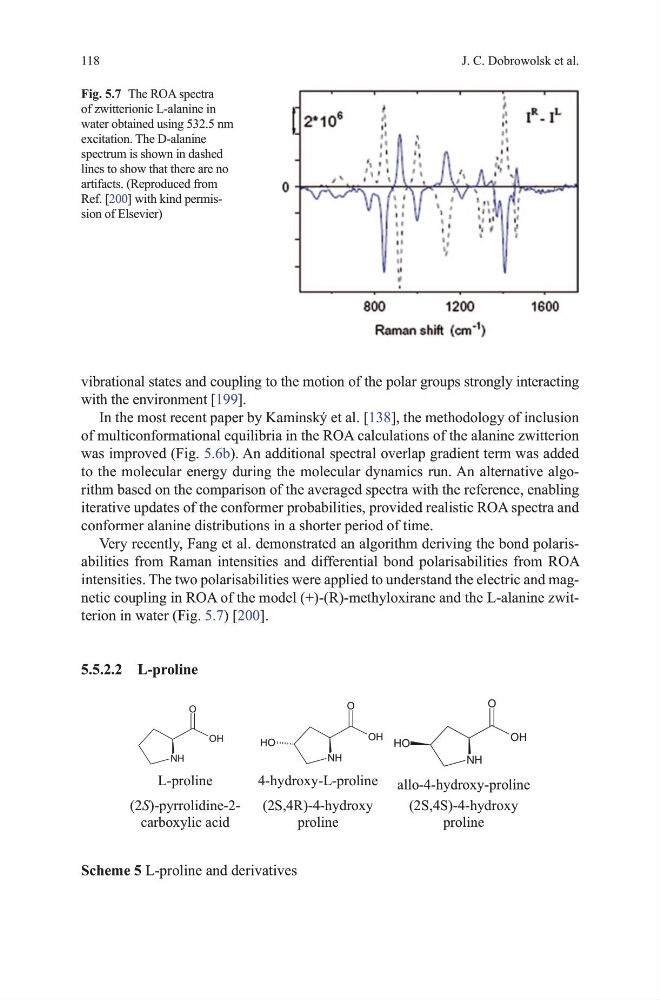
intensities. the two polarisabilities were applied to understand the electric and magnetic coupling in RoA of the model (+)-(R)-methyloxirane and the L-alanine zwitterion in water (Fig. 5.7) [200].
5.5.2.2 L-proline
O
OH
NH
O
OH
NH
O
H
O
OH
NH
O
H
L-proline
4-hydroxy-L-proline allo-4-hydroxy-proline
(2S)-pyrrolidine-2carboxylic acid
(2S,4R)-4-hydroxy
proline
(2S,4S)-4-hydroxy
proline
Scheme 5 L-proline and derivatives
Fig. 5.7 the RoA spectra
of zwitterionic L-alanine in
water obtained using 532.5 nm
excitation. the d-alanine
spectrum is shown in dashed
lines to show that there are no
artifacts. (Reproduced from
Ref. [200] with kind permission of Elsevier)
118
vibrational states and coupling to the motion of the polar groups strongly interacting
with the environment [199].
In the most recent paper by Kaminský et al. [138], the methodology of inclusion
of multiconformational equilibria in the RoA calculations of the alanine zwitterion
was improved (Fig. 5.6b). An additional spectral overlap gradient term was added
to the molecular energy during the molecular dynamics run. An alternative algorithm based on the comparison of the averaged spectra with the reference, enabling
iterative updates of the conformer probabilities, provided realistic RoA spectra and
conformer alanine distributions in a shorter period of time.
very recently, Fang et al. demonstrated an algorithm deriving the bond polarisabilities from Raman intensities and differential bond polarisabilities from RoA
intensities. the two polarisabilities were applied to understand the electric and magnetic coupling in RoA of the model (+)-(R)-methyloxirane and the L-alanine zwitterion in water (Fig. 5.7) [200].
5.5.2.2 L-proline
O
OH
NH
O
OH
NH
O
H
O
OH
NH
O
H
L-proline
4-hydroxy-L-proline allo-4-hydroxy-proline
(2S)-pyrrolidine-2carboxylic acid
(2S,4R)-4-hydroxy
proline
(2S,4S)-4-hydroxy
proline
Scheme 5 L-proline and derivatives
Fig. 5.7 the RoA spectra
of zwitterionic L-alanine in
water obtained using 532.5 nm
excitation. the d-alanine
spectrum is shown in dashed
lines to show that there are no
artifacts. (Reproduced from
Ref. [200] with kind permission of Elsevier)