

no sign of thermionic emission is observed here may be a consequence of our
instrument configuration, where the keV ions will pass through the focus of the
electron spectrometer on the sub μs timescale, and delayed emission of electrons
will hence not be registered (at least, not giving a meaningful radial distribution on
the detector).
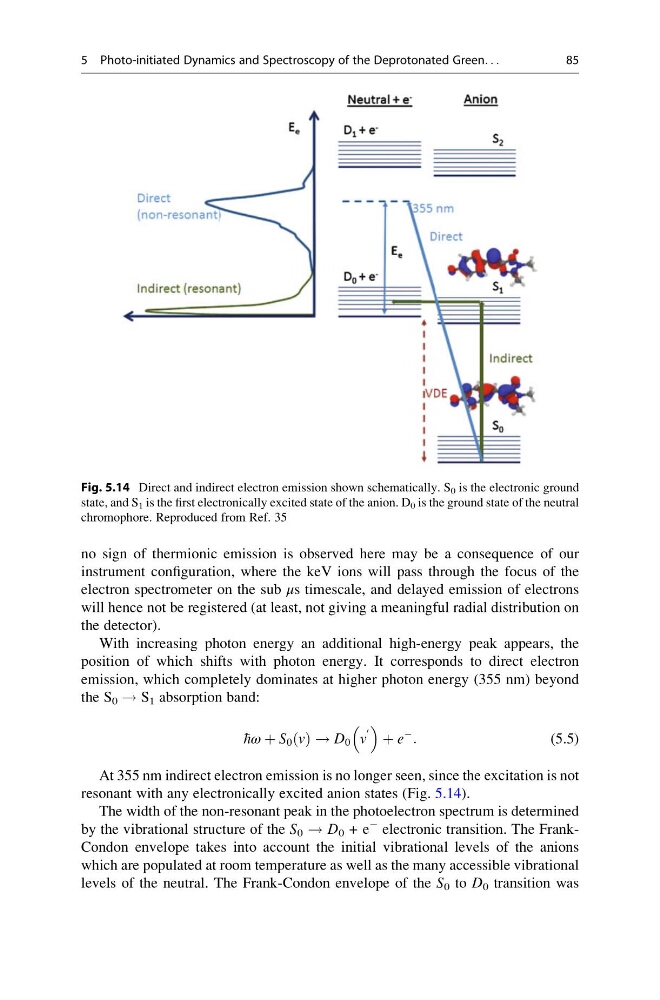
With increasing photon energy an additional high-energy peak appears, the
position of which shifts with photon energy. It corresponds to direct electron
emission, which completely dominates at higher photon energy (355 nm) beyond
the S 0 ! S 1 absorption band:
hω þ S 0 v
ð Þ ! D 0 v
0
þ e
À
:
(5.5)
At 355 nm indirect electron emission is no longer seen, since the excitation is not
resonant with any electronically excited anion states (Fig. 5.14).
The width of the non-resonant peak in the photoelectron spectrum is determined
by the vibrational structure of the S 0 ! D 0 + e
À electronic transition. The FrankCondon envelope takes into account the initial vibrational levels of the anions
which are populated at room temperature as well as the many accessible vibrational
levels of the neutral. The Frank-Condon envelope of the S 0 to D 0 transition was
Fig. 5.14 Direct and indirect electron emission shown schematically. S 0 is the electronic ground
state, and S 1 is the first electronically excited state of the anion. D 0 is the ground state of the neutral
chromophore. Reproduced from Ref. 35
5 Photo-initiated Dynamics and Spectroscopy of the Deprotonated Green. . .
85
instrument configuration, where the keV ions will pass through the focus of the
electron spectrometer on the sub μs timescale, and delayed emission of electrons
will hence not be registered (at least, not giving a meaningful radial distribution on
the detector).
With increasing photon energy an additional high-energy peak appears, the
position of which shifts with photon energy. It corresponds to direct electron
emission, which completely dominates at higher photon energy (355 nm) beyond
the S 0 ! S 1 absorption band:
hω þ S 0 v
ð Þ ! D 0 v
0
þ e
À
:
(5.5)
At 355 nm indirect electron emission is no longer seen, since the excitation is not
resonant with any electronically excited anion states (Fig. 5.14).
The width of the non-resonant peak in the photoelectron spectrum is determined
by the vibrational structure of the S 0 ! D 0 + e
À electronic transition. The FrankCondon envelope takes into account the initial vibrational levels of the anions
which are populated at room temperature as well as the many accessible vibrational
levels of the neutral. The Frank-Condon envelope of the S 0 to D 0 transition was
Fig. 5.14 Direct and indirect electron emission shown schematically. S 0 is the electronic ground
state, and S 1 is the first electronically excited state of the anion. D 0 is the ground state of the neutral
chromophore. Reproduced from Ref. 35
5 Photo-initiated Dynamics and Spectroscopy of the Deprotonated Green. . .
85