

desirable that do not require MO theory, which leads to approaches generally
referred to as polarisation models or polarisable force fields.
Two types of polarisation models are used in MM force fields. The first is based
on chemical potential equilibration (CPE), sometimes called fluctuating charge
models. These introduce atomic parameters for electronegativity χ and chemical
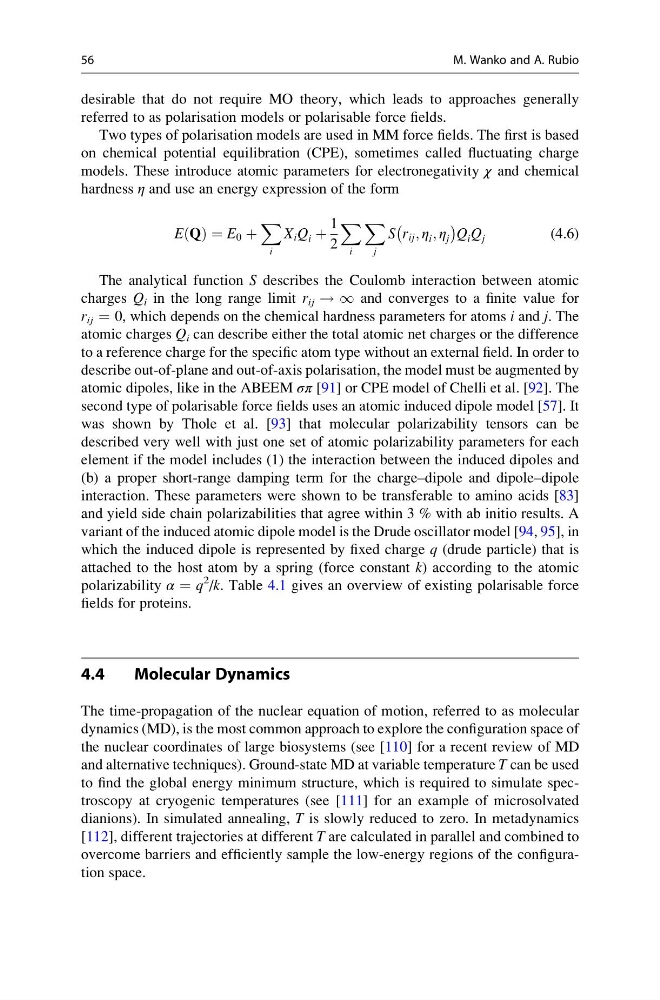
hardness η and use an energy expression of the form
E Q
ð Þ ¼ E 0 þ
X
i
X i Q i þ
1
2
X
i
X
j
S r ij ; η i ; η j
À
Á
Q i Q j
(4.6)
The analytical function S describes the Coulomb interaction between atomic
charges Q i in the long range limit r ij ! 1 and converges to a finite value for
r ij ¼ 0, which depends on the chemical hardness parameters for atoms i and j. The
atomic charges Q i can describe either the total atomic net charges or the difference
to a reference charge for the specific atom type without an external field. In order to
describe out-of-plane and out-of-axis polarisation, the model must be augmented by
atomic dipoles, like in the ABEEM σπ [91] or CPE model of Chelli et al. [92]. The
second type of polarisable force fields uses an atomic induced dipole model [57]. It
was shown by Thole et al. [93] that molecular polarizability tensors can be
described very well with just one set of atomic polarizability parameters for each
element if the model includes (1) the interaction between the induced dipoles and
(b) a proper short-range damping term for the charge–dipole and dipole–dipole
interaction. These parameters were shown to be transferable to amino acids [83]
and yield side chain polarizabilities that agree within 3 % with ab initio results. A
variant of the induced atomic dipole model is the Drude oscillator model [94, 95], in
which the induced dipole is represented by fixed charge q (drude particle) that is
attached to the host atom by a spring (force constant k) according to the atomic
polarizability α ¼ q
2 /k. Table 4.1 gives an overview of existing polarisable force
fields for proteins.
4.4
Molecular Dynamics
The time-propagation of the nuclear equation of motion, referred to as molecular
dynamics (MD), is the most common approach to explore the configuration space of
the nuclear coordinates of large biosystems (see [110] for a recent review of MD
and alternative techniques). Ground-state MD at variable temperature T can be used
to find the global energy minimum structure, which is required to simulate spectroscopy at cryogenic temperatures (see [111] for an example of microsolvated
dianions). In simulated annealing, T is slowly reduced to zero. In metadynamics
[112], different trajectories at different T are calculated in parallel and combined to
overcome barriers and efficiently sample the low-energy regions of the configuration space.
56
M. Wanko and A. Rubio
referred to as polarisation models or polarisable force fields.
Two types of polarisation models are used in MM force fields. The first is based
on chemical potential equilibration (CPE), sometimes called fluctuating charge
models. These introduce atomic parameters for electronegativity χ and chemical
hardness η and use an energy expression of the form
E Q
ð Þ ¼ E 0 þ
X
i
X i Q i þ
1
2
X
i
X
j
S r ij ; η i ; η j
À
Á
Q i Q j
(4.6)
The analytical function S describes the Coulomb interaction between atomic
charges Q i in the long range limit r ij ! 1 and converges to a finite value for
r ij ¼ 0, which depends on the chemical hardness parameters for atoms i and j. The
atomic charges Q i can describe either the total atomic net charges or the difference
to a reference charge for the specific atom type without an external field. In order to
describe out-of-plane and out-of-axis polarisation, the model must be augmented by
atomic dipoles, like in the ABEEM σπ [91] or CPE model of Chelli et al. [92]. The
second type of polarisable force fields uses an atomic induced dipole model [57]. It
was shown by Thole et al. [93] that molecular polarizability tensors can be
described very well with just one set of atomic polarizability parameters for each
element if the model includes (1) the interaction between the induced dipoles and
(b) a proper short-range damping term for the charge–dipole and dipole–dipole
interaction. These parameters were shown to be transferable to amino acids [83]
and yield side chain polarizabilities that agree within 3 % with ab initio results. A
variant of the induced atomic dipole model is the Drude oscillator model [94, 95], in
which the induced dipole is represented by fixed charge q (drude particle) that is
attached to the host atom by a spring (force constant k) according to the atomic
polarizability α ¼ q
2 /k. Table 4.1 gives an overview of existing polarisable force
fields for proteins.
4.4
Molecular Dynamics
The time-propagation of the nuclear equation of motion, referred to as molecular
dynamics (MD), is the most common approach to explore the configuration space of
the nuclear coordinates of large biosystems (see [110] for a recent review of MD
and alternative techniques). Ground-state MD at variable temperature T can be used
to find the global energy minimum structure, which is required to simulate spectroscopy at cryogenic temperatures (see [111] for an example of microsolvated
dianions). In simulated annealing, T is slowly reduced to zero. In metadynamics
[112], different trajectories at different T are calculated in parallel and combined to
overcome barriers and efficiently sample the low-energy regions of the configuration space.
56
M. Wanko and A. Rubio