

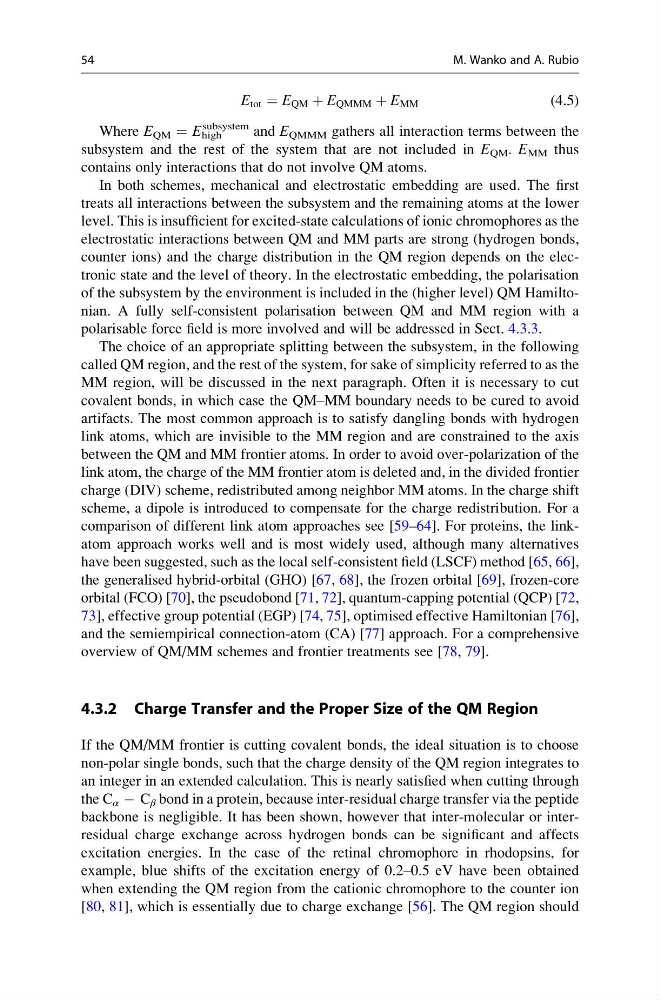
E tot ¼ E QM þ E QMMM þ E MM
(4.5)
Where E QM ¼ E high
subsystem and E QMMM gathers all interaction terms between the
subsystem and the rest of the system that are not included in E QM . E MM thus
contains only interactions that do not involve QM atoms.
In both schemes, mechanical and electrostatic embedding are used. The first
treats all interactions between the subsystem and the remaining atoms at the lower
level. This is insufficient for excited-state calculations of ionic chromophores as the
electrostatic interactions between QM and MM parts are strong (hydrogen bonds,
counter ions) and the charge distribution in the QM region depends on the electronic state and the level of theory. In the electrostatic embedding, the polarisation
of the subsystem by the environment is included in the (higher level) QM Hamiltonian. A fully self-consistent polarisation between QM and MM region with a
polarisable force field is more involved and will be addressed in Sect. 4.3.3.
The choice of an appropriate splitting between the subsystem, in the following
called QM region, and the rest of the system, for sake of simplicity referred to as the
MM region, will be discussed in the next paragraph. Often it is necessary to cut
covalent bonds, in which case the QM–MM boundary needs to be cured to avoid
artifacts. The most common approach is to satisfy dangling bonds with hydrogen
link atoms, which are invisible to the MM region and are constrained to the axis
between the QM and MM frontier atoms. In order to avoid over-polarization of the
link atom, the charge of the MM frontier atom is deleted and, in the divided frontier
charge (DIV) scheme, redistributed among neighbor MM atoms. In the charge shift
scheme, a dipole is introduced to compensate for the charge redistribution. For a
comparison of different link atom approaches see [59–64]. For proteins, the linkatom approach works well and is most widely used, although many alternatives
have been suggested, such as the local self-consistent field (LSCF) method [65, 66],
the generalised hybrid-orbital (GHO) [67, 68], the frozen orbital [69], frozen-core
orbital (FCO) [70], the pseudobond [71, 72], quantum-capping potential (QCP) [72,
73], effective group potential (EGP) [74, 75], optimised effective Hamiltonian [76],
and the semiempirical connection-atom (CA) [77] approach. For a comprehensive
overview of QM/MM schemes and frontier treatments see [78, 79].
4.3.2 Charge Transfer and the Proper Size of the QM Region
If the QM/MM frontier is cutting covalent bonds, the ideal situation is to choose
non-polar single bonds, such that the charge density of the QM region integrates to
an integer in an extended calculation. This is nearly satisfied when cutting through
the C α À C β bond in a protein, because inter-residual charge transfer via the peptide
backbone is negligible. It has been shown, however that inter-molecular or interresidual charge exchange across hydrogen bonds can be significant and affects
excitation energies. In the case of the retinal chromophore in rhodopsins, for
example, blue shifts of the excitation energy of 0.2–0.5 eV have been obtained
when extending the QM region from the cationic chromophore to the counter ion
[80, 81], which is essentially due to charge exchange [56]. The QM region should
54
M. Wanko and A. Rubio
(4.5)
Where E QM ¼ E high
subsystem and E QMMM gathers all interaction terms between the
subsystem and the rest of the system that are not included in E QM . E MM thus
contains only interactions that do not involve QM atoms.
In both schemes, mechanical and electrostatic embedding are used. The first
treats all interactions between the subsystem and the remaining atoms at the lower
level. This is insufficient for excited-state calculations of ionic chromophores as the
electrostatic interactions between QM and MM parts are strong (hydrogen bonds,
counter ions) and the charge distribution in the QM region depends on the electronic state and the level of theory. In the electrostatic embedding, the polarisation
of the subsystem by the environment is included in the (higher level) QM Hamiltonian. A fully self-consistent polarisation between QM and MM region with a
polarisable force field is more involved and will be addressed in Sect. 4.3.3.
The choice of an appropriate splitting between the subsystem, in the following
called QM region, and the rest of the system, for sake of simplicity referred to as the
MM region, will be discussed in the next paragraph. Often it is necessary to cut
covalent bonds, in which case the QM–MM boundary needs to be cured to avoid
artifacts. The most common approach is to satisfy dangling bonds with hydrogen
link atoms, which are invisible to the MM region and are constrained to the axis
between the QM and MM frontier atoms. In order to avoid over-polarization of the
link atom, the charge of the MM frontier atom is deleted and, in the divided frontier
charge (DIV) scheme, redistributed among neighbor MM atoms. In the charge shift
scheme, a dipole is introduced to compensate for the charge redistribution. For a
comparison of different link atom approaches see [59–64]. For proteins, the linkatom approach works well and is most widely used, although many alternatives
have been suggested, such as the local self-consistent field (LSCF) method [65, 66],
the generalised hybrid-orbital (GHO) [67, 68], the frozen orbital [69], frozen-core
orbital (FCO) [70], the pseudobond [71, 72], quantum-capping potential (QCP) [72,
73], effective group potential (EGP) [74, 75], optimised effective Hamiltonian [76],
and the semiempirical connection-atom (CA) [77] approach. For a comprehensive
overview of QM/MM schemes and frontier treatments see [78, 79].
4.3.2 Charge Transfer and the Proper Size of the QM Region
If the QM/MM frontier is cutting covalent bonds, the ideal situation is to choose
non-polar single bonds, such that the charge density of the QM region integrates to
an integer in an extended calculation. This is nearly satisfied when cutting through
the C α À C β bond in a protein, because inter-residual charge transfer via the peptide
backbone is negligible. It has been shown, however that inter-molecular or interresidual charge exchange across hydrogen bonds can be significant and affects
excitation energies. In the case of the retinal chromophore in rhodopsins, for
example, blue shifts of the excitation energy of 0.2–0.5 eV have been obtained
when extending the QM region from the cationic chromophore to the counter ion
[80, 81], which is essentially due to charge exchange [56]. The QM region should
54
M. Wanko and A. Rubio