

3.2
Fluorescence Measurements
In the previous section, apparatus used to obtain action spectra were discussed, and
it was mentioned that these action spectra are often taken to be equivalent to
absorption spectra. However, as fluorescence is a possible relaxation pathway for
some excited molecules, and its quantum yield may be wavelength dependent,
fluorescent measurements are necessary to acquire a true absorption spectrum.
Fluorescence experiments are superior to action spectroscopy ones as only one
photon need be absorbed, and there are no kinetic shifts to be concerned about as
dissociation is not sampled. However, a true measurement should detect all emitted
photons, and in reality only a limited emission angle is sampled due to physical
constraints. Furthermore, extremely sensitive photon detectors are required due to
the low number of emitting ions, and scattered light and ambient light consequently
become a problem. Different experimental apparatus used for fluorescence
measurements are discussed in the following.
3.2.1 Fluorescence Measurements in a Quadrupole Ion Trap
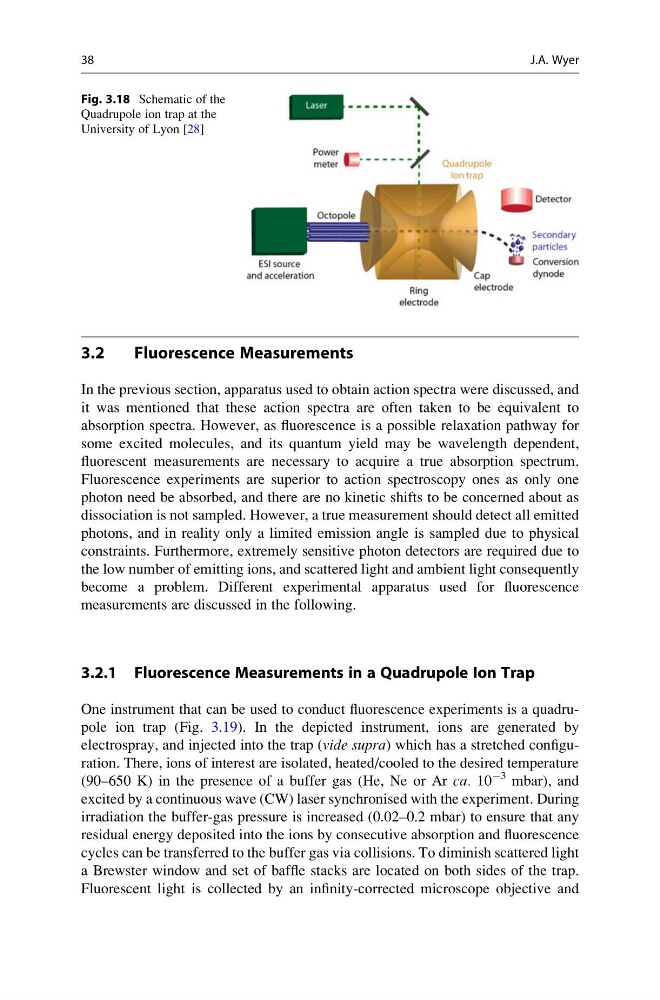
One instrument that can be used to conduct fluorescence experiments is a quadrupole ion trap (Fig. 3.19). In the depicted instrument, ions are generated by
electrospray, and injected into the trap (vide supra) which has a stretched configuration. There, ions of interest are isolated, heated/cooled to the desired temperature
(90–650 K) in the presence of a buffer gas (He, Ne or Ar ca. 10
À3 mbar), and
excited by a continuous wave (CW) laser synchronised with the experiment. During
irradiation the buffer-gas pressure is increased (0.02–0.2 mbar) to ensure that any
residual energy deposited into the ions by consecutive absorption and fluorescence
cycles can be transferred to the buffer gas via collisions. To diminish scattered light
a Brewster window and set of baffle stacks are located on both sides of the trap.
Fluorescent light is collected by an infinity-corrected microscope objective and
Fig. 3.18 Schematic of the
Quadrupole ion trap at the
University of Lyon [28]
38
J.A. Wyer
Fluorescence Measurements
In the previous section, apparatus used to obtain action spectra were discussed, and
it was mentioned that these action spectra are often taken to be equivalent to
absorption spectra. However, as fluorescence is a possible relaxation pathway for
some excited molecules, and its quantum yield may be wavelength dependent,
fluorescent measurements are necessary to acquire a true absorption spectrum.
Fluorescence experiments are superior to action spectroscopy ones as only one
photon need be absorbed, and there are no kinetic shifts to be concerned about as
dissociation is not sampled. However, a true measurement should detect all emitted
photons, and in reality only a limited emission angle is sampled due to physical
constraints. Furthermore, extremely sensitive photon detectors are required due to
the low number of emitting ions, and scattered light and ambient light consequently
become a problem. Different experimental apparatus used for fluorescence
measurements are discussed in the following.
3.2.1 Fluorescence Measurements in a Quadrupole Ion Trap
One instrument that can be used to conduct fluorescence experiments is a quadrupole ion trap (Fig. 3.19). In the depicted instrument, ions are generated by
electrospray, and injected into the trap (vide supra) which has a stretched configuration. There, ions of interest are isolated, heated/cooled to the desired temperature
(90–650 K) in the presence of a buffer gas (He, Ne or Ar ca. 10
À3 mbar), and
excited by a continuous wave (CW) laser synchronised with the experiment. During
irradiation the buffer-gas pressure is increased (0.02–0.2 mbar) to ensure that any
residual energy deposited into the ions by consecutive absorption and fluorescence
cycles can be transferred to the buffer gas via collisions. To diminish scattered light
a Brewster window and set of baffle stacks are located on both sides of the trap.
Fluorescent light is collected by an infinity-corrected microscope objective and
Fig. 3.18 Schematic of the
Quadrupole ion trap at the
University of Lyon [28]
38
J.A. Wyer