

Daughter ion mass spectrometry is an alternative method for detecting dissociation and can be relevant in cases where dissociation is fast or where statistical
dissociation versus non-statistical is to be compared. Daughter ions can be
measured by changing, at a particular time, the voltages on the electrostatic
elements so that the parent ions are no longer stored but instead ions with a different
kinetic energy (proportional to their mass-to-charge ratio) are. Then after some time
the 10
deflector (parallel plates 2) can be switched off, and if any ions with this
mass-to-charge ratio were produced, a signal will be detected (Fig. 3.13). By
repeating this process for different potential daughter ions a mass spectrum can
be obtained (Figs. 3.10c and 3.14).
Daughter ion mass spectrometry is possible as ELISA has been equipped with
pulsed power supplies with microsecond response times [17–19]. A disadvantage
with using a storage ring to perform mass spectrometry is that as the ring is designed
to maximise the storage of ions, even ions with imperfect trajectories are stored.
Furthermore, in contrast to other instruments where ions are differentiated based on
their mass-to-charge ratio and not kinetic energies or velocities, e.g. an FT-ICR
(vide infra), ions are stored based on their kinetic energies. Thus, the resolution of
daughter ion mass spectra is poor (~100). However, in most cases this resolution is
enough to determine the dissociation channels and their time dependence. If the
electrostatic elements are switched concurrently with photoexcitation, prompt dissociation can be measured. With the detection of ionic fragments produced at short
times, it is possible to measure absorption which cannot be measured from the
production of neutrals due to short dissociation timescales (Fig. 3.10c). It should be
noted, however, that the resulting mass spectrum will be inaccurate if a daughter ion
is unstable and dissociates prior to when the bunch is dumped on the detector. The
elements can be switched at later times to investigate if and how the dissociation
channels vary over time (Fig. 3.14c).
In other experiments, the excitation of ions by electron capture from an alkali
metal, e.g., Na is facilitated in a collision cell prior to the ring. The decay of
dianions or charge-reduced cations in the ring can then be followed in time.
τ* = 100 μs
τ = 1 sec
τ = 1 sec
Laser irradiation
100 μs
Decay rate
Time
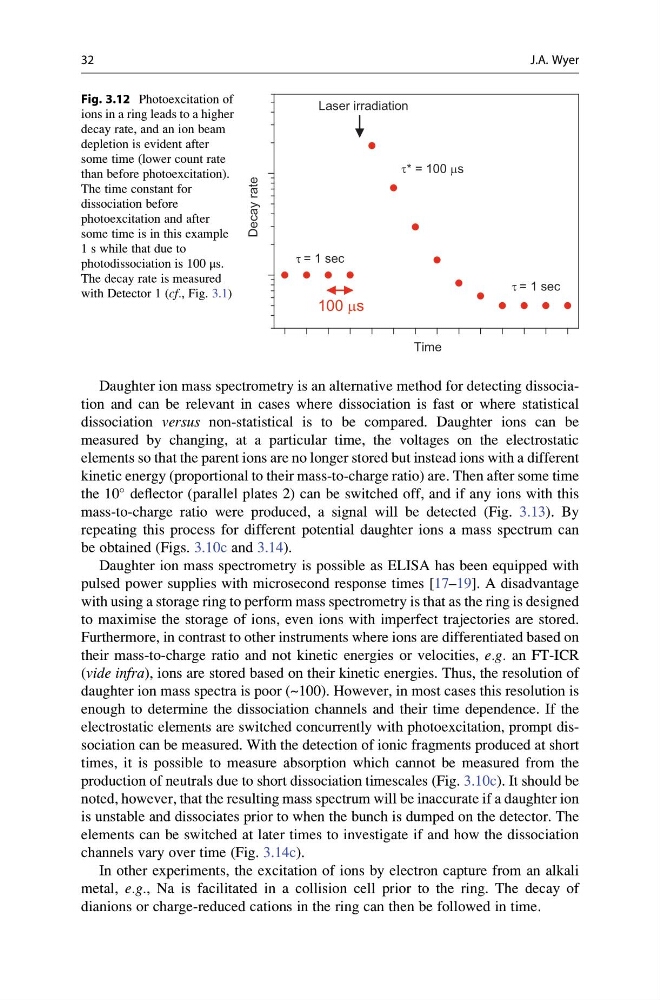
Fig. 3.12 Photoexcitation of
ions in a ring leads to a higher
decay rate, and an ion beam
depletion is evident after
some time (lower count rate
than before photoexcitation).
The time constant for
dissociation before
photoexcitation and after
some time is in this example
1 s while that due to
photodissociation is 100 μs.
The decay rate is measured
with Detector 1 (cf., Fig. 3.1)
32
J.A. Wyer
dissociation versus non-statistical is to be compared. Daughter ions can be
measured by changing, at a particular time, the voltages on the electrostatic
elements so that the parent ions are no longer stored but instead ions with a different
kinetic energy (proportional to their mass-to-charge ratio) are. Then after some time
the 10
deflector (parallel plates 2) can be switched off, and if any ions with this
mass-to-charge ratio were produced, a signal will be detected (Fig. 3.13). By
repeating this process for different potential daughter ions a mass spectrum can
be obtained (Figs. 3.10c and 3.14).
Daughter ion mass spectrometry is possible as ELISA has been equipped with
pulsed power supplies with microsecond response times [17–19]. A disadvantage
with using a storage ring to perform mass spectrometry is that as the ring is designed
to maximise the storage of ions, even ions with imperfect trajectories are stored.
Furthermore, in contrast to other instruments where ions are differentiated based on
their mass-to-charge ratio and not kinetic energies or velocities, e.g. an FT-ICR
(vide infra), ions are stored based on their kinetic energies. Thus, the resolution of
daughter ion mass spectra is poor (~100). However, in most cases this resolution is
enough to determine the dissociation channels and their time dependence. If the
electrostatic elements are switched concurrently with photoexcitation, prompt dissociation can be measured. With the detection of ionic fragments produced at short
times, it is possible to measure absorption which cannot be measured from the
production of neutrals due to short dissociation timescales (Fig. 3.10c). It should be
noted, however, that the resulting mass spectrum will be inaccurate if a daughter ion
is unstable and dissociates prior to when the bunch is dumped on the detector. The
elements can be switched at later times to investigate if and how the dissociation
channels vary over time (Fig. 3.14c).
In other experiments, the excitation of ions by electron capture from an alkali
metal, e.g., Na is facilitated in a collision cell prior to the ring. The decay of
dianions or charge-reduced cations in the ring can then be followed in time.
τ* = 100 μs
τ = 1 sec
τ = 1 sec
Laser irradiation
100 μs
Decay rate
Time
Fig. 3.12 Photoexcitation of
ions in a ring leads to a higher
decay rate, and an ion beam
depletion is evident after
some time (lower count rate
than before photoexcitation).
The time constant for
dissociation before
photoexcitation and after
some time is in this example
1 s while that due to
photodissociation is 100 μs.
The decay rate is measured
with Detector 1 (cf., Fig. 3.1)
32
J.A. Wyer