

neutrals indicates photon absorption. While the signal can be monitored over time,
the first counts are measured after a time delay as the detector is located at the end
of straight section 1 while photoexcitation is performed in straight section 2. Hence,
ions which dissociate on a fast time scale will not appear to absorb the light (using
detector 1 only (vide infra)). However, as the dissociation processes are measured
over time, it is possible to fit the data if the timescales are long enough, extrapolate
back to time zero (defined as the time when the laser was fired) and obtain a number
proportional to the total number of excited ions (Fig. 3.6). This is an advantage over
other instruments which sample fragmentation over a finite time and thus can
introduce kinetic shifts: if the lifetime of fragmentation changes with wavelength,
then the fragmentation occurring at each wavelength in a window of time is not
linearly representative of the total fragmentation (Fig. 3.7).
Spectroscopy of photo-excited ions can also be done using two lasers [5]. This is
discussed in more detail in Chap. 7 by Wyer and Brøndsted Nielsen.
Note Doppler shifts are unimportant in these experiments: Consider an ion with
mass 100 and a kinetic energy of 22 keV. The wavelength the ions see is
10
0
10
1
10
2
10
3
Counts (arb. units)
a
b
0
2
4
6
8
1 0
1 2
10
-3
10
-2
10
-1
Time (ms)
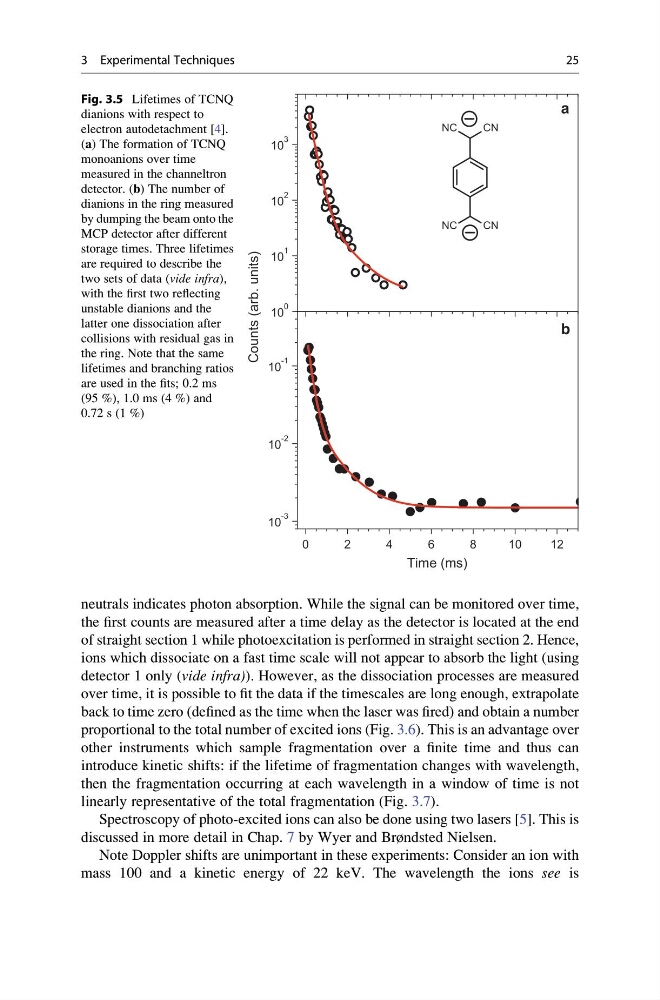
Fig. 3.5 Lifetimes of TCNQ
dianions with respect to
electron autodetachment [4].
(a) The formation of TCNQ
monoanions over time
measured in the channeltron
detector. (b) The number of
dianions in the ring measured
by dumping the beam onto the
MCP detector after different
storage times. Three lifetimes
are required to describe the
two sets of data (vide infra),
with the first two reflecting
unstable dianions and the
latter one dissociation after
collisions with residual gas in
the ring. Note that the same
lifetimes and branching ratios
are used in the fits; 0.2 ms
(95 %), 1.0 ms (4 %) and
0.72 s (1 %)
3 Experimental Techniques
25
the first counts are measured after a time delay as the detector is located at the end
of straight section 1 while photoexcitation is performed in straight section 2. Hence,
ions which dissociate on a fast time scale will not appear to absorb the light (using
detector 1 only (vide infra)). However, as the dissociation processes are measured
over time, it is possible to fit the data if the timescales are long enough, extrapolate
back to time zero (defined as the time when the laser was fired) and obtain a number
proportional to the total number of excited ions (Fig. 3.6). This is an advantage over
other instruments which sample fragmentation over a finite time and thus can
introduce kinetic shifts: if the lifetime of fragmentation changes with wavelength,
then the fragmentation occurring at each wavelength in a window of time is not
linearly representative of the total fragmentation (Fig. 3.7).
Spectroscopy of photo-excited ions can also be done using two lasers [5]. This is
discussed in more detail in Chap. 7 by Wyer and Brøndsted Nielsen.
Note Doppler shifts are unimportant in these experiments: Consider an ion with
mass 100 and a kinetic energy of 22 keV. The wavelength the ions see is
10
0
10
1
10
2
10
3
Counts (arb. units)
a
b
0
2
4
6
8
1 0
1 2
10
-3
10
-2
10
-1
Time (ms)
Fig. 3.5 Lifetimes of TCNQ
dianions with respect to
electron autodetachment [4].
(a) The formation of TCNQ
monoanions over time
measured in the channeltron
detector. (b) The number of
dianions in the ring measured
by dumping the beam onto the
MCP detector after different
storage times. Three lifetimes
are required to describe the
two sets of data (vide infra),
with the first two reflecting
unstable dianions and the
latter one dissociation after
collisions with residual gas in
the ring. Note that the same
lifetimes and branching ratios
are used in the fits; 0.2 ms
(95 %), 1.0 ms (4 %) and
0.72 s (1 %)
3 Experimental Techniques
25