

range at which the detector can be operated is limited (>350 nm) as higherenergy photons will damage the coating. More details can be found in Chap. 5 by
Andersen and Bochenkova.
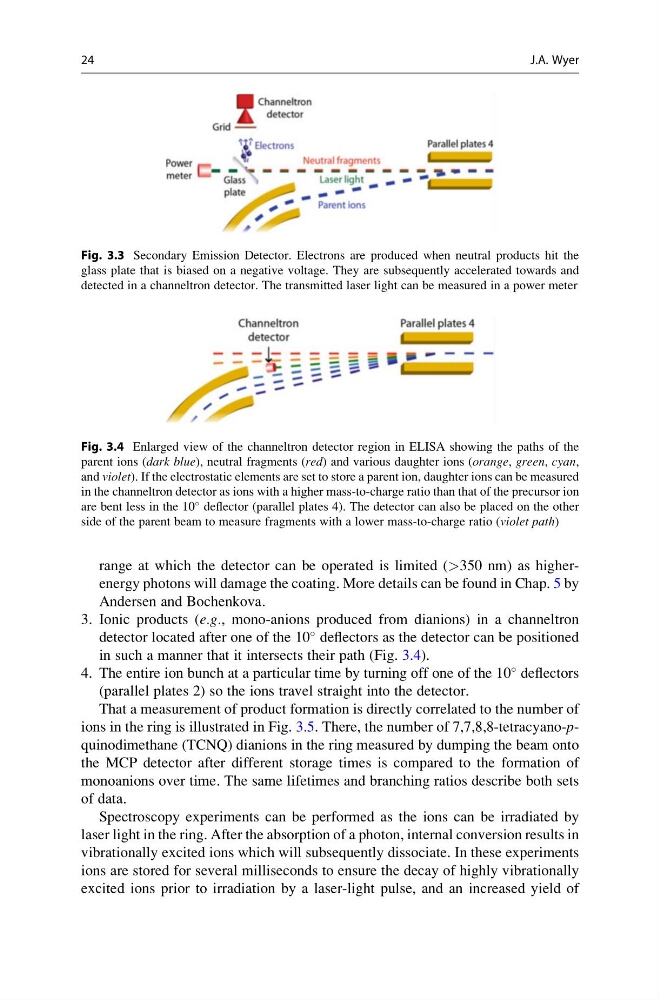
3. Ionic products (e.g., mono-anions produced from dianions) in a channeltron
detector located after one of the 10
deflectors as the detector can be positioned
in such a manner that it intersects their path (Fig. 3.4).
4. The entire ion bunch at a particular time by turning off one of the 10
deflectors
(parallel plates 2) so the ions travel straight into the detector.
That a measurement of product formation is directly correlated to the number of
ions in the ring is illustrated in Fig. 3.5. There, the number of 7,7,8,8-tetracyano-pquinodimethane (TCNQ) dianions in the ring measured by dumping the beam onto
the MCP detector after different storage times is compared to the formation of
monoanions over time. The same lifetimes and branching ratios describe both sets
of data.
Spectroscopy experiments can be performed as the ions can be irradiated by
laser light in the ring. After the absorption of a photon, internal conversion results in
vibrationally excited ions which will subsequently dissociate. In these experiments
ions are stored for several milliseconds to ensure the decay of highly vibrationally
excited ions prior to irradiation by a laser-light pulse, and an increased yield of
Fig. 3.3 Secondary Emission Detector. Electrons are produced when neutral products hit the
glass plate that is biased on a negative voltage. They are subsequently accelerated towards and
detected in a channeltron detector. The transmitted laser light can be measured in a power meter
Fig. 3.4 Enlarged view of the channeltron detector region in ELISA showing the paths of the
parent ions (dark blue), neutral fragments (red) and various daughter ions (orange, green, cyan,
and violet). If the electrostatic elements are set to store a parent ion, daughter ions can be measured
in the channeltron detector as ions with a higher mass-to-charge ratio than that of the precursor ion
are bent less in the 10
deflector (parallel plates 4). The detector can also be placed on the other
side of the parent beam to measure fragments with a lower mass-to-charge ratio (violet path)
24
J.A. Wyer
Andersen and Bochenkova.
3. Ionic products (e.g., mono-anions produced from dianions) in a channeltron
detector located after one of the 10
deflectors as the detector can be positioned
in such a manner that it intersects their path (Fig. 3.4).
4. The entire ion bunch at a particular time by turning off one of the 10
deflectors
(parallel plates 2) so the ions travel straight into the detector.
That a measurement of product formation is directly correlated to the number of
ions in the ring is illustrated in Fig. 3.5. There, the number of 7,7,8,8-tetracyano-pquinodimethane (TCNQ) dianions in the ring measured by dumping the beam onto
the MCP detector after different storage times is compared to the formation of
monoanions over time. The same lifetimes and branching ratios describe both sets
of data.
Spectroscopy experiments can be performed as the ions can be irradiated by
laser light in the ring. After the absorption of a photon, internal conversion results in
vibrationally excited ions which will subsequently dissociate. In these experiments
ions are stored for several milliseconds to ensure the decay of highly vibrationally
excited ions prior to irradiation by a laser-light pulse, and an increased yield of
Fig. 3.3 Secondary Emission Detector. Electrons are produced when neutral products hit the
glass plate that is biased on a negative voltage. They are subsequently accelerated towards and
detected in a channeltron detector. The transmitted laser light can be measured in a power meter
Fig. 3.4 Enlarged view of the channeltron detector region in ELISA showing the paths of the
parent ions (dark blue), neutral fragments (red) and various daughter ions (orange, green, cyan,
and violet). If the electrostatic elements are set to store a parent ion, daughter ions can be measured
in the channeltron detector as ions with a higher mass-to-charge ratio than that of the precursor ion
are bent less in the 10
deflector (parallel plates 4). The detector can also be placed on the other
side of the parent beam to measure fragments with a lower mass-to-charge ratio (violet path)
24
J.A. Wyer