

polarisability of the excited state than that of the ground state increases the
interaction energy between the chromophore and the solvent molecules.
1.6
The Franck-Condon Principle
According to the Born-Oppenheimer approximation, as nuclei move slowly compared to the far lighter electrons, electrons follow the nuclei instantaneously.
Conversely, the nuclei adjust slowly to a change in the electronic state. This implies
that in an electronic excitation the wavefunction for the nuclear motion is nearly the
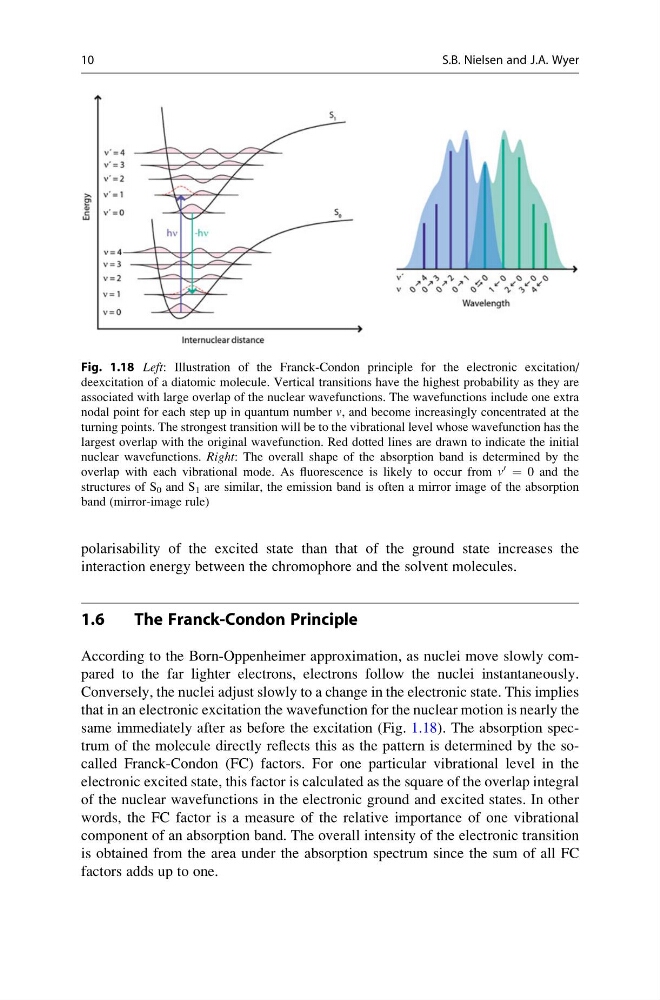
same immediately after as before the excitation (Fig. 1.18). The absorption spectrum of the molecule directly reflects this as the pattern is determined by the socalled Franck-Condon (FC) factors. For one particular vibrational level in the
electronic excited state, this factor is calculated as the square of the overlap integral
of the nuclear wavefunctions in the electronic ground and excited states. In other
words, the FC factor is a measure of the relative importance of one vibrational
component of an absorption band. The overall intensity of the electronic transition
is obtained from the area under the absorption spectrum since the sum of all FC
factors adds up to one.
Fig. 1.18 Left: Illustration of the Franck-Condon principle for the electronic excitation/
deexcitation of a diatomic molecule. Vertical transitions have the highest probability as they are
associated with large overlap of the nuclear wavefunctions. The wavefunctions include one extra
nodal point for each step up in quantum number v, and become increasingly concentrated at the
turning points. The strongest transition will be to the vibrational level whose wavefunction has the
largest overlap with the original wavefunction. Red dotted lines are drawn to indicate the initial
nuclear wavefunctions. Right: The overall shape of the absorption band is determined by the
overlap with each vibrational mode. As fluorescence is likely to occur from v
0 ¼ 0 and the
structures of S 0 and S 1 are similar, the emission band is often a mirror image of the absorption
band (mirror-image rule)
10
S.B. Nielsen and J.A. Wyer
interaction energy between the chromophore and the solvent molecules.
1.6
The Franck-Condon Principle
According to the Born-Oppenheimer approximation, as nuclei move slowly compared to the far lighter electrons, electrons follow the nuclei instantaneously.
Conversely, the nuclei adjust slowly to a change in the electronic state. This implies
that in an electronic excitation the wavefunction for the nuclear motion is nearly the
same immediately after as before the excitation (Fig. 1.18). The absorption spectrum of the molecule directly reflects this as the pattern is determined by the socalled Franck-Condon (FC) factors. For one particular vibrational level in the
electronic excited state, this factor is calculated as the square of the overlap integral
of the nuclear wavefunctions in the electronic ground and excited states. In other
words, the FC factor is a measure of the relative importance of one vibrational
component of an absorption band. The overall intensity of the electronic transition
is obtained from the area under the absorption spectrum since the sum of all FC
factors adds up to one.
Fig. 1.18 Left: Illustration of the Franck-Condon principle for the electronic excitation/
deexcitation of a diatomic molecule. Vertical transitions have the highest probability as they are
associated with large overlap of the nuclear wavefunctions. The wavefunctions include one extra
nodal point for each step up in quantum number v, and become increasingly concentrated at the
turning points. The strongest transition will be to the vibrational level whose wavefunction has the
largest overlap with the original wavefunction. Red dotted lines are drawn to indicate the initial
nuclear wavefunctions. Right: The overall shape of the absorption band is determined by the
overlap with each vibrational mode. As fluorescence is likely to occur from v
0 ¼ 0 and the
structures of S 0 and S 1 are similar, the emission band is often a mirror image of the absorption
band (mirror-image rule)
10
S.B. Nielsen and J.A. Wyer