

backbone are efficiently transferred to terminal and non-terminal aromatic sidechain. This process starts to be quenched, however, for larger peptides. Instead,
large dications and large singly charged fragments are observed.
Soft X-ray absorption close to the C K-edge allows to site-selectively ionise
protonated peptides. Clearly, this implies great potential for charge migration
studies in synthetic model systems.
For the entire photon energy range under study, a new two-step fragmentation
process is identified, where the photoionised system first cools off excitation
energy by fast loss of an aromatic side-chain. In a second step the remaining
system is subject to conventional statistical fragmentation along the backbone.
Acknowledgements All experiments have been performed at the Helmholtz-Zentrum Berlin—
Electron storage ring BESSY II. We thank for provision of synchrotron radiation from the
beamlines U49/2-PGM-1 and U125/2-NIM.
References
1. Ruban, A.V., Berera, R., Ilioaia, C., van Stokkum, I.H.M., Kennis, J.T.M., Pascal, A.A., van
Amerongen, H., Robert, B., Horton, P., van Grondelle, R.: Identification of a mechanism of
photoprotective energy dissipation in higher plants. Nature 450, 575–578 (2007)
285
295
0
1
2
3
4
285
295
0.0
0.3
0.6
0.9
285
295
0.0
0.8
1.6
2.4
285
295
0.0
0.1
0.2
0.3
0.4
intensity
photon energy (eV)
a 2 c 2
b 2
b 3
a 2 -107
b 2 -107
c 2 -107
b 3 -107
107
86
114
131
171
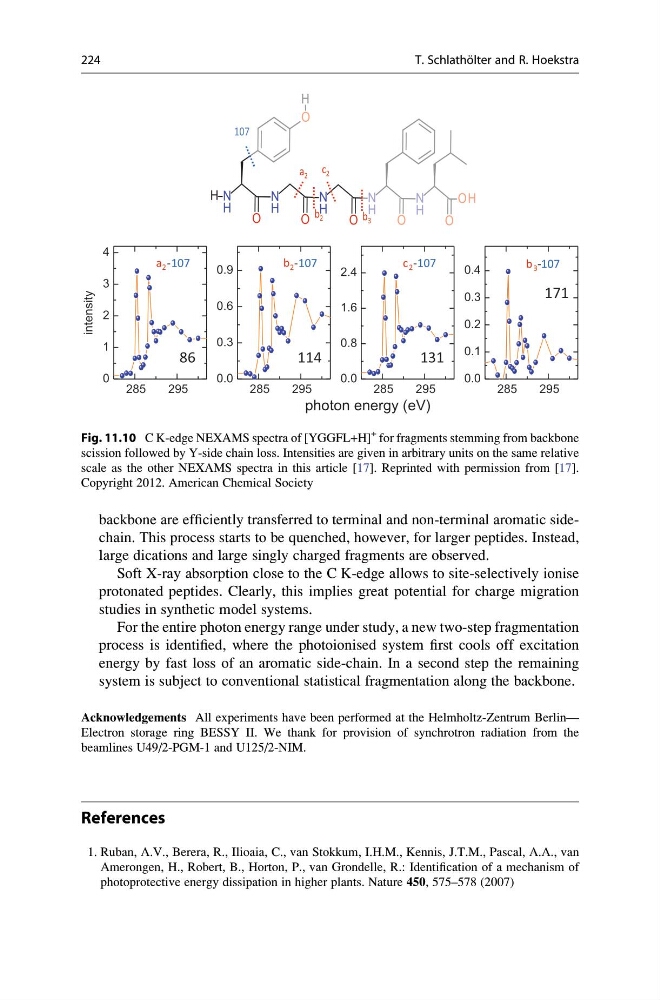
Fig. 11.10 C K-edge NEXAMS spectra of [YGGFL+H]
+ for fragments stemming from backbone
scission followed by Y-side chain loss. Intensities are given in arbitrary units on the same relative
scale as the other NEXAMS spectra in this article [17]. Reprinted with permission from [17].
Copyright 2012. American Chemical Society
224
T. Schlatho ¨ lter and R. Hoekstra
large dications and large singly charged fragments are observed.
Soft X-ray absorption close to the C K-edge allows to site-selectively ionise
protonated peptides. Clearly, this implies great potential for charge migration
studies in synthetic model systems.
For the entire photon energy range under study, a new two-step fragmentation
process is identified, where the photoionised system first cools off excitation
energy by fast loss of an aromatic side-chain. In a second step the remaining
system is subject to conventional statistical fragmentation along the backbone.
Acknowledgements All experiments have been performed at the Helmholtz-Zentrum Berlin—
Electron storage ring BESSY II. We thank for provision of synchrotron radiation from the
beamlines U49/2-PGM-1 and U125/2-NIM.
References
1. Ruban, A.V., Berera, R., Ilioaia, C., van Stokkum, I.H.M., Kennis, J.T.M., Pascal, A.A., van
Amerongen, H., Robert, B., Horton, P., van Grondelle, R.: Identification of a mechanism of
photoprotective energy dissipation in higher plants. Nature 450, 575–578 (2007)
285
295
0
1
2
3
4
285
295
0.0
0.3
0.6
0.9
285
295
0.0
0.8
1.6
2.4
285
295
0.0
0.1
0.2
0.3
0.4
intensity
photon energy (eV)
a 2 c 2
b 2
b 3
a 2 -107
b 2 -107
c 2 -107
b 3 -107
107
86
114
131
171
Fig. 11.10 C K-edge NEXAMS spectra of [YGGFL+H]
+ for fragments stemming from backbone
scission followed by Y-side chain loss. Intensities are given in arbitrary units on the same relative
scale as the other NEXAMS spectra in this article [17]. Reprinted with permission from [17].
Copyright 2012. American Chemical Society
224
T. Schlatho ¨ lter and R. Hoekstra