

Figure 11.10 shows the NEXAMS data for the fragmentation channels involving
backbone scission. These channels are usually associated with lower activation
energies than formation of immonium ions and immonium ion fragments because
scission of fewer or weaker bonds is involved. Here, for all observed channels, peak
A is strongest, i.e. the process is preferably triggered by absorption by the aromatic
rings. This is most pronounced for the largest b3À107 fragment.
In summary, C 1s ! π
* excitations in the aromatic rings appear to be softest
X-ray absorption channels protonated leucine enkephalin at the C K-edge. C 1s
excitation along the peptide backbone on the other hand, contributes strongly to the
formation of smaller fragments and is a more destructive channel. C 1s ionisation
(above threshold) always induces extensive fragmentation and is not site selective.
Conclusions
In this chapter we have shown how the combination of tandem mass spectrometry and VUV and soft X-ray photoabsorption can be used to investigate charge
dynamics in small gas-phase peptides. The absorption of energetic photons
predominantly leads to formation of fragments related to the side-chains of
aromatic amino acids—a finding that is not observed in conventional mass
spectrometry. It is also clear that photon induced holes along the peptide
285
295
0.0
1.1
2.2
3.3
4.4
285
295
0
4
8
12
16
0.0
2.5
5.0
7.5
10.0
285
295
285
295
0.0
1.6
3.2
4.8
6.4
285
295
0.0
2.8
5.6
8.4
11.2
photon energy (eV)
intensity
77
91
107
F, 120
Y, 136
a
b
c
d
e
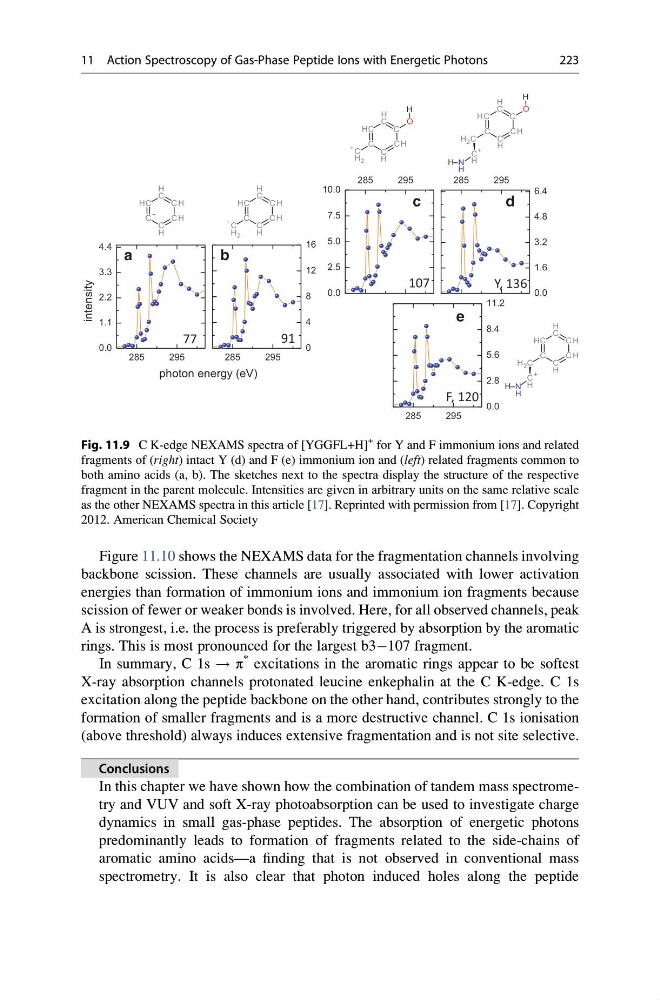
Fig. 11.9 C K-edge NEXAMS spectra of [YGGFL+H]
+ for Y and F immonium ions and related
fragments of (right) intact Y (d) and F (e) immonium ion and (left) related fragments common to
both amino acids (a, b). The sketches next to the spectra display the structure of the respective
fragment in the parent molecule. Intensities are given in arbitrary units on the same relative scale
as the other NEXAMS spectra in this article [17]. Reprinted with permission from [17]. Copyright
2012. American Chemical Society
11 Action Spectroscopy of Gas-Phase Peptide Ions with Energetic Photons
223
backbone scission. These channels are usually associated with lower activation
energies than formation of immonium ions and immonium ion fragments because
scission of fewer or weaker bonds is involved. Here, for all observed channels, peak
A is strongest, i.e. the process is preferably triggered by absorption by the aromatic
rings. This is most pronounced for the largest b3À107 fragment.
In summary, C 1s ! π
* excitations in the aromatic rings appear to be softest
X-ray absorption channels protonated leucine enkephalin at the C K-edge. C 1s
excitation along the peptide backbone on the other hand, contributes strongly to the
formation of smaller fragments and is a more destructive channel. C 1s ionisation
(above threshold) always induces extensive fragmentation and is not site selective.
Conclusions
In this chapter we have shown how the combination of tandem mass spectrometry and VUV and soft X-ray photoabsorption can be used to investigate charge
dynamics in small gas-phase peptides. The absorption of energetic photons
predominantly leads to formation of fragments related to the side-chains of
aromatic amino acids—a finding that is not observed in conventional mass
spectrometry. It is also clear that photon induced holes along the peptide
285
295
0.0
1.1
2.2
3.3
4.4
285
295
0
4
8
12
16
0.0
2.5
5.0
7.5
10.0
285
295
285
295
0.0
1.6
3.2
4.8
6.4
285
295
0.0
2.8
5.6
8.4
11.2
photon energy (eV)
intensity
77
91
107
F, 120
Y, 136
a
b
c
d
e
Fig. 11.9 C K-edge NEXAMS spectra of [YGGFL+H]
+ for Y and F immonium ions and related
fragments of (right) intact Y (d) and F (e) immonium ion and (left) related fragments common to
both amino acids (a, b). The sketches next to the spectra display the structure of the respective
fragment in the parent molecule. Intensities are given in arbitrary units on the same relative scale
as the other NEXAMS spectra in this article [17]. Reprinted with permission from [17]. Copyright
2012. American Chemical Society
11 Action Spectroscopy of Gas-Phase Peptide Ions with Energetic Photons
223