

higher in energy by more than the σ orbital is lowered. Popularly speaking, “the σ*
orbital is more antibonding than the σ is bonding”. (This follows from the variational principle and a non-zero orbital overlap integral. Notice that the energy of the
H 1s orbital on the figure is not that of an isolated H atom (À13.6 eV) but has been
lowered by the favourable interaction between the electron and the other nucleus at
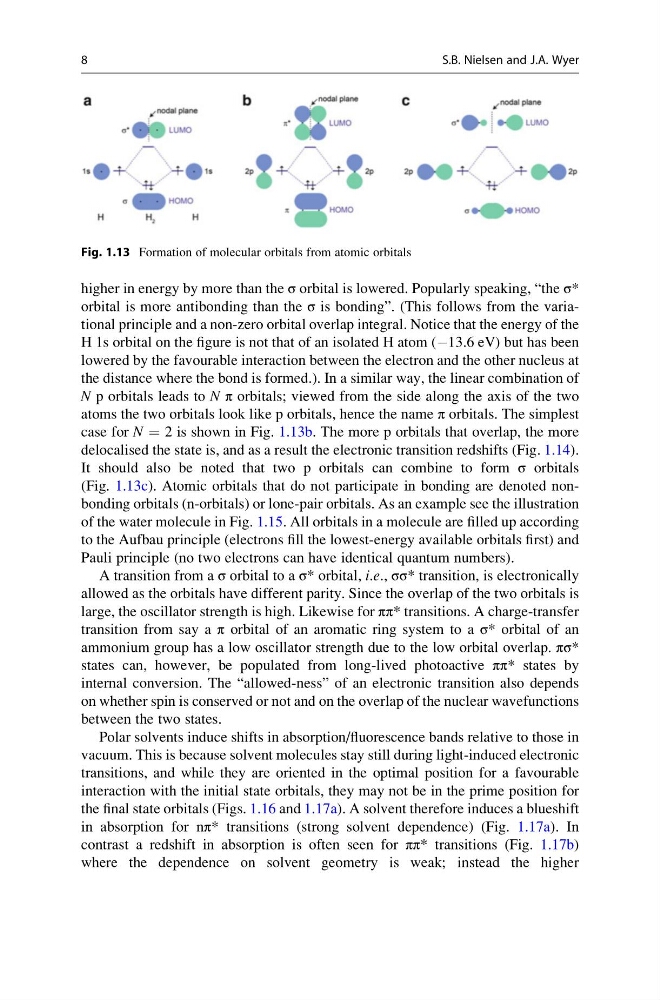
the distance where the bond is formed.). In a similar way, the linear combination of
N p orbitals leads to N π orbitals; viewed from the side along the axis of the two
atoms the two orbitals look like p orbitals, hence the name π orbitals. The simplest
case for N ¼ 2 is shown in Fig. 1.13b. The more p orbitals that overlap, the more
delocalised the state is, and as a result the electronic transition redshifts (Fig. 1.14).
It should also be noted that two p orbitals can combine to form σ orbitals
(Fig. 1.13c). Atomic orbitals that do not participate in bonding are denoted nonbonding orbitals (n-orbitals) or lone-pair orbitals. As an example see the illustration
of the water molecule in Fig. 1.15. All orbitals in a molecule are filled up according
to the Aufbau principle (electrons fill the lowest-energy available orbitals first) and
Pauli principle (no two electrons can have identical quantum numbers).
A transition from a σ orbital to a σ* orbital, i.e., σσ* transition, is electronically
allowed as the orbitals have different parity. Since the overlap of the two orbitals is
large, the oscillator strength is high. Likewise for ππ* transitions. A charge-transfer
transition from say a π orbital of an aromatic ring system to a σ* orbital of an
ammonium group has a low oscillator strength due to the low orbital overlap. πσ*
states can, however, be populated from long-lived photoactive ππ* states by
internal conversion. The “allowed-ness” of an electronic transition also depends
on whether spin is conserved or not and on the overlap of the nuclear wavefunctions
between the two states.
Polar solvents induce shifts in absorption/fluorescence bands relative to those in
vacuum. This is because solvent molecules stay still during light-induced electronic
transitions, and while they are oriented in the optimal position for a favourable
interaction with the initial state orbitals, they may not be in the prime position for
the final state orbitals (Figs. 1.16 and 1.17a). A solvent therefore induces a blueshift
in absorption for nπ* transitions (strong solvent dependence) (Fig. 1.17a). In
contrast a redshift in absorption is often seen for ππ* transitions (Fig. 1.17b)
where the dependence on solvent geometry is weak; instead the higher
Fig. 1.13 Formation of molecular orbitals from atomic orbitals
8
S.B. Nielsen and J.A. Wyer
orbital is more antibonding than the σ is bonding”. (This follows from the variational principle and a non-zero orbital overlap integral. Notice that the energy of the
H 1s orbital on the figure is not that of an isolated H atom (À13.6 eV) but has been
lowered by the favourable interaction between the electron and the other nucleus at
the distance where the bond is formed.). In a similar way, the linear combination of
N p orbitals leads to N π orbitals; viewed from the side along the axis of the two
atoms the two orbitals look like p orbitals, hence the name π orbitals. The simplest
case for N ¼ 2 is shown in Fig. 1.13b. The more p orbitals that overlap, the more
delocalised the state is, and as a result the electronic transition redshifts (Fig. 1.14).
It should also be noted that two p orbitals can combine to form σ orbitals
(Fig. 1.13c). Atomic orbitals that do not participate in bonding are denoted nonbonding orbitals (n-orbitals) or lone-pair orbitals. As an example see the illustration
of the water molecule in Fig. 1.15. All orbitals in a molecule are filled up according
to the Aufbau principle (electrons fill the lowest-energy available orbitals first) and
Pauli principle (no two electrons can have identical quantum numbers).
A transition from a σ orbital to a σ* orbital, i.e., σσ* transition, is electronically
allowed as the orbitals have different parity. Since the overlap of the two orbitals is
large, the oscillator strength is high. Likewise for ππ* transitions. A charge-transfer
transition from say a π orbital of an aromatic ring system to a σ* orbital of an
ammonium group has a low oscillator strength due to the low orbital overlap. πσ*
states can, however, be populated from long-lived photoactive ππ* states by
internal conversion. The “allowed-ness” of an electronic transition also depends
on whether spin is conserved or not and on the overlap of the nuclear wavefunctions
between the two states.
Polar solvents induce shifts in absorption/fluorescence bands relative to those in
vacuum. This is because solvent molecules stay still during light-induced electronic
transitions, and while they are oriented in the optimal position for a favourable
interaction with the initial state orbitals, they may not be in the prime position for
the final state orbitals (Figs. 1.16 and 1.17a). A solvent therefore induces a blueshift
in absorption for nπ* transitions (strong solvent dependence) (Fig. 1.17a). In
contrast a redshift in absorption is often seen for ππ* transitions (Fig. 1.17b)
where the dependence on solvent geometry is weak; instead the higher
Fig. 1.13 Formation of molecular orbitals from atomic orbitals
8
S.B. Nielsen and J.A. Wyer