

The first experiments to investigate the intrinsic time scale of nucleotide
photofragmentation were performed on the storage ring ELISA in 2003 by Brøndsted
Nielsen and co-workers [17]. Photoexcitation of adenosine 5
0 -monophosphate anions
([AMP–H]
À ) and cations ([AMP+H]
+
) with 266-nm light led to dissociation on the
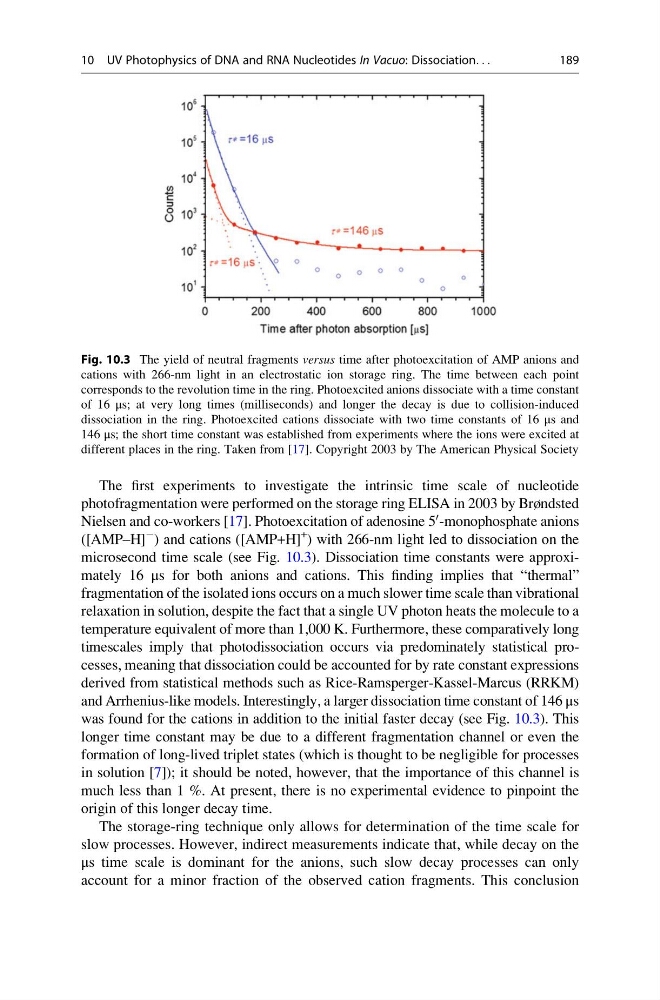
microsecond time scale (see Fig. 10.3). Dissociation time constants were approximately 16 μs for both anions and cations. This finding implies that “thermal”
fragmentation of the isolated ions occurs on a much slower time scale than vibrational
relaxation in solution, despite the fact that a single UV photon heats the molecule to a
temperature equivalent of more than 1,000 K. Furthermore, these comparatively long
timescales imply that photodissociation occurs via predominately statistical processes, meaning that dissociation could be accounted for by rate constant expressions
derived from statistical methods such as Rice-Ramsperger-Kassel-Marcus (RRKM)
and Arrhenius-like models. Interestingly, a larger dissociation time constant of 146 μs
was found for the cations in addition to the initial faster decay (see Fig. 10.3). This
longer time constant may be due to a different fragmentation channel or even the
formation of long-lived triplet states (which is thought to be negligible for processes
in solution [7]); it should be noted, however, that the importance of this channel is
much less than 1 %. At present, there is no experimental evidence to pinpoint the
origin of this longer decay time.
The storage-ring technique only allows for determination of the time scale for
slow processes. However, indirect measurements indicate that, while decay on the
μs time scale is dominant for the anions, such slow decay processes can only
account for a minor fraction of the observed cation fragments. This conclusion
Fig. 10.3 The yield of neutral fragments versus time after photoexcitation of AMP anions and
cations with 266-nm light in an electrostatic ion storage ring. The time between each point
corresponds to the revolution time in the ring. Photoexcited anions dissociate with a time constant
of 16 μs; at very long times (milliseconds) and longer the decay is due to collision-induced
dissociation in the ring. Photoexcited cations dissociate with two time constants of 16 μs and
146 μs; the short time constant was established from experiments where the ions were excited at
different places in the ring. Taken from [17]. Copyright 2003 by The American Physical Society
10 UV Photophysics of DNA and RNA Nucleotides In Vacuo: Dissociation. . .
189
photofragmentation were performed on the storage ring ELISA in 2003 by Brøndsted
Nielsen and co-workers [17]. Photoexcitation of adenosine 5
0 -monophosphate anions
([AMP–H]
À ) and cations ([AMP+H]
+
) with 266-nm light led to dissociation on the
microsecond time scale (see Fig. 10.3). Dissociation time constants were approximately 16 μs for both anions and cations. This finding implies that “thermal”
fragmentation of the isolated ions occurs on a much slower time scale than vibrational
relaxation in solution, despite the fact that a single UV photon heats the molecule to a
temperature equivalent of more than 1,000 K. Furthermore, these comparatively long
timescales imply that photodissociation occurs via predominately statistical processes, meaning that dissociation could be accounted for by rate constant expressions
derived from statistical methods such as Rice-Ramsperger-Kassel-Marcus (RRKM)
and Arrhenius-like models. Interestingly, a larger dissociation time constant of 146 μs
was found for the cations in addition to the initial faster decay (see Fig. 10.3). This
longer time constant may be due to a different fragmentation channel or even the
formation of long-lived triplet states (which is thought to be negligible for processes
in solution [7]); it should be noted, however, that the importance of this channel is
much less than 1 %. At present, there is no experimental evidence to pinpoint the
origin of this longer decay time.
The storage-ring technique only allows for determination of the time scale for
slow processes. However, indirect measurements indicate that, while decay on the
μs time scale is dominant for the anions, such slow decay processes can only
account for a minor fraction of the observed cation fragments. This conclusion
Fig. 10.3 The yield of neutral fragments versus time after photoexcitation of AMP anions and
cations with 266-nm light in an electrostatic ion storage ring. The time between each point
corresponds to the revolution time in the ring. Photoexcited anions dissociate with a time constant
of 16 μs; at very long times (milliseconds) and longer the decay is due to collision-induced
dissociation in the ring. Photoexcited cations dissociate with two time constants of 16 μs and
146 μs; the short time constant was established from experiments where the ions were excited at
different places in the ring. Taken from [17]. Copyright 2003 by The American Physical Society
10 UV Photophysics of DNA and RNA Nucleotides In Vacuo: Dissociation. . .
189