

9.5.1.3 Tryptophan
The case of tryptophan (Trp) is different because no vibrationally resolved spectra
could be realised under similar experimental conditions. This is due to the very
short excited-state lifetime, in the femtosecond range (between 10 and 100 fs),
which is indicative of a very efficient non-radiative process in Trp as will be
discussed in the next sections.
9.5.2 Comparison Between Spectroscopic Results and Ab-initio
Calculations
Since the experimental spectroscopy of protonated molecules has made tremendous
progress, it is worthwhile to compare with the results from recent ab-initio methods.
This will give some confidence in the calculations, which is particularly necessary to
230
240
250
260
270
280
290
44000
42000
40000
38000
36000
Wavenumbers (cm
-1
)
Wavelength (nm)
107 amu
108 amu
119 amu
136 amu
181 amu
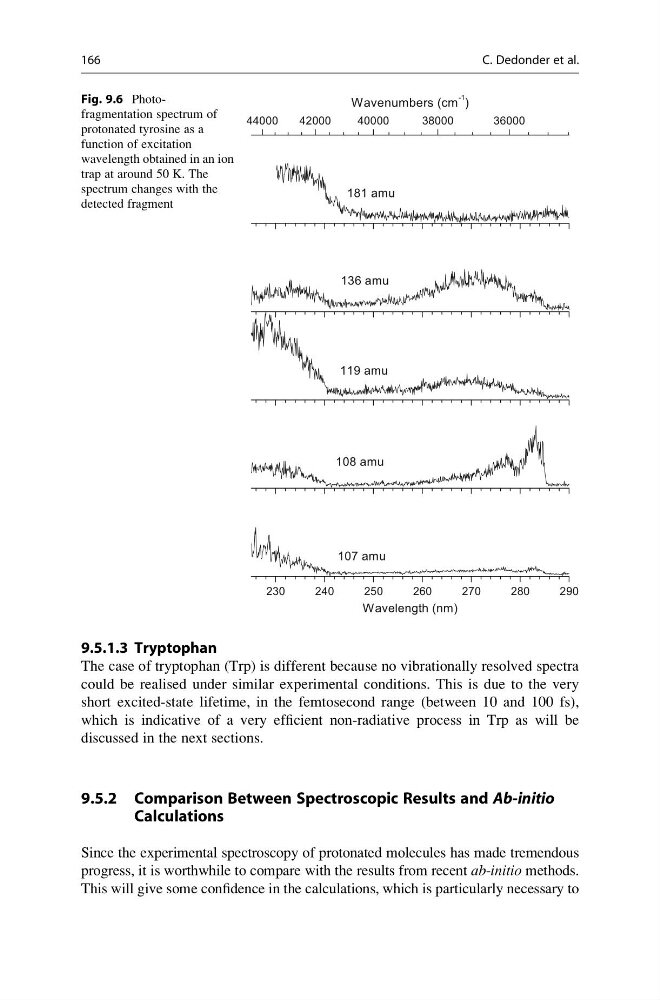
Fig. 9.6 Photofragmentation spectrum of
protonated tyrosine as a
function of excitation
wavelength obtained in an ion
trap at around 50 K. The
spectrum changes with the
detected fragment
166
C. Dedonder et al.
The case of tryptophan (Trp) is different because no vibrationally resolved spectra
could be realised under similar experimental conditions. This is due to the very
short excited-state lifetime, in the femtosecond range (between 10 and 100 fs),
which is indicative of a very efficient non-radiative process in Trp as will be
discussed in the next sections.
9.5.2 Comparison Between Spectroscopic Results and Ab-initio
Calculations
Since the experimental spectroscopy of protonated molecules has made tremendous
progress, it is worthwhile to compare with the results from recent ab-initio methods.
This will give some confidence in the calculations, which is particularly necessary to
230
240
250
260
270
280
290
44000
42000
40000
38000
36000
Wavenumbers (cm
-1
)
Wavelength (nm)
107 amu
108 amu
119 amu
136 amu
181 amu
Fig. 9.6 Photofragmentation spectrum of
protonated tyrosine as a
function of excitation
wavelength obtained in an ion
trap at around 50 K. The
spectrum changes with the
detected fragment
166
C. Dedonder et al.