

case for protonated aromatic amino acids since their excited-state lifetimes are very
short. Electron photo-detachment of these ions has been tried but has been unsuccessful even with powerful femtosecond lasers. This is probably due to the very
high IE for producing doubly charged species, so that electron detachment is likely
not competitive with fragmentation. (It should be mentioned that this is also the
case for neutral molecules for which the ionisation quantum yield at threshold is
quite small, typically 10 %) [29].
Thus in all spectroscopic experiments on protonated aromatic amino acids, the
excited-states properties are obtained by detecting fragment ions as the laser
wavelength is changed for absorption spectra, or as a function of the delay between
pump and probe lasers for lifetime measurements. One can notice that since the
electronic excitation is around 4 eV, the photon energy is large enough to induce
some fragmentation, i.e., a one-photon process is enough to induce bond dissociation. The fragmentation dynamics is very complex and not yet fully understood. It
can be divided into two parts: the evolution of the excited state (electrons), and the
evolution of the nuclei on a longer time scale.
The primary fragmentation process is linked to the dynamics in the excited state.
Photo-excitation can lead to direct fragmentation in the excited state, which often
occurs after an electron transfer, or to ground-state fragmentation after internal
conversion, i.e., the electronic energy is converted into vibrational energy in the
ground state. Internal conversion produces very hot ions that are expected to
fragment in a very similar way as fragmentation induced by low-energy collisions,
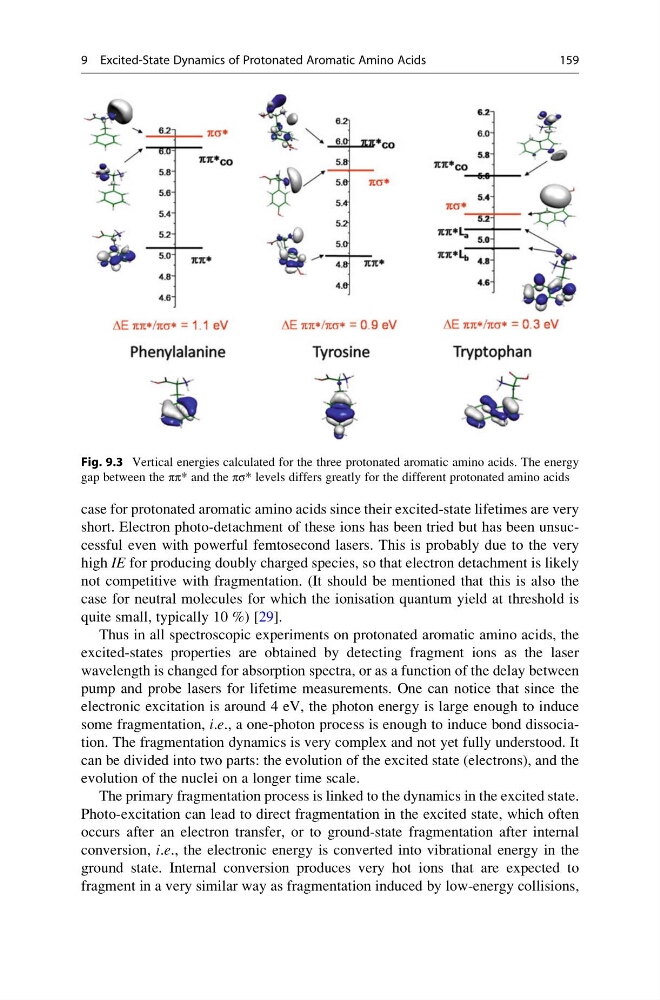
Fig. 9.3 Vertical energies calculated for the three protonated aromatic amino acids. The energy
gap between the ππ* and the πσ* levels differs greatly for the different protonated amino acids
9 Excited-State Dynamics of Protonated Aromatic Amino Acids
159
short. Electron photo-detachment of these ions has been tried but has been unsuccessful even with powerful femtosecond lasers. This is probably due to the very
high IE for producing doubly charged species, so that electron detachment is likely
not competitive with fragmentation. (It should be mentioned that this is also the
case for neutral molecules for which the ionisation quantum yield at threshold is
quite small, typically 10 %) [29].
Thus in all spectroscopic experiments on protonated aromatic amino acids, the
excited-states properties are obtained by detecting fragment ions as the laser
wavelength is changed for absorption spectra, or as a function of the delay between
pump and probe lasers for lifetime measurements. One can notice that since the
electronic excitation is around 4 eV, the photon energy is large enough to induce
some fragmentation, i.e., a one-photon process is enough to induce bond dissociation. The fragmentation dynamics is very complex and not yet fully understood. It
can be divided into two parts: the evolution of the excited state (electrons), and the
evolution of the nuclei on a longer time scale.
The primary fragmentation process is linked to the dynamics in the excited state.
Photo-excitation can lead to direct fragmentation in the excited state, which often
occurs after an electron transfer, or to ground-state fragmentation after internal
conversion, i.e., the electronic energy is converted into vibrational energy in the
ground state. Internal conversion produces very hot ions that are expected to
fragment in a very similar way as fragmentation induced by low-energy collisions,
Fig. 9.3 Vertical energies calculated for the three protonated aromatic amino acids. The energy
gap between the ππ* and the πσ* levels differs greatly for the different protonated amino acids
9 Excited-State Dynamics of Protonated Aromatic Amino Acids
159