

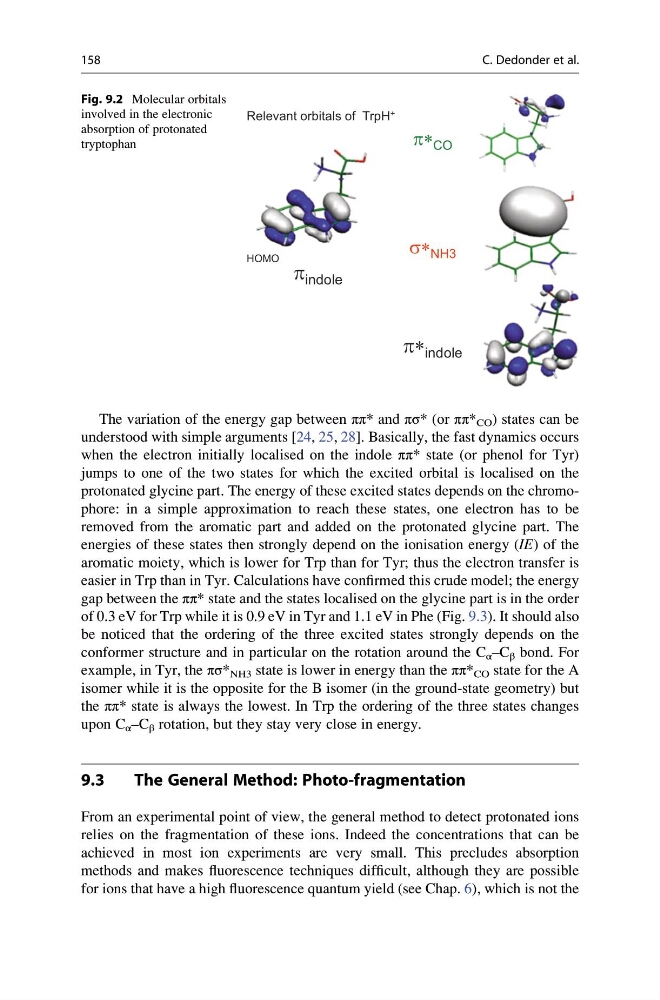
The variation of the energy gap between ππ* and πσ* (or ππ* CO ) states can be
understood with simple arguments [24, 25, 28]. Basically, the fast dynamics occurs
when the electron initially localised on the indole ππ* state (or phenol for Tyr)
jumps to one of the two states for which the excited orbital is localised on the
protonated glycine part. The energy of these excited states depends on the chromophore: in a simple approximation to reach these states, one electron has to be
removed from the aromatic part and added on the protonated glycine part. The
energies of these states then strongly depend on the ionisation energy (IE) of the
aromatic moiety, which is lower for Trp than for Tyr; thus the electron transfer is
easier in Trp than in Tyr. Calculations have confirmed this crude model; the energy
gap between the ππ* state and the states localised on the glycine part is in the order
of 0.3 eV for Trp while it is 0.9 eV in Tyr and 1.1 eV in Phe (Fig. 9.3). It should also
be noticed that the ordering of the three excited states strongly depends on the
conformer structure and in particular on the rotation around the C α –C β bond. For
example, in Tyr, the πσ* NH3 state is lower in energy than the ππ* CO state for the A
isomer while it is the opposite for the B isomer (in the ground-state geometry) but
the ππ* state is always the lowest. In Trp the ordering of the three states changes
upon C α –C β rotation, but they stay very close in energy.
9.3
The General Method: Photo-fragmentation
From an experimental point of view, the general method to detect protonated ions
relies on the fragmentation of these ions. Indeed the concentrations that can be
achieved in most ion experiments are very small. This precludes absorption
methods and makes fluorescence techniques difficult, although they are possible
for ions that have a high fluorescence quantum yield (see Chap. 6), which is not the
HOMO
Relevant orbitals of TrpH +
σ∗ NH3
π∗ CO
π∗ indole
π indole
Fig. 9.2 Molecular orbitals
involved in the electronic
absorption of protonated
tryptophan
158
C. Dedonder et al.
understood with simple arguments [24, 25, 28]. Basically, the fast dynamics occurs
when the electron initially localised on the indole ππ* state (or phenol for Tyr)
jumps to one of the two states for which the excited orbital is localised on the
protonated glycine part. The energy of these excited states depends on the chromophore: in a simple approximation to reach these states, one electron has to be
removed from the aromatic part and added on the protonated glycine part. The
energies of these states then strongly depend on the ionisation energy (IE) of the
aromatic moiety, which is lower for Trp than for Tyr; thus the electron transfer is
easier in Trp than in Tyr. Calculations have confirmed this crude model; the energy
gap between the ππ* state and the states localised on the glycine part is in the order
of 0.3 eV for Trp while it is 0.9 eV in Tyr and 1.1 eV in Phe (Fig. 9.3). It should also
be noticed that the ordering of the three excited states strongly depends on the
conformer structure and in particular on the rotation around the C α –C β bond. For
example, in Tyr, the πσ* NH3 state is lower in energy than the ππ* CO state for the A
isomer while it is the opposite for the B isomer (in the ground-state geometry) but
the ππ* state is always the lowest. In Trp the ordering of the three states changes
upon C α –C β rotation, but they stay very close in energy.
9.3
The General Method: Photo-fragmentation
From an experimental point of view, the general method to detect protonated ions
relies on the fragmentation of these ions. Indeed the concentrations that can be
achieved in most ion experiments are very small. This precludes absorption
methods and makes fluorescence techniques difficult, although they are possible
for ions that have a high fluorescence quantum yield (see Chap. 6), which is not the
HOMO
Relevant orbitals of TrpH +
σ∗ NH3
π∗ CO
π∗ indole
π indole
Fig. 9.2 Molecular orbitals
involved in the electronic
absorption of protonated
tryptophan
158
C. Dedonder et al.