

after photon absorption. One is internal conversion to the electronic ground state
producing vibrationally excited ions that dissociate on the shorter time scale. The
other is intersystem crossing to a long-lived triplet state that acts as a bottleneck for
the dissociation process. The probability of the latter pathway is about 60 % based
on the areas under the decay spectrum associated with each decay (Fig. 7.17).
It is well-known from solution-phase experiments that porphyrins have high
triplet quantum yields [46]. Indeed, photodynamic therapy for cancer treatment
exploits this fact in order to generate highly reactive singlet-oxygen (
1 O 2 ) in
reactions between triplet-state porphyrins and molecular oxygen (
3 O 2 ) [47–51].
Triplet quantum yields are often more than 50 % and triplet-state lifetimes are
hundreds of microseconds, dependent on the solvent [46]. That the gas-phase
experiment provided similar numbers supports the above discussed interpretation
for the two time constants.
In order to further support the idea that the ions decaying on the longer timescale
had crossed into a triplet state, Støchkel et al. [45] carried out pump-probe
experiments on the PP anions in the ELISA ring using two pulsed ns-laser systems
(Figs. 7.16b, c and 7.18). The first laser pulse (430 nm light) excited the ions, and
after 0.67 ms corresponding to seven revolutions in the ring, the ions were
irradiated with the second laser pulse (684 nm). Most of the ions belonging to the
short time component had dissociated at this time. Neutral fragments were
measured on the other side of the ring to the laser interaction region. An increased
yield of photofragments due to the absorption of 684-nm light was clearly seen
(Fig. 7.16b). Importantly, the red light did not produce photofragments if the
430-nm pump laser beam was switched off (Fig. 7.16c). Absorption of red light is
expected for triplet-state PP ions; for comparison triplet-state excited
protoporphyrins in solution have been reported to absorb above 550 nm, and in
benzene solution the triplet state of PP dimethyl ether has a very small band centred
around 700 nm [52].
450
500
550
600
650
0
100
200
300
400
500
600
Counts
m/z
Heme
+
10
30
50
0
2
4
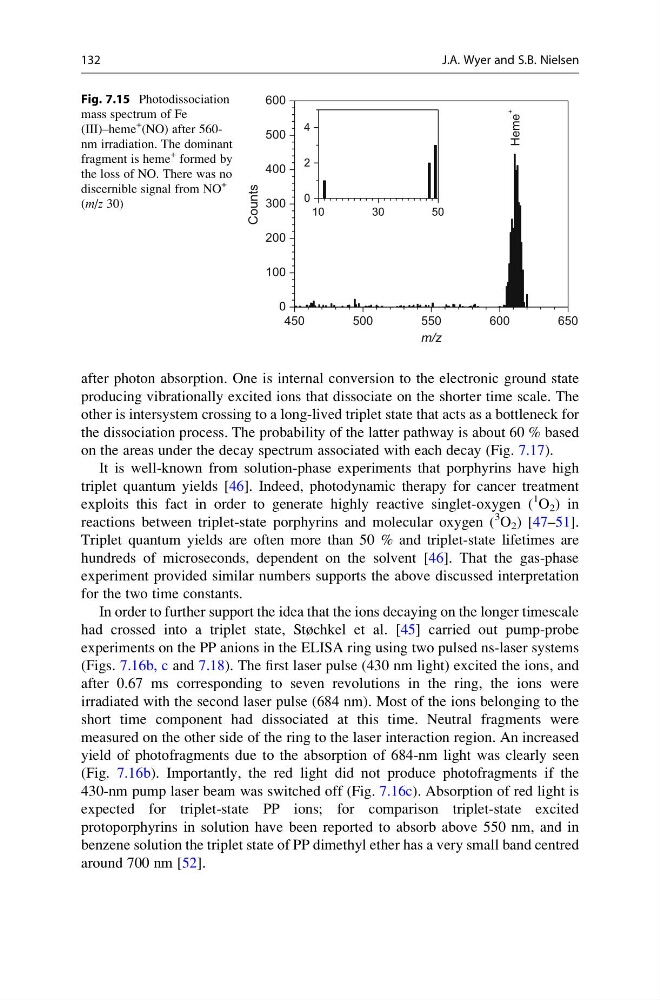
Fig. 7.15 Photodissociation
mass spectrum of Fe
(III)–heme
+ (NO) after 560nm irradiation. The dominant
fragment is heme
+ formed by
the loss of NO. There was no
discernible signal from NO
+
(m/z 30)
132
J.A. Wyer and S.B. Nielsen
producing vibrationally excited ions that dissociate on the shorter time scale. The
other is intersystem crossing to a long-lived triplet state that acts as a bottleneck for
the dissociation process. The probability of the latter pathway is about 60 % based
on the areas under the decay spectrum associated with each decay (Fig. 7.17).
It is well-known from solution-phase experiments that porphyrins have high
triplet quantum yields [46]. Indeed, photodynamic therapy for cancer treatment
exploits this fact in order to generate highly reactive singlet-oxygen (
1 O 2 ) in
reactions between triplet-state porphyrins and molecular oxygen (
3 O 2 ) [47–51].
Triplet quantum yields are often more than 50 % and triplet-state lifetimes are
hundreds of microseconds, dependent on the solvent [46]. That the gas-phase
experiment provided similar numbers supports the above discussed interpretation
for the two time constants.
In order to further support the idea that the ions decaying on the longer timescale
had crossed into a triplet state, Støchkel et al. [45] carried out pump-probe
experiments on the PP anions in the ELISA ring using two pulsed ns-laser systems
(Figs. 7.16b, c and 7.18). The first laser pulse (430 nm light) excited the ions, and
after 0.67 ms corresponding to seven revolutions in the ring, the ions were
irradiated with the second laser pulse (684 nm). Most of the ions belonging to the
short time component had dissociated at this time. Neutral fragments were
measured on the other side of the ring to the laser interaction region. An increased
yield of photofragments due to the absorption of 684-nm light was clearly seen
(Fig. 7.16b). Importantly, the red light did not produce photofragments if the
430-nm pump laser beam was switched off (Fig. 7.16c). Absorption of red light is
expected for triplet-state PP ions; for comparison triplet-state excited
protoporphyrins in solution have been reported to absorb above 550 nm, and in
benzene solution the triplet state of PP dimethyl ether has a very small band centred
around 700 nm [52].
450
500
550
600
650
0
100
200
300
400
500
600
Counts
m/z
Heme
+
10
30
50
0
2
4
Fig. 7.15 Photodissociation
mass spectrum of Fe
(III)–heme
+ (NO) after 560nm irradiation. The dominant
fragment is heme
+ formed by
the loss of NO. There was no
discernible signal from NO
+
(m/z 30)
132
J.A. Wyer and S.B. Nielsen