

80
M. I. Stockman
where we remind that E(ω) is the macroscopic field. In the resonance, ω = ω n , only
one term at the pole of in Eq. (1.91) dominates, and it becomes
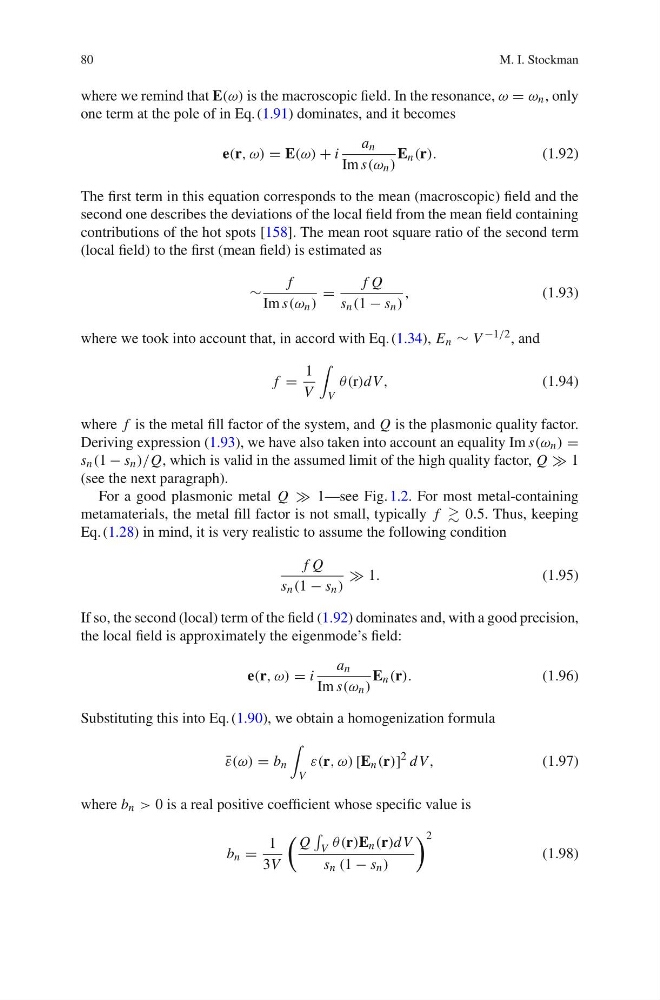
e(r, ω) = E(ω) + i
a n
Im s(ω n )
E n (r).
(1.92)
The first term in this equation corresponds to the mean (macroscopic) field and the
second one describes the deviations of the local field from the mean field containing
contributions of the hot spots [158]. The mean root square ratio of the second term
(local field) to the first (mean field) is estimated as
∼
f
Im s(ω n )
=
f Q
s n (1 − s n )
,
(1.93)
where we took into account that, in accord with Eq. (1.34), E n ∼ V −1/2 , and
f =
1
V
V
θ(r)dV,
(1.94)
where f is the metal fill factor of the system, and Q is the plasmonic quality factor.
Deriving expression (1.93), we have also taken into account an equality Im s(ω n ) =
s n (1 − s n )/Q, which is valid in the assumed limit of the high quality factor, Q 1
(see the next paragraph).
For a good plasmonic metal Q 1—see Fig. 1.2. For most metal-containing
metamaterials, the metal fill factor is not small, typically f 0.5. Thus, keeping
Eq. (1.28) in mind, it is very realistic to assume the following condition
f Q
s n (1 − s n )
1.
(1.95)
If so, the second (local) term of the field (1.92) dominates and, with a good precision,
the local field is approximately the eigenmode’s field:
e(r, ω) = i
a n
Im s(ω n )
E n (r).
(1.96)
Substituting this into Eq. (1.90), we obtain a homogenization formula
¯
ε(ω) = b n
V
ε(r, ω) [E n (r)]
2 dV,
(1.97)
where b n > 0 is a real positive coefficient whose specific value is
b n =
1
3V
Q
V θ(r)E n (r)dV
s n (1 − s n )
2
(1.98)
M. I. Stockman
where we remind that E(ω) is the macroscopic field. In the resonance, ω = ω n , only
one term at the pole of in Eq. (1.91) dominates, and it becomes
e(r, ω) = E(ω) + i
a n
Im s(ω n )
E n (r).
(1.92)
The first term in this equation corresponds to the mean (macroscopic) field and the
second one describes the deviations of the local field from the mean field containing
contributions of the hot spots [158]. The mean root square ratio of the second term
(local field) to the first (mean field) is estimated as
∼
f
Im s(ω n )
=
f Q
s n (1 − s n )
,
(1.93)
where we took into account that, in accord with Eq. (1.34), E n ∼ V −1/2 , and
f =
1
V
V
θ(r)dV,
(1.94)
where f is the metal fill factor of the system, and Q is the plasmonic quality factor.
Deriving expression (1.93), we have also taken into account an equality Im s(ω n ) =
s n (1 − s n )/Q, which is valid in the assumed limit of the high quality factor, Q 1
(see the next paragraph).
For a good plasmonic metal Q 1—see Fig. 1.2. For most metal-containing
metamaterials, the metal fill factor is not small, typically f 0.5. Thus, keeping
Eq. (1.28) in mind, it is very realistic to assume the following condition
f Q
s n (1 − s n )
1.
(1.95)
If so, the second (local) term of the field (1.92) dominates and, with a good precision,
the local field is approximately the eigenmode’s field:
e(r, ω) = i
a n
Im s(ω n )
E n (r).
(1.96)
Substituting this into Eq. (1.90), we obtain a homogenization formula
¯
ε(ω) = b n
V
ε(r, ω) [E n (r)]
2 dV,
(1.97)
where b n > 0 is a real positive coefficient whose specific value is
b n =
1
3V
Q
V θ(r)E n (r)dV
s n (1 − s n )
2
(1.98)