

1 Nanoplasmonics: From Present into Future
79
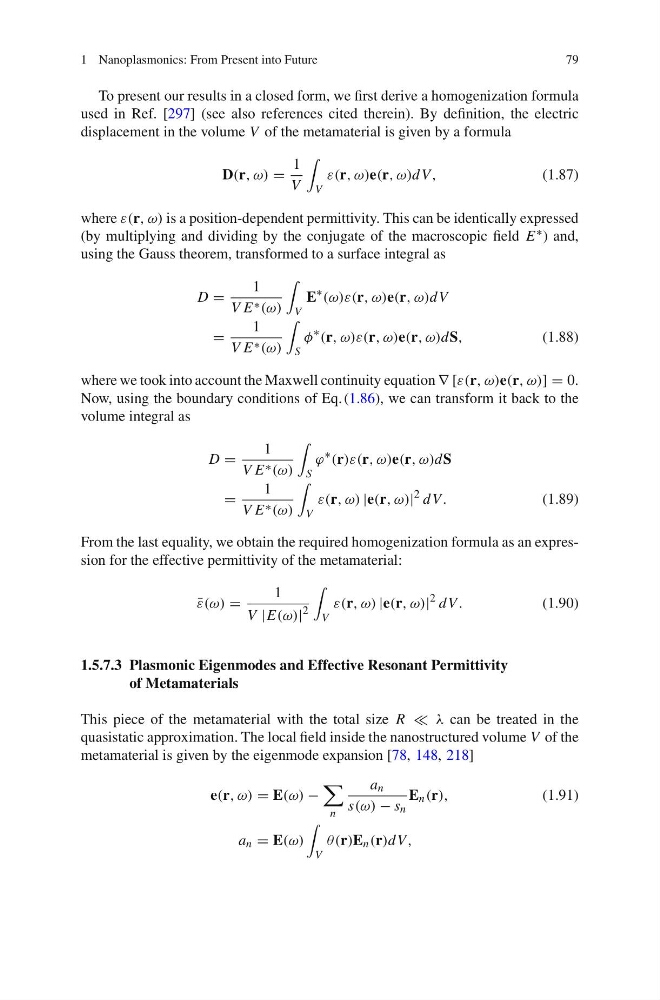
To present our results in a closed form, we first derive a homogenization formula
used in Ref. [297] (see also references cited therein). By definition, the electric
displacement in the volume V of the metamaterial is given by a formula
D(r, ω) =
1
V
V
ε(r, ω)e(r, ω)dV,
(1.87)
where ε(r, ω) is a position-dependent permittivity. This can be identically expressed
(by multiplying and dividing by the conjugate of the macroscopic field E ∗ ) and,
using the Gauss theorem, transformed to a surface integral as
D =
1
V E ∗ (ω)
V
E
∗
(ω)ε(r, ω)e(r, ω)dV
=
1
V E ∗ (ω)
S
φ
∗
(r, ω)ε(r, ω)e(r, ω)dS,
(1.88)
where we took into account the Maxwell continuity equation ∇ [ε(r, ω)e(r, ω)] = 0.
Now, using the boundary conditions of Eq. (1.86), we can transform it back to the
volume integral as
D =
1
V E ∗ (ω)
S
ϕ
∗
(r)ε(r, ω)e(r, ω)dS
=
1
V E ∗ (ω)
V
ε(r, ω) |e(r, ω)|
2 dV.
(1.89)
From the last equality, we obtain the required homogenization formula as an expression for the effective permittivity of the metamaterial:
¯
ε(ω) =
1
V |E(ω)|
2
V
ε(r, ω) |e(r, ω)|
2 dV.
(1.90)
1.5.7.3 Plasmonic Eigenmodes and Effective Resonant Permittivity
of Metamaterials
This piece of the metamaterial with the total size R ∪ λ can be treated in the
quasistatic approximation. The local field inside the nanostructured volume V of the
metamaterial is given by the eigenmode expansion [78, 148, 218]
e(r, ω) = E(ω) −
n
a n
s(ω) − s n
E n (r),
(1.91)
a n = E(ω)
V
θ(r)E n (r)dV,
79
To present our results in a closed form, we first derive a homogenization formula
used in Ref. [297] (see also references cited therein). By definition, the electric
displacement in the volume V of the metamaterial is given by a formula
D(r, ω) =
1
V
V
ε(r, ω)e(r, ω)dV,
(1.87)
where ε(r, ω) is a position-dependent permittivity. This can be identically expressed
(by multiplying and dividing by the conjugate of the macroscopic field E ∗ ) and,
using the Gauss theorem, transformed to a surface integral as
D =
1
V E ∗ (ω)
V
E
∗
(ω)ε(r, ω)e(r, ω)dV
=
1
V E ∗ (ω)
S
φ
∗
(r, ω)ε(r, ω)e(r, ω)dS,
(1.88)
where we took into account the Maxwell continuity equation ∇ [ε(r, ω)e(r, ω)] = 0.
Now, using the boundary conditions of Eq. (1.86), we can transform it back to the
volume integral as
D =
1
V E ∗ (ω)
S
ϕ
∗
(r)ε(r, ω)e(r, ω)dS
=
1
V E ∗ (ω)
V
ε(r, ω) |e(r, ω)|
2 dV.
(1.89)
From the last equality, we obtain the required homogenization formula as an expression for the effective permittivity of the metamaterial:
¯
ε(ω) =
1
V |E(ω)|
2
V
ε(r, ω) |e(r, ω)|
2 dV.
(1.90)
1.5.7.3 Plasmonic Eigenmodes and Effective Resonant Permittivity
of Metamaterials
This piece of the metamaterial with the total size R ∪ λ can be treated in the
quasistatic approximation. The local field inside the nanostructured volume V of the
metamaterial is given by the eigenmode expansion [78, 148, 218]
e(r, ω) = E(ω) −
n
a n
s(ω) − s n
E n (r),
(1.91)
a n = E(ω)
V
θ(r)E n (r)dV,