

1 Nanoplasmonics: From Present into Future
71
0.05
0.1
g=1.01g th
ω (eV)
S(ω)
×10 3
Spaser radiation
Plasmon fluorescence
Gain medium fluores.
1
2
3
4
1.1
1.2
1.3
1.1
1.2
1.3
1.1
1.2
1.3
50
100
150
g=2g th
g=10g th
S(ω)
ω (eV)
S(ω)
ω (eV)
×10 4
×10 5
×10
×100
100
200
300
400
5×10
12
1×10
13
N n
g (s -1 )
s =1.2 eV
1.5 eV
1.8 eV
2.2 eV
(a)
(b)
(c)
(d)
(e)
(f)
1
2
3
4
5
5×10
12
1×10
13
g (s -1 )
s (meV)
-0.3
-0.2
-0.1
0
2×10
12 4×10
12
g (s -1 )
n 21
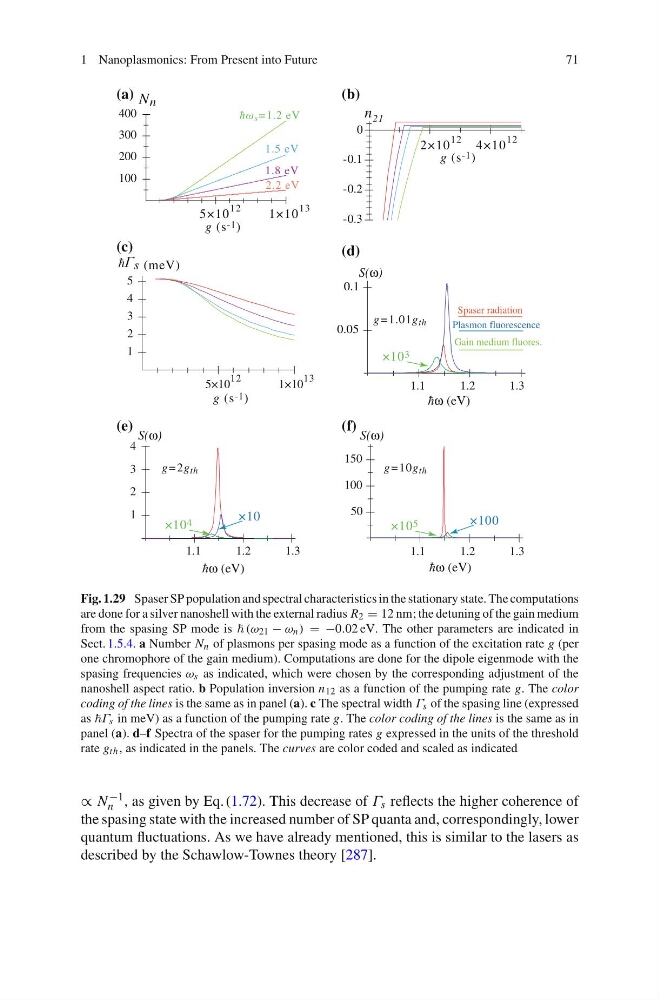
Fig. 1.29 Spaser SP population and spectral characteristics in the stationary state. The computations
are done for a silver nanoshell with the external radius R 2 = 12 nm; the detuning of the gain medium
from the spasing SP mode is (ω 21 − ω n ) = −0.02 eV. The other parameters are indicated in
Sect. 1.5.4. a Number N n of plasmons per spasing mode as a function of the excitation rate g (per
one chromophore of the gain medium). Computations are done for the dipole eigenmode with the
spasing frequencies ω s as indicated, which were chosen by the corresponding adjustment of the
nanoshell aspect ratio. b Population inversion n 12 as a function of the pumping rate g. The color
coding of the lines is the same as in panel (a). c The spectral width Γ s of the spasing line (expressed
as Γ s in meV) as a function of the pumping rate g. The color coding of the lines is the same as in
panel (a). d–f Spectra of the spaser for the pumping rates g expressed in the units of the threshold
rate g th , as indicated in the panels. The curves are color coded and scaled as indicated
∝ N −1
n , as given by Eq. (1.72). This decrease of Γ s reflects the higher coherence of
the spasing state with the increased number of SP quanta and, correspondingly, lower
quantum fluctuations. As we have already mentioned, this is similar to the lasers as
described by the Schawlow-Townes theory [287].
71
0.05
0.1
g=1.01g th
ω (eV)
S(ω)
×10 3
Spaser radiation
Plasmon fluorescence
Gain medium fluores.
1
2
3
4
1.1
1.2
1.3
1.1
1.2
1.3
1.1
1.2
1.3
50
100
150
g=2g th
g=10g th
S(ω)
ω (eV)
S(ω)
ω (eV)
×10 4
×10 5
×10
×100
100
200
300
400
5×10
12
1×10
13
N n
g (s -1 )
s =1.2 eV
1.5 eV
1.8 eV
2.2 eV
(a)
(b)
(c)
(d)
(e)
(f)
1
2
3
4
5
5×10
12
1×10
13
g (s -1 )
s (meV)
-0.3
-0.2
-0.1
0
2×10
12 4×10
12
g (s -1 )
n 21
Fig. 1.29 Spaser SP population and spectral characteristics in the stationary state. The computations
are done for a silver nanoshell with the external radius R 2 = 12 nm; the detuning of the gain medium
from the spasing SP mode is (ω 21 − ω n ) = −0.02 eV. The other parameters are indicated in
Sect. 1.5.4. a Number N n of plasmons per spasing mode as a function of the excitation rate g (per
one chromophore of the gain medium). Computations are done for the dipole eigenmode with the
spasing frequencies ω s as indicated, which were chosen by the corresponding adjustment of the
nanoshell aspect ratio. b Population inversion n 12 as a function of the pumping rate g. The color
coding of the lines is the same as in panel (a). c The spectral width Γ s of the spasing line (expressed
as Γ s in meV) as a function of the pumping rate g. The color coding of the lines is the same as in
panel (a). d–f Spectra of the spaser for the pumping rates g expressed in the units of the threshold
rate g th , as indicated in the panels. The curves are color coded and scaled as indicated
∝ N −1
n , as given by Eq. (1.72). This decrease of Γ s reflects the higher coherence of
the spasing state with the increased number of SP quanta and, correspondingly, lower
quantum fluctuations. As we have already mentioned, this is similar to the lasers as
described by the Schawlow-Townes theory [287].