

70
M. I. Stockman
1 1.5 2 2.5 3 3.5
5000
10000
15000
20000
25000
30000
1 1.5 2 2.5 3 3.5
5000
10000
15000
20000
25000
30000
g
th (cm -1
)
g
th (cm -1
)
Go ld
Silv er
(eV)
(eV)
Go ld
Silv er
d =2
d =10
(a)
(b)
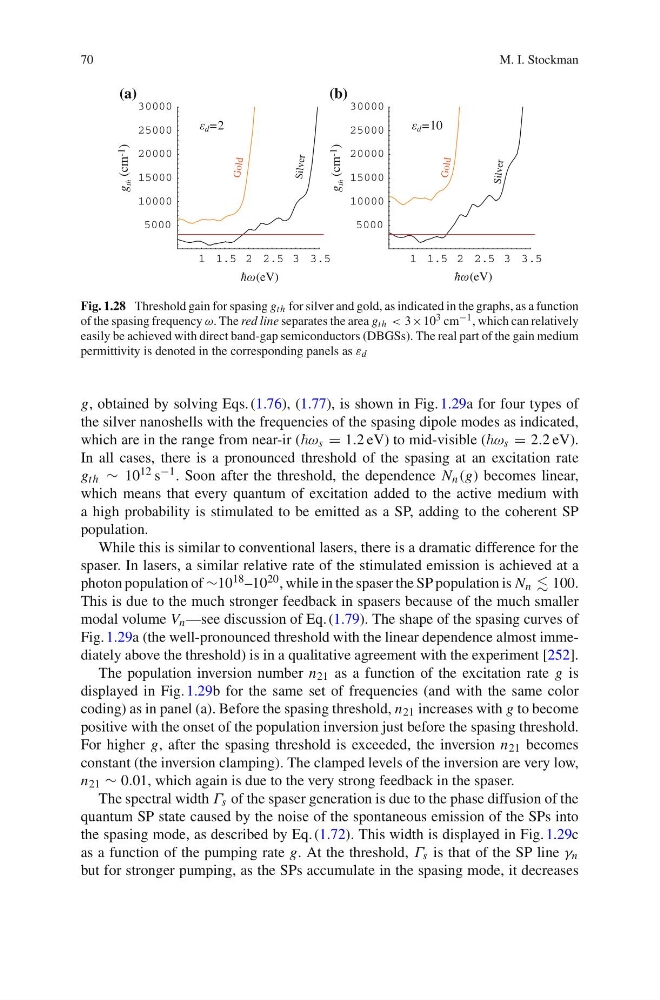
Fig. 1.28 Threshold gain for spasing g th for silver and gold, as indicated in the graphs, as a function
of the spasing frequency ω. The red line separates the area g th < 3×10 3 cm −1 , which can relatively
easily be achieved with direct band-gap semiconductors (DBGSs). The real part of the gain medium
permittivity is denoted in the corresponding panels as ε d
g, obtained by solving Eqs. (1.76), (1.77), is shown in Fig. 1.29a for four types of
the silver nanoshells with the frequencies of the spasing dipole modes as indicated,
which are in the range from near-ir (ω s = 1.2 eV) to mid-visible (ω s = 2.2 eV).
In all cases, there is a pronounced threshold of the spasing at an excitation rate
g th ∼ 10 12 s −1 . Soon after the threshold, the dependence N n (g) becomes linear,
which means that every quantum of excitation added to the active medium with
a high probability is stimulated to be emitted as a SP, adding to the coherent SP
population.
While this is similar to conventional lasers, there is a dramatic difference for the
spaser. In lasers, a similar relative rate of the stimulated emission is achieved at a
photon population of ∼10 18 –10 20 , while in the spaser the SP population is N n 100.
This is due to the much stronger feedback in spasers because of the much smaller
modal volume V n —see discussion of Eq. (1.79). The shape of the spasing curves of
Fig. 1.29a (the well-pronounced threshold with the linear dependence almost immediately above the threshold) is in a qualitative agreement with the experiment [252].
The population inversion number n 21 as a function of the excitation rate g is
displayed in Fig. 1.29b for the same set of frequencies (and with the same color
coding) as in panel (a). Before the spasing threshold, n 21 increases with g to become
positive with the onset of the population inversion just before the spasing threshold.
For higher g, after the spasing threshold is exceeded, the inversion n 21 becomes
constant (the inversion clamping). The clamped levels of the inversion are very low,
n 21 ∼ 0.01, which again is due to the very strong feedback in the spaser.
The spectral width Γ s of the spaser generation is due to the phase diffusion of the
quantum SP state caused by the noise of the spontaneous emission of the SPs into
the spasing mode, as described by Eq. (1.72). This width is displayed in Fig. 1.29c
as a function of the pumping rate g. At the threshold, Γ s is that of the SP line γ n
but for stronger pumping, as the SPs accumulate in the spasing mode, it decreases
M. I. Stockman
1 1.5 2 2.5 3 3.5
5000
10000
15000
20000
25000
30000
1 1.5 2 2.5 3 3.5
5000
10000
15000
20000
25000
30000
g
th (cm -1
)
g
th (cm -1
)
Go ld
Silv er
(eV)
(eV)
Go ld
Silv er
d =2
d =10
(a)
(b)
Fig. 1.28 Threshold gain for spasing g th for silver and gold, as indicated in the graphs, as a function
of the spasing frequency ω. The red line separates the area g th < 3×10 3 cm −1 , which can relatively
easily be achieved with direct band-gap semiconductors (DBGSs). The real part of the gain medium
permittivity is denoted in the corresponding panels as ε d
g, obtained by solving Eqs. (1.76), (1.77), is shown in Fig. 1.29a for four types of
the silver nanoshells with the frequencies of the spasing dipole modes as indicated,
which are in the range from near-ir (ω s = 1.2 eV) to mid-visible (ω s = 2.2 eV).
In all cases, there is a pronounced threshold of the spasing at an excitation rate
g th ∼ 10 12 s −1 . Soon after the threshold, the dependence N n (g) becomes linear,
which means that every quantum of excitation added to the active medium with
a high probability is stimulated to be emitted as a SP, adding to the coherent SP
population.
While this is similar to conventional lasers, there is a dramatic difference for the
spaser. In lasers, a similar relative rate of the stimulated emission is achieved at a
photon population of ∼10 18 –10 20 , while in the spaser the SP population is N n 100.
This is due to the much stronger feedback in spasers because of the much smaller
modal volume V n —see discussion of Eq. (1.79). The shape of the spasing curves of
Fig. 1.29a (the well-pronounced threshold with the linear dependence almost immediately above the threshold) is in a qualitative agreement with the experiment [252].
The population inversion number n 21 as a function of the excitation rate g is
displayed in Fig. 1.29b for the same set of frequencies (and with the same color
coding) as in panel (a). Before the spasing threshold, n 21 increases with g to become
positive with the onset of the population inversion just before the spasing threshold.
For higher g, after the spasing threshold is exceeded, the inversion n 21 becomes
constant (the inversion clamping). The clamped levels of the inversion are very low,
n 21 ∼ 0.01, which again is due to the very strong feedback in the spaser.
The spectral width Γ s of the spaser generation is due to the phase diffusion of the
quantum SP state caused by the noise of the spontaneous emission of the SPs into
the spasing mode, as described by Eq. (1.72). This width is displayed in Fig. 1.29c
as a function of the pumping rate g. At the threshold, Γ s is that of the SP line γ n
but for stronger pumping, as the SPs accumulate in the spasing mode, it decreases