

1 Nanoplasmonics: From Present into Future
65
optical field and chromophores. We denote |1 and |2 as the ground and excited
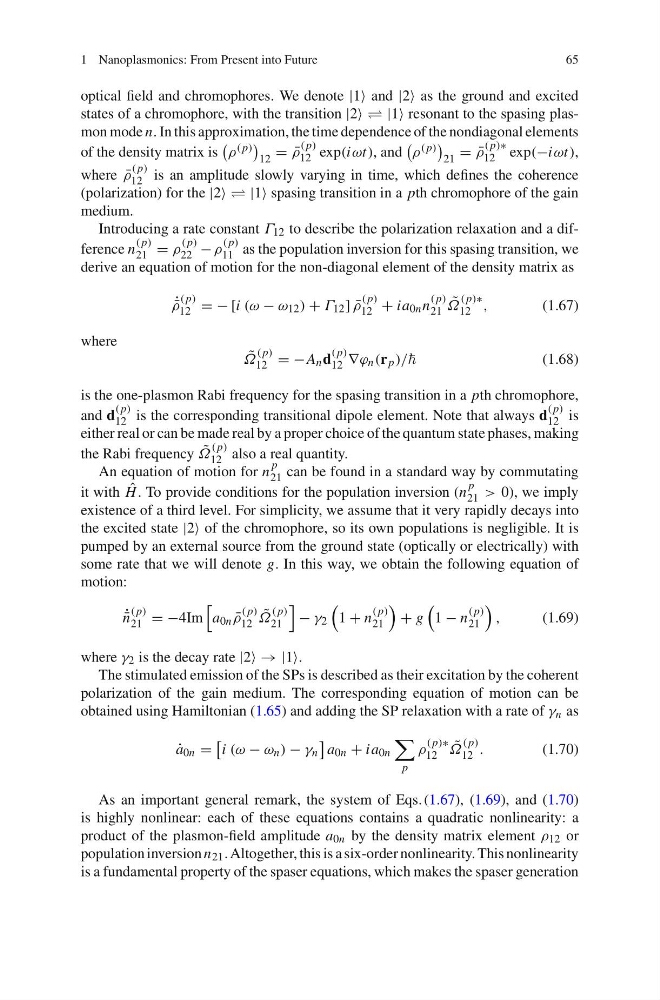
states of a chromophore, with the transition |2 |1 resonant to the spasing plasmon mode n. In this approximation, the time dependence of the nondiagonal elements
of the density matrix is
ρ ( p)
12
= ¯
ρ
( p)
12 exp(iωt), and
ρ ( p)
21
= ¯
ρ
( p)∗
12 exp(−iωt),
where ¯
ρ
( p)
12 is an amplitude slowly varying in time, which defines the coherence
(polarization) for the |2 |1 spasing transition in a pth chromophore of the gain
medium.
Introducing a rate constant Γ 12 to describe the polarization relaxation and a difference n
( p)
21 = ρ
( p)
22 − ρ
( p)
11 as the population inversion for this spasing transition, we
derive an equation of motion for the non-diagonal element of the density matrix as
˙ ¯
ρ
( p)
12 = − [i (ω − ω 12 ) + Γ 12 ] ¯
ρ
( p)
12 + ia 0n n
( p)
21
˜
Ω
( p)∗
12 ,
(1.67)
where
˜
Ω
( p)
12 = −A n d
( p)
12 ∇ϕ n (r p )/
(1.68)
is the one-plasmon Rabi frequency for the spasing transition in a pth chromophore,
and d
( p)
12 is the corresponding transitional dipole element. Note that always d
( p)
12 is
either real or can be made real by a proper choice of the quantum state phases, making
the Rabi frequency ˜
Ω
( p)
12 also a real quantity.
An equation of motion for n
p
21 can be found in a standard way by commutating
it with ˆ
H . To provide conditions for the population inversion (n
p
21 > 0), we imply
existence of a third level. For simplicity, we assume that it very rapidly decays into
the excited state |2 of the chromophore, so its own populations is negligible. It is
pumped by an external source from the ground state (optically or electrically) with
some rate that we will denote g. In this way, we obtain the following equation of
motion:
˙ ¯
n
( p)
21 = −4Im
a 0n ¯
ρ
( p)
12
˜
Ω
( p)
21
⎛
− γ 2
⎝
1 + n
( p)
21
⎞
+ g
⎝
1 − n
( p)
21
⎞
,
(1.69)
where γ 2 is the decay rate |2 → |1.
The stimulated emission of the SPs is described as their excitation by the coherent
polarization of the gain medium. The corresponding equation of motion can be
obtained using Hamiltonian (1.65) and adding the SP relaxation with a rate of γ n as
˙
a 0n =
i (ω − ω n ) − γ n
a 0n + ia 0n
p
ρ
( p)∗
12
˜
Ω
( p)
12 .
(1.70)
As an important general remark, the system of Eqs. (1.67), (1.69), and (1.70)
is highly nonlinear: each of these equations contains a quadratic nonlinearity: a
product of the plasmon-field amplitude a 0n by the density matrix element ρ 12 or
population inversion n 21 . Altogether, this is a six-order nonlinearity. This nonlinearity
is a fundamental property of the spaser equations, which makes the spaser generation
65
optical field and chromophores. We denote |1 and |2 as the ground and excited
states of a chromophore, with the transition |2 |1 resonant to the spasing plasmon mode n. In this approximation, the time dependence of the nondiagonal elements
of the density matrix is
ρ ( p)
12
= ¯
ρ
( p)
12 exp(iωt), and
ρ ( p)
21
= ¯
ρ
( p)∗
12 exp(−iωt),
where ¯
ρ
( p)
12 is an amplitude slowly varying in time, which defines the coherence
(polarization) for the |2 |1 spasing transition in a pth chromophore of the gain
medium.
Introducing a rate constant Γ 12 to describe the polarization relaxation and a difference n
( p)
21 = ρ
( p)
22 − ρ
( p)
11 as the population inversion for this spasing transition, we
derive an equation of motion for the non-diagonal element of the density matrix as
˙ ¯
ρ
( p)
12 = − [i (ω − ω 12 ) + Γ 12 ] ¯
ρ
( p)
12 + ia 0n n
( p)
21
˜
Ω
( p)∗
12 ,
(1.67)
where
˜
Ω
( p)
12 = −A n d
( p)
12 ∇ϕ n (r p )/
(1.68)
is the one-plasmon Rabi frequency for the spasing transition in a pth chromophore,
and d
( p)
12 is the corresponding transitional dipole element. Note that always d
( p)
12 is
either real or can be made real by a proper choice of the quantum state phases, making
the Rabi frequency ˜
Ω
( p)
12 also a real quantity.
An equation of motion for n
p
21 can be found in a standard way by commutating
it with ˆ
H . To provide conditions for the population inversion (n
p
21 > 0), we imply
existence of a third level. For simplicity, we assume that it very rapidly decays into
the excited state |2 of the chromophore, so its own populations is negligible. It is
pumped by an external source from the ground state (optically or electrically) with
some rate that we will denote g. In this way, we obtain the following equation of
motion:
˙ ¯
n
( p)
21 = −4Im
a 0n ¯
ρ
( p)
12
˜
Ω
( p)
21
⎛
− γ 2
⎝
1 + n
( p)
21
⎞
+ g
⎝
1 − n
( p)
21
⎞
,
(1.69)
where γ 2 is the decay rate |2 → |1.
The stimulated emission of the SPs is described as their excitation by the coherent
polarization of the gain medium. The corresponding equation of motion can be
obtained using Hamiltonian (1.65) and adding the SP relaxation with a rate of γ n as
˙
a 0n =
i (ω − ω n ) − γ n
a 0n + ia 0n
p
ρ
( p)∗
12
˜
Ω
( p)
12 .
(1.70)
As an important general remark, the system of Eqs. (1.67), (1.69), and (1.70)
is highly nonlinear: each of these equations contains a quadratic nonlinearity: a
product of the plasmon-field amplitude a 0n by the density matrix element ρ 12 or
population inversion n 21 . Altogether, this is a six-order nonlinearity. This nonlinearity
is a fundamental property of the spaser equations, which makes the spaser generation