

64
M. I. Stockman
Ref. [283] is Δτ 100 ps, i.e., three orders of magnitude coarser. The physical
reason for g (2) (τ ) = const is that the spaser under steady-state pumping tends to
keep a constant plasmon population. After the emission of a photon, this population
is decreased by one. However, very rapidly, within ∼100 fs, it restores to the preemission level. This transitional restoration process is too fast and the photodetectors
of Ref. [283] miss it, producing g (2) (τ ) = const.
1.5.4 Equations of Spaser
1.5.4.1 Quantum Density Matrix Equations (Optical Bloch Equations)
for Spaser
The SP eigenmodes ϕ n (r) are described by a wave equation (1.25) [31, 78]. The
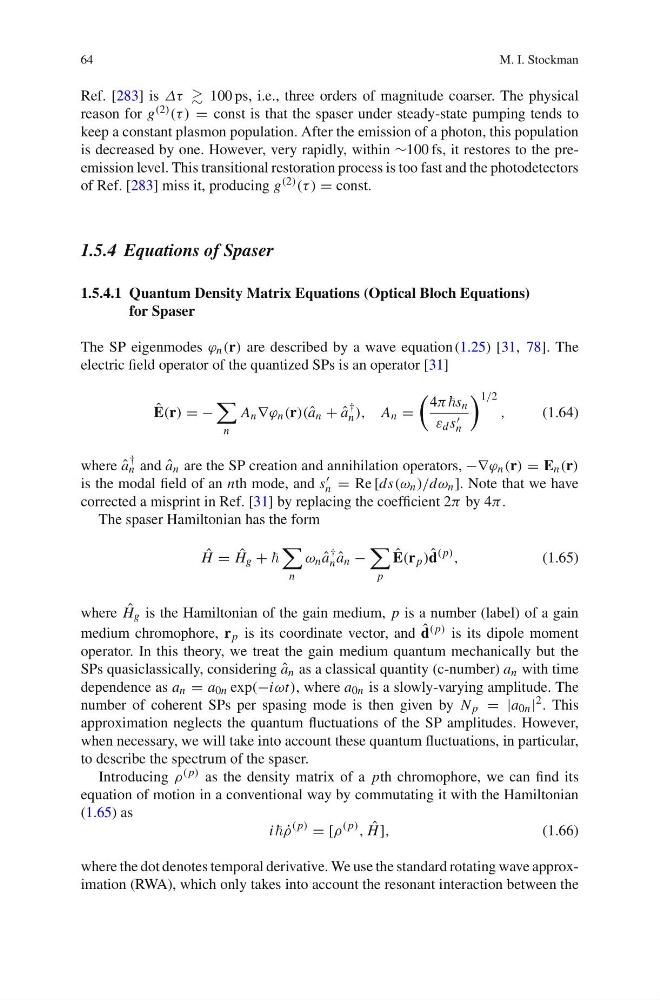
electric field operator of the quantized SPs is an operator [31]
ˆ
E(r) = −
n
A n ∇ϕ n (r)( ˆ
a n + ˆ
a
†
n ), A n =
4π s n
ε d s
n
1/2
,
(1.64)
where ˆ
a
†
n and ˆ
a n are the SP creation and annihilation operators, −∇ϕ n (r) = E n (r)
is the modal field of an nth mode, and s
n = Re [ds(ω n )/dω n ]. Note that we have
corrected a misprint in Ref. [31] by replacing the coefficient 2π by 4π .
The spaser Hamiltonian has the form
ˆ
H = ˆ
H g +
n
ω n ˆ
a
†
n ˆ
a n −
p
ˆ
E(r p ) ˆ
d
( p)
,
(1.65)
where ˆ
H g is the Hamiltonian of the gain medium, p is a number (label) of a gain
medium chromophore, r p is its coordinate vector, and ˆ
d ( p) is its dipole moment
operator. In this theory, we treat the gain medium quantum mechanically but the
SPs quasiclassically, considering ˆ
a n as a classical quantity (c-number) a n with time
dependence as a n = a 0n exp(−iωt), where a 0n is a slowly-varying amplitude. The
number of coherent SPs per spasing mode is then given by N p = |a 0n | 2 . This
approximation neglects the quantum fluctuations of the SP amplitudes. However,
when necessary, we will take into account these quantum fluctuations, in particular,
to describe the spectrum of the spaser.
Introducing ρ ( p) as the density matrix of a pth chromophore, we can find its
equation of motion in a conventional way by commutating it with the Hamiltonian
(1.65) as
i ˙
ρ
( p)
= [ρ
( p)
, ˆ
H ],
(1.66)
where the dot denotes temporal derivative. We use the standard rotating wave approximation (RWA), which only takes into account the resonant interaction between the
M. I. Stockman
Ref. [283] is Δτ 100 ps, i.e., three orders of magnitude coarser. The physical
reason for g (2) (τ ) = const is that the spaser under steady-state pumping tends to
keep a constant plasmon population. After the emission of a photon, this population
is decreased by one. However, very rapidly, within ∼100 fs, it restores to the preemission level. This transitional restoration process is too fast and the photodetectors
of Ref. [283] miss it, producing g (2) (τ ) = const.
1.5.4 Equations of Spaser
1.5.4.1 Quantum Density Matrix Equations (Optical Bloch Equations)
for Spaser
The SP eigenmodes ϕ n (r) are described by a wave equation (1.25) [31, 78]. The
electric field operator of the quantized SPs is an operator [31]
ˆ
E(r) = −
n
A n ∇ϕ n (r)( ˆ
a n + ˆ
a
†
n ), A n =
4π s n
ε d s
n
1/2
,
(1.64)
where ˆ
a
†
n and ˆ
a n are the SP creation and annihilation operators, −∇ϕ n (r) = E n (r)
is the modal field of an nth mode, and s
n = Re [ds(ω n )/dω n ]. Note that we have
corrected a misprint in Ref. [31] by replacing the coefficient 2π by 4π .
The spaser Hamiltonian has the form
ˆ
H = ˆ
H g +
n
ω n ˆ
a
†
n ˆ
a n −
p
ˆ
E(r p ) ˆ
d
( p)
,
(1.65)
where ˆ
H g is the Hamiltonian of the gain medium, p is a number (label) of a gain
medium chromophore, r p is its coordinate vector, and ˆ
d ( p) is its dipole moment
operator. In this theory, we treat the gain medium quantum mechanically but the
SPs quasiclassically, considering ˆ
a n as a classical quantity (c-number) a n with time
dependence as a n = a 0n exp(−iωt), where a 0n is a slowly-varying amplitude. The
number of coherent SPs per spasing mode is then given by N p = |a 0n | 2 . This
approximation neglects the quantum fluctuations of the SP amplitudes. However,
when necessary, we will take into account these quantum fluctuations, in particular,
to describe the spectrum of the spaser.
Introducing ρ ( p) as the density matrix of a pth chromophore, we can find its
equation of motion in a conventional way by commutating it with the Hamiltonian
(1.65) as
i ˙
ρ
( p)
= [ρ
( p)
, ˆ
H ],
(1.66)
where the dot denotes temporal derivative. We use the standard rotating wave approximation (RWA), which only takes into account the resonant interaction between the