

46
M. I. Stockman
Nanofocus
x
1 µm
y
Light beams
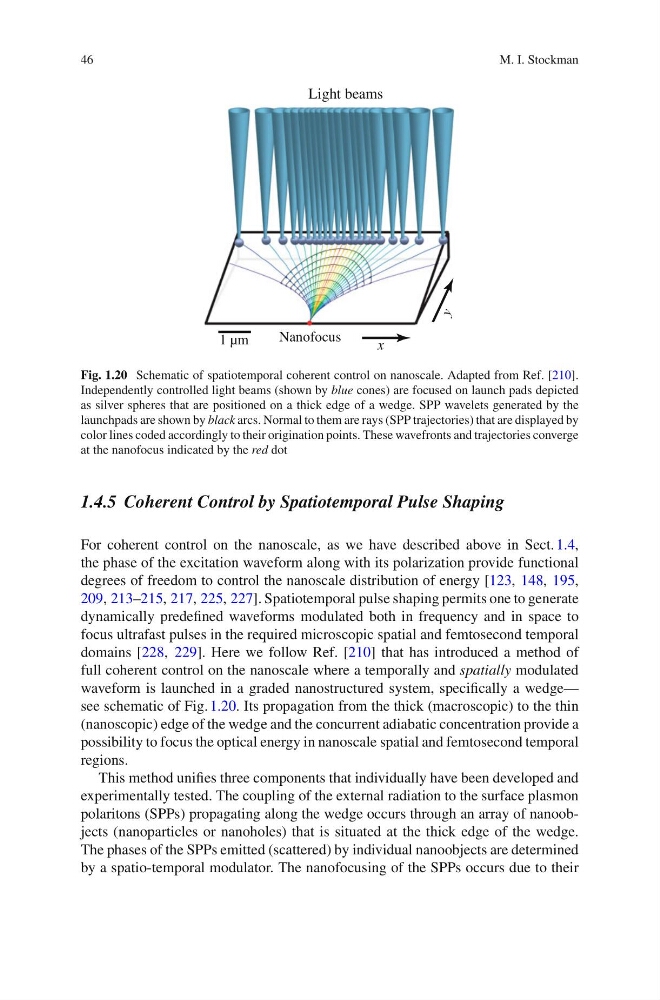
Fig. 1.20 Schematic of spatiotemporal coherent control on nanoscale. Adapted from Ref. [210].
Independently controlled light beams (shown by blue cones) are focused on launch pads depicted
as silver spheres that are positioned on a thick edge of a wedge. SPP wavelets generated by the
launchpads are shown by black arcs. Normal to them are rays (SPP trajectories) that are displayed by
color lines coded accordingly to their origination points. These wavefronts and trajectories converge
at the nanofocus indicated by the red dot
1.4.5 Coherent Control by Spatiotemporal Pulse Shaping
For coherent control on the nanoscale, as we have described above in Sect. 1.4,
the phase of the excitation waveform along with its polarization provide functional
degrees of freedom to control the nanoscale distribution of energy [123, 148, 195,
209, 213–215, 217, 225, 227]. Spatiotemporal pulse shaping permits one to generate
dynamically predefined waveforms modulated both in frequency and in space to
focus ultrafast pulses in the required microscopic spatial and femtosecond temporal
domains [228, 229]. Here we follow Ref. [210] that has introduced a method of
full coherent control on the nanoscale where a temporally and spatially modulated
waveform is launched in a graded nanostructured system, specifically a wedge—
see schematic of Fig. 1.20. Its propagation from the thick (macroscopic) to the thin
(nanoscopic) edge of the wedge and the concurrent adiabatic concentration provide a
possibility to focus the optical energy in nanoscale spatial and femtosecond temporal
regions.
This method unifies three components that individually have been developed and
experimentally tested. The coupling of the external radiation to the surface plasmon
polaritons (SPPs) propagating along the wedge occurs through an array of nanoobjects (nanoparticles or nanoholes) that is situated at the thick edge of the wedge.
The phases of the SPPs emitted (scattered) by individual nanoobjects are determined
by a spatio-temporal modulator. The nanofocusing of the SPPs occurs due to their
M. I. Stockman
Nanofocus
x
1 µm
y
Light beams
Fig. 1.20 Schematic of spatiotemporal coherent control on nanoscale. Adapted from Ref. [210].
Independently controlled light beams (shown by blue cones) are focused on launch pads depicted
as silver spheres that are positioned on a thick edge of a wedge. SPP wavelets generated by the
launchpads are shown by black arcs. Normal to them are rays (SPP trajectories) that are displayed by
color lines coded accordingly to their origination points. These wavefronts and trajectories converge
at the nanofocus indicated by the red dot
1.4.5 Coherent Control by Spatiotemporal Pulse Shaping
For coherent control on the nanoscale, as we have described above in Sect. 1.4,
the phase of the excitation waveform along with its polarization provide functional
degrees of freedom to control the nanoscale distribution of energy [123, 148, 195,
209, 213–215, 217, 225, 227]. Spatiotemporal pulse shaping permits one to generate
dynamically predefined waveforms modulated both in frequency and in space to
focus ultrafast pulses in the required microscopic spatial and femtosecond temporal
domains [228, 229]. Here we follow Ref. [210] that has introduced a method of
full coherent control on the nanoscale where a temporally and spatially modulated
waveform is launched in a graded nanostructured system, specifically a wedge—
see schematic of Fig. 1.20. Its propagation from the thick (macroscopic) to the thin
(nanoscopic) edge of the wedge and the concurrent adiabatic concentration provide a
possibility to focus the optical energy in nanoscale spatial and femtosecond temporal
regions.
This method unifies three components that individually have been developed and
experimentally tested. The coupling of the external radiation to the surface plasmon
polaritons (SPPs) propagating along the wedge occurs through an array of nanoobjects (nanoparticles or nanoholes) that is situated at the thick edge of the wedge.
The phases of the SPPs emitted (scattered) by individual nanoobjects are determined
by a spatio-temporal modulator. The nanofocusing of the SPPs occurs due to their